The Inventory of Quiet Moments
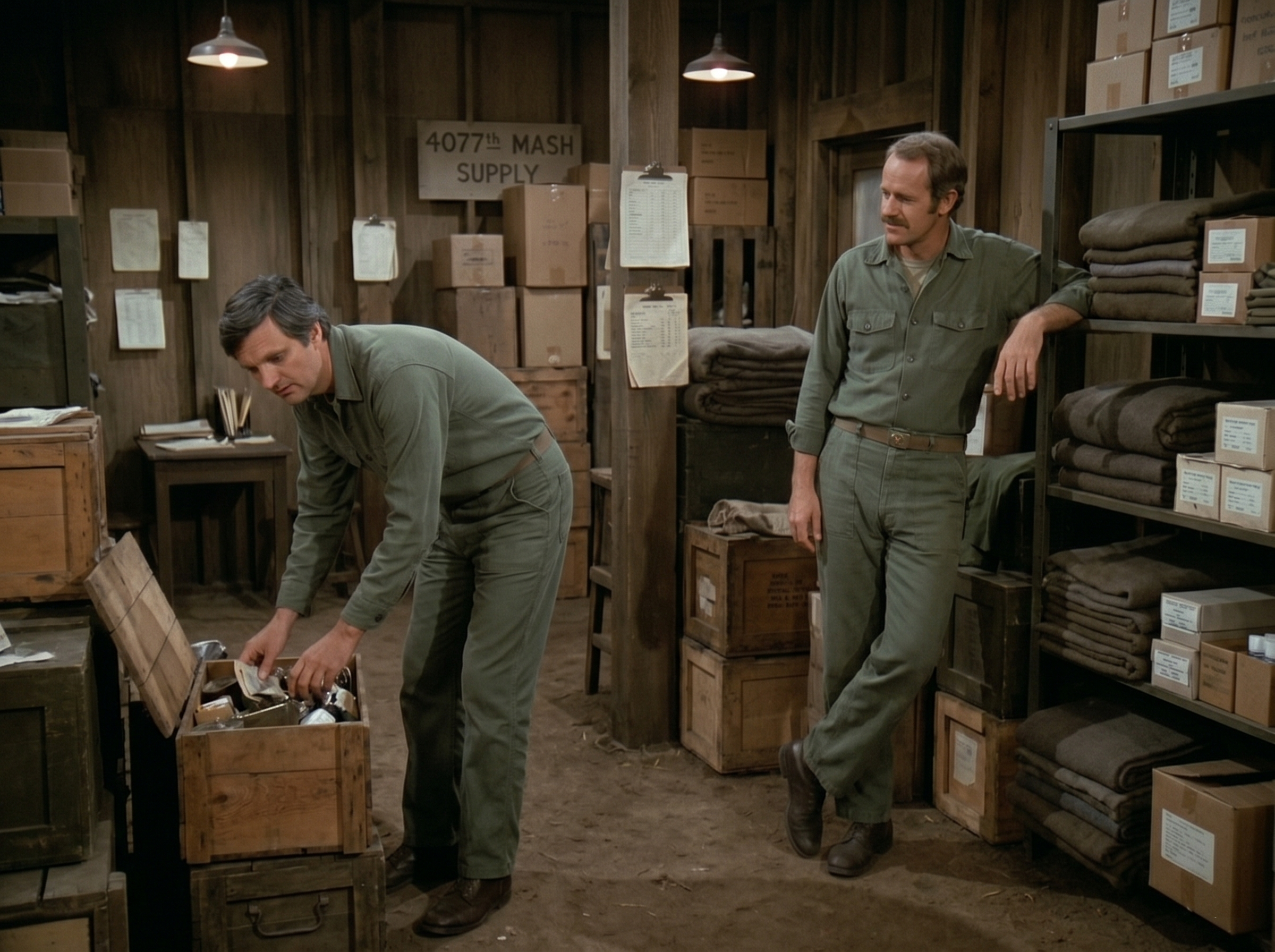
The supply tent at the 4077th never smelled of anything but dry rot, damp earth, and the faint, lingering scent of desperation. It was the place where things went to be counted, sorted, and cataloged, as if an accurate tally of blankets could somehow outweigh the chaotic tally of the operating room.
Hawkeye Pierce stood hunched over a wooden crate, his hands rummaging through the clutter with the impatient grace of a man who would rather be anywhere else on God’s green earth. Beside him, leaning against a shelf with the practiced, weary ease of a man who had mastered the art of waiting, was B.J. Hunnicutt.
“If we find one more crate of mismatched wool socks, I’m going to personally knit them into a straightjacket for Frank,” Hawkeye muttered, his voice tight with the frantic, brittle humor that always surfaced after a long stretch of casualties.
B.J. didn’t smile, not really. He just adjusted his stance, his eyes tracking Hawkeye’s restless movements with a steady, quiet concern. He knew the look—the tension in the shoulders, the way the wisecracks were coming a little too fast, a little too sharp.
“Take a breath, Hawk,” B.J. said softly, his voice a calm anchor in the dust-choked air. “The blankets aren’t going anywhere. Neither is the war, unfortunately.”
Hawkeye stopped digging. He pulled his hands out of the crate, gripping the edges of the wood so hard his knuckles went white. He turned, his face suddenly stripped of the smirk, revealing the hollowed-out exhaustion that lived just beneath the surface.
“I can’t find it, Beej,” Hawkeye whispered, his voice cracking just enough to let the vulnerability spill through. “I promised I’d send it home in the mail, and now it’s gone. It’s just… gone.”
B.J. sighed, pushing off the shelf. He didn’t ask what “it” was. He didn’t need to. In this place, the most important things were often the smallest—a letter, a photograph, a trinket, a sense of self—and losing one felt like losing a piece of the life they were all desperately trying to preserve.
“Alright,” B.J. said, stepping closer and placing a steadying hand on Hawkeye’s shoulder. “Let’s rethink this. You said you had it right before we went into pre-op. Did you come here after?”
Hawkeye ran a hand through his hair, leaving a streak of dust across his forehead. “I came straight here. I thought I tucked it into the side of this crate. I just wanted to make sure it was safe before I got it to Radar for the courier.”
B.J. looked at the pile of crates, then back at his friend. He could see the tremor in Hawkeye’s hands—not from fear, but from the sheer, crushing weight of holding everything together for everyone else.
B.J. began to methodically move the smaller boxes, his movements unhurried and deliberate. “We aren’t leaving until we find it, Hawk. Even if we have to unpack every single stitch of thread in this tent.”
They worked in a companionable silence for several minutes. The only sound was the rustle of paper and the soft thud of wood on dirt. Finally, tucked deep into a crevice behind a stack of regulation towels, B.J. saw a flash of color.
He reached in and pulled out a small, worn envelope, slightly creased but perfectly intact.
He held it out, not with a flourish, but with a quiet, knowing smile. Hawkeye froze. The breath he had been holding for the last hour finally escaped him in a long, shaky exhale. He took the envelope, clutching it like a lifeline.
“You’re a lifesaver, Beej,” Hawkeye said, his voice quiet, the sharp edges of his earlier panic replaced by a fragile, profound relief.
B.J. just leaned back against the shelves again, crossing his arms and watching his friend tuck the envelope away into his shirt pocket, right over his heart. “Just making sure the supply room stays supplied with a little bit of sanity, Hawk. It’s the least I can do.”
They stood there for a moment longer in the dim light of the tent, two tired men in olive drab, surrounded by the inventory of a war that never seemed to end. They didn’t talk about the patients or the sirens or the endless cold. They didn’t have to. In the quiet of the 4077th, that simple, unspoken solidarity was the only thing that kept them standing.
Sometimes, the most vital medicine in the 4077th wasn’t found in a bottle, but in the steady presence of a friend who refused to let you lose your way.