The Inventory of the Human Heart —
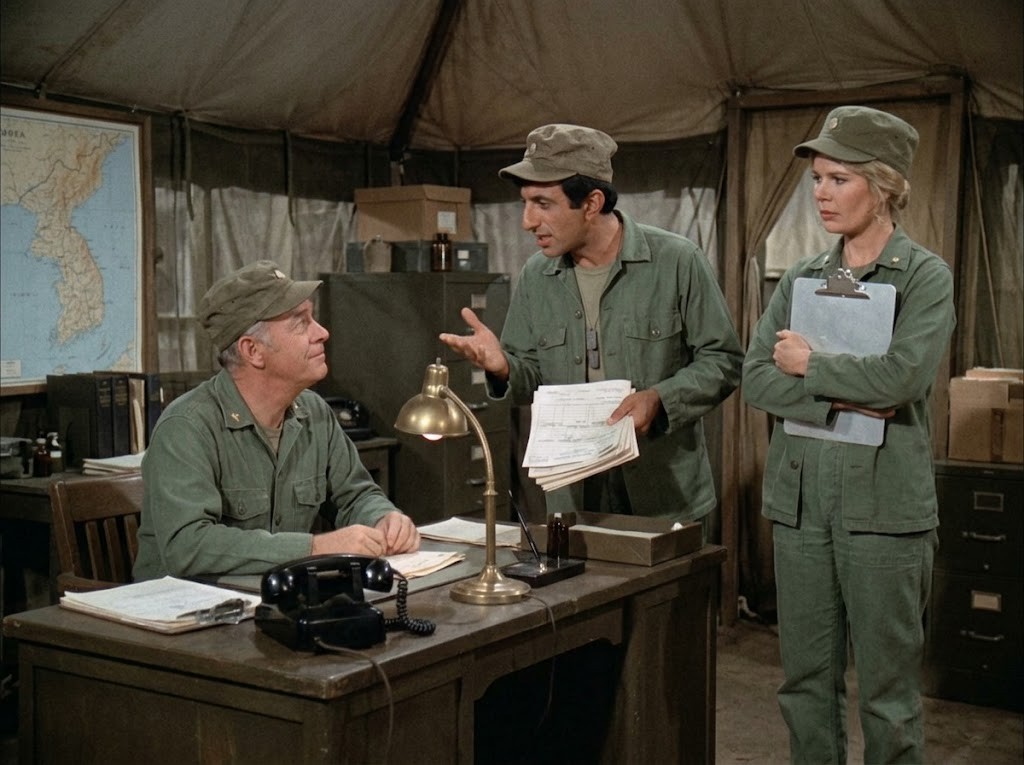
The Korean mud had a way of seeping into everything, including a man’s patience.
Inside the commanding officer’s tent of the 4077th, the air was thick with the smell of canvas, stale coffee, and the quiet exhaustion that followed a seventy-two-hour shift in the Operating Room.
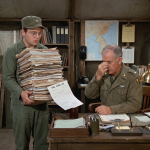
Colonel Potter sat behind his desk, his cap pulled low, staring at a stack of requisition forms like they were an enemy platoon advancing on his position. His shoulder-bars caught the dim light of the brass desk lamp, but his eyes held only the deep, fatherly fatigue of a man carrying the weight of two hundred souls in the middle of a forgotten war.
“Corporal,” Potter sighed, not looking up from a form that demanded to know why the camp had gone through three times its monthly quota of surgical tape. “Tell me you brought me good news, or tell me you brought me a very large glass of bourbon.”
Klinger, standing in the center of the tent and holding a thick sheaf of papers like a shield, didn’t offer a drink. Instead, he wore the expression of a man who had just walked through a minefield and survived only to find his shoelaces tied together.
He wasn’t wearing one of his signature dresses today; he was in standard olive drabs, his utility cap perched neatly on his head, his dog tags dangling over a plain t-shirt. But the theatricality was still there, vibrant and desperate, written in the wide sweep of his outstretched hand and the earnest tilt of his chin.
“Colonel, it’s not just news, it’s a bureaucratic tragedy,” Klinger said, his voice a mix of Toledo street-smarts and sheer panic. “The supply depot in Seoul is questioning the discrepancies in our latest shipment of penicillin and winter blankets. They’re claiming we’re hoarding, sir! Hoarding!”
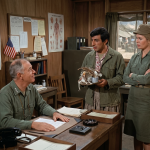
To his left stood Major Margaret Houlihan. Her arms were tightly crossed over her chest, a heavy metal clipboard tucked securely under her elbow. Her blonde hair was pinned neatly beneath her cap, her uniform immaculate despite the dust, but her eyes weren’t filled with her usual rigid military fire.
Instead, she looked down at Klinger’s paperwork with a flicker of genuine apprehension. She had spent the last three days watching young boys fight for their lives on her tables, and she knew exactly where every single one of those missing blankets had gone.
“They’re threatening an official audit, Colonel,” Margaret added, her voice dropping its usual command tone, replacing it with a quiet, protective edge. “If the Inspector General’s office comes up here sniffing around our inventory records right now, we won’t just be short on supplies. We’ll be drowning in court-martial paperwork.”
Potter finally lifted his head, his gaze shifting from the desk to Klinger’s desperate face, and then to Margaret’s tense posture. The map of Korea hung silently on the tent wall behind him, a stark reminder of where they were and what was at stake.
“An audit,” Potter muttered, his jaw tightening as he looked at the sheer volume of unauthorized distributions Klinger was holding in his hands, knowing that one wrong signature could tear the fragile sanctuary of the 4077th apart.
—
The silence in the tent grew heavy, punctuated only by the distant, rhythmic thud of artillery fire echoing off the distant hills.
Potter leaned back in his chair, his eyes locking onto the papers in Klinger’s hand. “Give ’em here, Max,” he said softly.
Klinger stepped forward, stepping into the warm glow of the desk lamp, and placed the stack on the blotter. “Sir, I tried to balance the books. I really did. I listed the blankets as ‘damaged by local rodents’ and the penicillin as ‘spoiled due to refrigeration failure.’ But some clerk in Seoul with shiny boots and too much time on his hands started cross-referencing our patient intake numbers.”
“Because our patient intake numbers don’t match the standard army survival percentages,” Margaret said, her voice trembling slightly as she uncrossed her arms. She took a step closer to the desk, her professional facade cracking just enough to let the woman underneath show through. “We keep people alive who shouldn’t be alive, Colonel. And that takes extra medicine. It takes extra warmth.”
Potter rubbed his temples, looking at the scribbled notes, the crossed-out numbers, and Klinger’s messy handwriting trying to shield the camp from the cold reality of the supply chain. He knew what Klinger had done. Klinger hadn’t stolen anything for himself; he had traded, bartered, and lied to make sure the post-op ward didn’t feel like a meat locker.
“You know, Klinger,” Potter said, his voice dropping its gruff exterior, becoming completely fatherly. “A smarter man would have just let the supply depot have their way. A smarter clerk wouldn’t risk Leavenworth to keep twenty extra boys from getting pneumonia.”
Klinger stood up straight, his chest swelling beneath his green utility shirt. The humor faded from his face, replaced by a raw, dignified sincerity. “With all due respect, Colonel… those boys aren’t supply numbers. I look ’em in the eye when they come through the gate. I see their faces. If a piece of paper in Seoul says they don’t deserve a warm blanket, then the piece of paper is wrong. Not me.”
Margaret looked at Klinger, a sudden, profound softness in her eyes. For all their past arguments about regulations and discipline, in this moment, they were entirely uniform in their purpose. She nodded to the Colonel, a silent endorsement of the corporal’s mutiny.
Potter picked up his fountain pen. He dipped it into the inkwell, his hand steady.
“Colonel?” Klinger whispered, suddenly nervous. “What are you doing?”
“I’m signing an emergency field directive,” Potter said, a faint, dry smile touching the corners of his mustache. “Stating that due to an unprecedented infestation of North Korean mountain moths, fifty percent of our textile inventory was rendered unfit for standard military service and destroyed under my direct supervision. Furthermore, the penicillin was utilized during an unseasonal outbreak of hemorrhagic fever among the local civilian population, legally authorized under the UN humanitarian mandate.”
He signed his name with a flourish, the scratch of the pen loud in the quiet tent. He blotted the signature and handed the papers back to Klinger.
“Take these, Corporal. File them under ‘Miracles and Miscellaneous.’ And if that clerk from Seoul comes up here to inspect the moths, you tell him they flew south for the winter.”
Klinger took the papers, a massive wave of relief washing over his face. A wide, bright smile broke through his anxiety, his white teeth flashing in the dim light. “Colonel, you are a prince among men. If I had a sister, I’d throw a banquet in your honor.”
“Just get out of here, Klinger,” Potter chuckled, shaking his head. “Before I remember that I’m a regular army officer and have you both scrubbing latrines.”
Margaret let out a breath she seemed to have been holding for hours. She looked at Potter, her eyes shining with immense respect and a quiet, familial loyalty. “Thank you, Colonel.”
“Go get some sleep, Major,” Potter said gently, his eyes returning to the desk. “We’ve got a convoy coming in tomorrow, and the moths are going to be very busy.”
As Klinger and Margaret turned to leave the tent, stepping out into the cold Korean night, the tent flap fell shut, leaving the old commander alone with his lamp, his map, and the quiet knowledge that in the middle of a war, the only inventory that truly mattered was the humanity they managed to keep alive.
—
Sometimes, the best way to follow the rules of humanity was to completely rewrite the army’s rulebook.