The Weight of a Spilled Cup
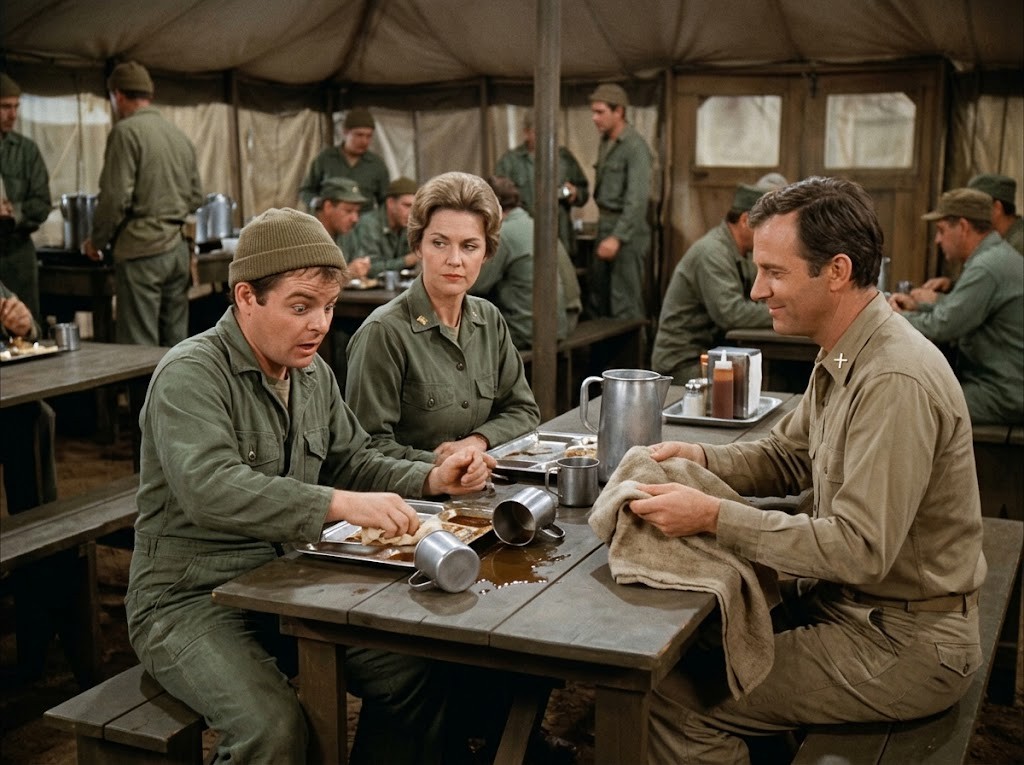
The mess tent of the 4077th was always a symphony of survival, played on the dented keys of stainless-steel trays and aluminum pitchers. Today, the noise felt heavier than usual, a thick blanket of exhaustion hanging over the men who had just s pent thirty-six straight hours in the operating room.
Radar O’Reilly sat at the end of the long wooden table, his knuckles white as he stared down at his tray. His iconic olive-drab beanie was pulled down tight over his ears, a small shield against the chaotic chatter of the background. He hadn’t touched his food, his mind miles away across the Pacific, anchored to a small farm in Ottumwa, Iowa, where the spring rains were supposed to be starting.
Across from him, Father Mulcahy sat with a quiet dignity, his gentle smile offering a sanctuary of peace in a place that knew very little of it. Next to Radar, Major Margaret Houlihan sat perfectly upright, her immaculate uniform a stark contrast to the slumped shoulders of the tired enlisted men filling the benches around them.
“You’re tracking dirt into your thoughts, Radar,” Margaret said, her voice unusually soft, devoid of the usual command-bound edge. “You’ve been staring at that spot on the metal for ten minutes.”
Radar blinked, startled out of his trance, his round eyes wide behind his glasses. “Oh, sorry, Major. Just… thinking. It’s nothing.”
He reached quickly for his metal cup, his movements clumsy from sheer fatigue and a sudden wave of nerves. His fingers slipped on the condensation, and with a harsh clatter that seemed to echo through the tent, the cup tipped over.
A dark, muddy river of army coffee rushed across the tray and pooled onto the weathered wooden table.
Radar froze, his mouth falling open in a perfect O of shock and deep embarrassment, looking down at the mess like it was a personal failure. In a place where everything was already broken, a spilled cup felt like the absolute last straw. He grabbed a scrap of cloth, desperately trying to stop the spread, his hands trembling as the liquid soaked into the wood.
The clatter brought a sudden, heavy silence to their immediate corner of the tent, and Radar felt the stinging weight of a dozen eyes turning toward him. He looked up, his breath catching in his throat, terrified of a reprimand he didn’t have the energy to bear.
—
Before the silence could stretch into humiliation, Father Mulcahy moved with a practiced, quiet grace. He unfolded a large, coarse khaki towel he had been holding in his hands, his face completely free of judgment.
Instead of a scolding, the priest simply offered a warm, reassuring smile that reached all the way to his eyes. He extended the towel across the table, catching Radar’s panicked gaze with a steadying calm.
“Easy there, Radar,” Father Mulcahy said softly, his voice a soothing balm. “The Lord may have walked on water, but I’m fairly certain He never had to contend with the camp’s coffee. Let’s get this taken care of.”
Margaret didn’t yell; she didn’t call for a disciplinary report or lecture him on military decorum. Instead, she watched Radar with a profound, quiet tenderness hidden beneath her professional gaze. She saw the tremor in the young clerk’s hands, recognizing the exact brand of exhaustion that no amount of sleep could fix.
“Take a breath, Corporal,” Margaret said, her tone gentle but firm, the way a mother might speak to a child who had stubbed his toe. “It’s just a spill. The table has seen much worse, and so have we.”
From a nearby table, Hawkeye Pierce looked over, a half-eaten piece of bread in his hand, his eyes tracking the commotion. Leave it to Hawkeye to find the comedic silver lining when the tension threatened to swallow the room.
“Careful, Radar,” Hawkeye called out, a tired but affectionate grin tugging at the corner of his mouth. “That coffee is technically classified as a chemical weapon by the Geneva Convention. If it eats through the wood, Potter will have us all digging a new latrine.”
B.J. Hunnicutt chuckled softly next to Hawkeye, nudging his friend with an elbow. “Pay no attention to him, Radar. He’s just jealous because your coffee actually has enough life in it to run away.”
The tension in the tent dissolved into a ripple of light, exhausted laughter, the familiar humor of the 4077th acting as a shield against the dark reality outside their canvas walls. Even Charles Winchester, sitting a few feet away with a look of supreme distaste for the culinary offerings, offered a brief, dignified nod of solidarity before returning to his book.
Colonel Potter walked into the mess tent just as Father Mulcahy finished dabbing up the last of the puddle. The old horse soldier took in the scene with a single, wise glance—the spilled drink, the towel, and the lingering anxiety on his young clerk’s face.
Potter walked over, placing a heavy, comforting hand on Radar’s shoulder. “Son, if a spilled cup of mud is the worst thing that happens today, we’re ahead of the game. Go get yourself a fresh one, and tell the cook I ordered him to give you a piece of that questionable peach cobbler.”
“Yes, sir. Thank you, Colonel,” Radar murmured, the color finally returning to his face as he looked at the family surrounding him.
He looked at Father Mulcahy, who was still smiling across the table, and at Margaret, whose stern expression had completely melted into a supportive gaze. In the middle of a forgotten corner of the world, surrounded by mud and misery, Radar realized he wasn’t alone. They were a family forged in the fires of necessity, holding each other together one small, broken moment at a time.
Because at the 4077th, it was never just about surviving the war; it was about keeping each other human until it was time to go home.