A Little Piece of Home in the Mud of the 4077th
The war has a way of stealing everything that makes a person feel human, stripping away the comforts of home until all that’s left is the constant, rhythmic thrum of incoming choppers and the smell of boiled cabbage and wet canvas.
But every now and then, if you look closely enough between the olive-drab tents and the rusted ambulances, the 4077th finds a way to remind you that the heart doesn’t just stop beating because it’s tired.
It started on a Tuesday, or maybe it was a Thursday—the days in Korea have a habit of bleeding together like cheap watercolor paint in a heavy downpour.
The surgeons had just crawled out of an eighteen-hour session in the Operating Room, their hands trembling from fatigue, their eyes bloodshot and stinging from the harsh glare of the overhead lamps.
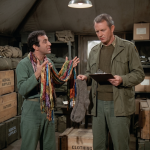
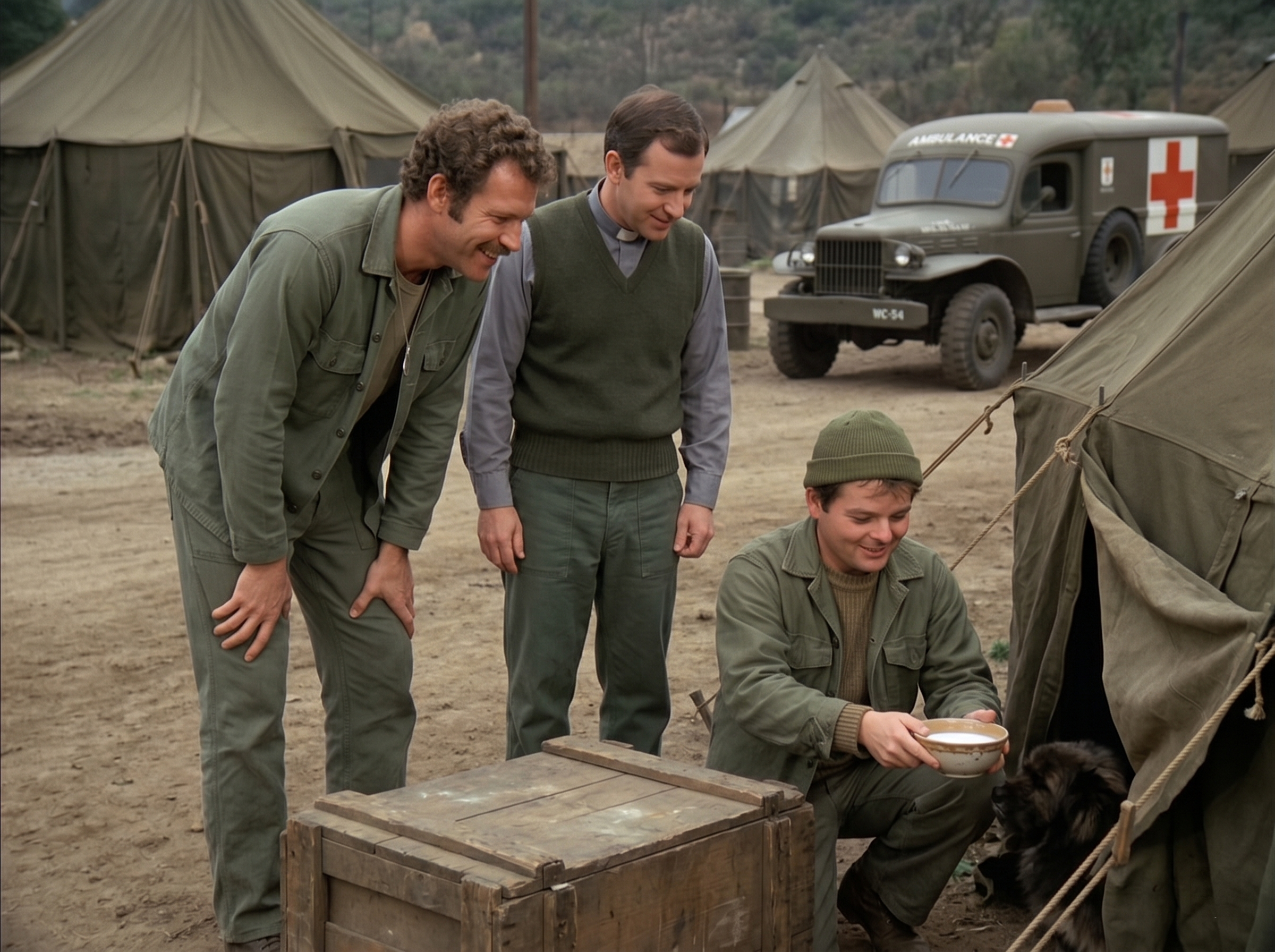
Trapper John was leaning against a wooden supply crate, his hands resting on his knees, his face etched with that familiar, hollow exhaustion that comes from holding too many fragile lives together with nothing but silk thread and sheer stubbornness.
Beside him stood Father Mulcahy, his hands clasped neatly over his dark green sweater vest, looking down with a gentle, weary smile that seemed to carry the weight of every prayer he’d whispered over the wounded that week.
Crouched in the dirt right in front of them was Radar, his knitted woolen cap pulled down tight over his ears, holding a cracked ceramic bowl filled to the brim with powdered milk.
And tucked just inside the dark, flapping opening of the tent, two bright, terrified eyes were staring back at them from a matted ball of dark, tangled fur.
It was a stray pup, no bigger than a loaf of army bread, shivering so hard that its tiny teeth clicked together in the freezing afternoon air.
Radar had found him whimpering near the compound perimeter, tangled in a patch of briars just a few hundred yards from where the heavy artillery usually echoed in the valleys.
“Easy there, fella,” Radar whispered, his voice cracking slightly with that earnest, midwestern innocence that the war hadn’t managed to wipe away. “Nobody’s gonna hurt ya. This is the good stuff. Well, it’s army stuff, but it’s warm.”
Trapper let out a low, dry chuckle, shaking his head as he watched the boy try to coax the animal out into the open. “Careful, Radar. If Margaret catches you harboring a fugitive with fleas, she’ll have you dipping that dog in boiling disinfectant before sundown.”
“He doesn’t have fleas, sir,” Radar defended quickly, not looking up, his eyes entirely locked on the trembling creature. “He’s just… highly animated. And he’s hungry. Look at him, Trapper. He looks the way I feel after a long night at the switchboard.”
Father Mulcahy stepped a fraction closer, his eyes soft with a profound, quiet tenderness. “The Lord certainly has an interesting way of sending us parishioners, doesn’t He? He looks like he’s seen the worst of the monsoon season.”
The puppy sniffed the air, its tiny black nose twitching as the scent of the warm milk finally reached through its terror, but every time the canvas tent flapped in the wind, it shrank backward into the shadows.
Just then, the heavy, unmistakable crunch of combat boots echoed from the gravel path behind them, and Radar froze, holding the bowl perfectly still as a shadow fell across the dirt.
Colonel Potter stepped into the small clearing, his brow furrowed beneath his cap, a half-burned cigar clamped firmly between his teeth.
Radar swallowed hard, his shoulders instantly tensing as he prepared himself for a lecture about camp regulations, sanitation directives, and the general military impropriety of keeping a four-legged roommate in a combat zone.
“What’s the holdup here, gentlemen?” Potter barked, his voice dry as Texas dust. “I’ve got a mountain of paperwork on my desk that needs sorting, and my company clerk is out here conducting a prayer meeting over a wooden crate.”
Father Mulcahy cleared his throat gently, stepping slightly to the side to shield the puppy from the Colonel’s immediate line of sight. “Ah, Colonel. We were just… assessing a local casualty. A very small one, mind you.”
Potter walked around the crate, his eyes dropping to the crouched form of Radar, then to the cracked bowl, and finally to the dark, shivering mass tucked inside the tent flap.
For a long, agonizing moment, the compound was completely silent, save for the distant, low rumble of the big guns miles away in the hills.
Then, the Colonel took the cigar out of his mouth, let out a long sigh that sounded more like a weary father than a commanding officer, and shook his head.
“Mule muffins,” Potter muttered softly, the sternness evaporating from his face to reveal the deeply compassionate, horse-loving farm boy underneath. “That animal is three-quarters mud and one-quarter ribs. Radar, you’re doing it all wrong. A frightened creature doesn’t want you staring at him like he’s a side of beef. Give him some room to breathe.”
Radar blinked, his eyes widening behind his glasses. “Yes, sir. Sorry, sir.”
Trapper smiled, the deep lines of fatigue around his mouth softening into something genuinely warm. “See, Radar? The Colonel’s an expert on stray livestock. He used to treat patients just like this back in Missouri, only they were usually pulling a plow.”
“Watch your tongue, Pierce,” Potter said with a faint, wry grin, though everyone knew Hawkeye wasn’t there and Trapper was the one taking the jab. “At least my patients in Missouri didn’t talk back to me in the O.R.”
With a gentle, patient click of his tongue, Radar lowered the bowl until it rested flat on the damp earth, right at the edge of the tent’s shadow, and then he slowly pulled his hands back, leaning his upper body away to give the pup space.
For a few seconds, nothing happened.
The little dog remained frozen, its dark fur blending into the shadows, its breathing fast and shallow.
But then, pushed by a hunger that overcame its fear, the puppy crept forward on its belly, its front paws sliding out onto the dirt, its tail giving a single, tentative, microscopic wag.
It reached the edge of the bowl, dipped its pink tongue into the white milk, and began to lap it up with a frantic, desperate intensity.
Radar’s face lit up with a grin so wide it looked like it belonged back in Iowa, completely unburdened by the weight of the 4077th.
Trapper let out a breath he seemed to have been holding since the first casualty chopper arrived that morning, his hand reaching out to give Father Mulcahy a quiet, supportive pat on the shoulder.
“There you go, little fella,” Father Mulcahy murmured, his voice thick with a quiet emotion that didn’t need a pulpit to be felt. “You’re safe now. You’re among friends.”
They stood there together for a few minutes, four tired men in faded green uniforms, completely captivated by the simple, beautiful sight of a small dog finding comfort in a harsh world.
In that single, quiet moment, the war didn’t exist; there were no charts, no red tape, no broken bodies—just the shared, undeniable warmth of human beings refusing to let a little piece of life slip away in the mud.
Sometimes, the best medicine the 4077th ever prescribed didn’t come from the pharmacy, but from the simple, quiet kindness of holding out a bowl of warm milk.