The Quiet Hours at Rosie’s
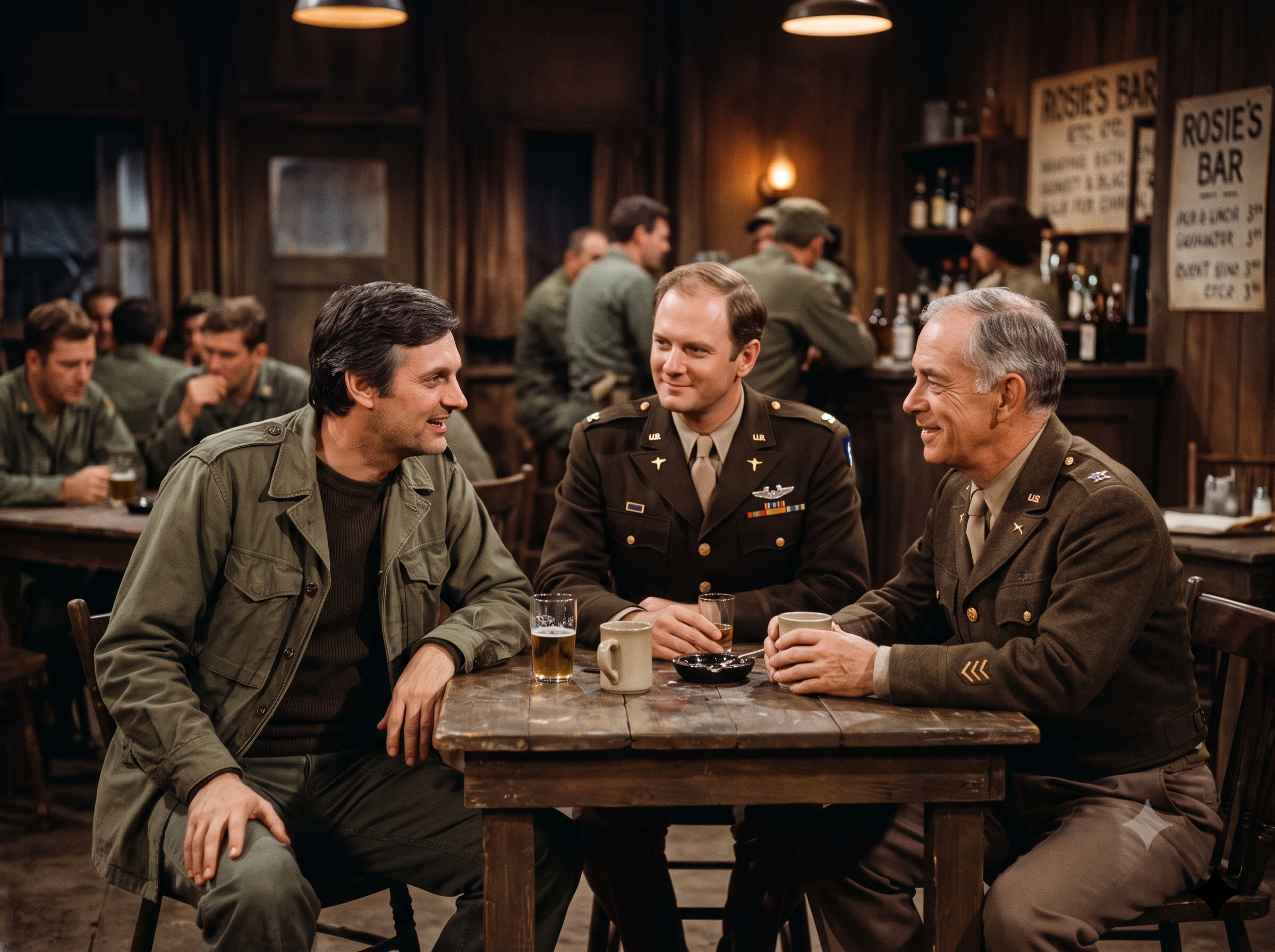
Rosie’s Bar was a sanctuary built out of cheap wood, stale beer, and the desperate need to forget the war for an hour.
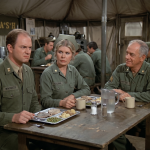
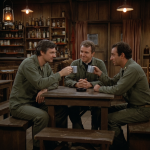
Inside, the air was thick with the smell of cheap cigars and pine needles. The practical, warm amber lighting cast a soft glow over the worn wall textures and the modest wooden tables.
It wasn’t much of a place, but to the doctors of the 4077th, it was the finest establishment on earth.
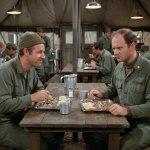
At a corner table, far from the noisy enlisted men playing cards near the door, sat three officers. They looked like they had just survived a shipwreck, which, in a medical sense, wasn’t far from the truth.
Hawkeye Pierce leaned heavily against the worn wood of the table. He wore his heavy olive-drab jacket over a dark woolen sweater, completely ignoring whatever military regulations dictated for off-duty attire.
His posture was exhausted, his shoulders slumped from the weight of a grueling thirty-two-hour shift in the operating room. Yet, despite the dark circles under his eyes, his face held a charismatic, easygoing warmth.
Across from him sat Colonel Sherman T. Potter. The commanding officer was holding a heavy ceramic mug, both hands wrapped around it as if drawing heat directly into his tired bones.
Potter’s face was a map of seasoned wisdom and patient endurance. He looked at the two younger surgeons with the affectionate, watchful eyes of a proud father who had just watched his sons win a brutal, bloody fight.
Sitting squarely between them was Major Charles Emerson Winchester III.
Unlike Hawkeye, Charles was still impeccably dressed in his officer’s uniform, his tie neatly knotted beneath his crisp collar. He sat upright, refusing to fully surrender to the exhaustion that was clearly pulling at his eyelids.
They had just walked away from the hardest surgical case of the week. A young private with a devastating, complex chest wound.
For four hours, Hawkeye and Charles had stood across from each other across the operating table. There had been no witty insults, no Boston elitism, and no Maine sarcasm. They had moved as one single, exhausted machine, trading instruments and closing arteries with a desperate, silent synchronicity.
Now, the adrenaline had faded, leaving behind a hollow, aching fatigue.
Hawkeye looked down at his glass of watered-down local beer, then glanced up at Charles. A slow, tired smile crept across Hawkeye’s face.
He leaned in, his voice barely above a whisper in the loud room, and offered a quiet, affectionate joke about the irony of a Harvard aristocrat up to his elbows in mud, taking orders from a swamp rat like him.
For a second, the table was silent. The air held its breath.
Then, something miraculous happened. Winchester didn’t scoff. He didn’t puff out his chest or issue a devastating, articulate rebuttal.
Instead, a subtle, genuine smile broke across Charles’s face. It was a soft, almost vulnerable expression that betrayed his hidden humanity and the reluctant camaraderie he felt for the man sitting next to him.
Potter beamed, his eyes crinkling at the corners. He raised his mug slightly, basking in the rare, beautiful peace of his two best surgeons finally getting along.
But in the 4077th, peace was always borrowed, never owned.
Suddenly, the heavy canvas door of Rosie’s swung open, letting in a bitter blast of Korean night air.
Corporal Radar O’Reilly stood in the doorway, his olive-drab cap clutched tightly in his hands. He looked pale, his eyes wide and anxious as he scanned the dimly lit room.
He spotted their table in the corner. Radar didn’t walk; he practically ran over to them, his boots thudding heavily against the wooden floorboards.
Hawkeye’s smile instantly vanished. Charles stiffened, his back going rigid. Potter slowly lowered his mug to the table.
They all knew the rule. You only interrupt doctors at Rosie’s when the post-op ward has taken a turn for the worse.
“Sirs,” Radar breathed, his chest heaving as he stopped at their table. “It’s Private Miller. The chest wound you just operated on.”
Hawkeye felt his stomach drop into his boots. He gripped the edge of the table, his knuckles turning white, bracing himself for the words he hated more than anything else in the world.
“What is it, son?” Colonel Potter asked, his voice low, steady, and anchoring.
Radar swallowed hard, looking from Potter to Hawkeye, and then to Charles.
“Nurse Houlihan sent me,” Radar said, his voice trembling slightly. “Private Miller… he just woke up.”
Hawkeye closed his eyes, his jaw tight. “And?”
“And his blood pressure is completely stable,” Radar blurted out, a massive, relieved smile suddenly breaking across his young, earnest face. “He’s asking for water, and he’s complaining loudly that his toes are freezing. Major Houlihan says his color is good. He’s going to make it, sirs.”
The silence that followed was entirely different from the one before. It was a silence of profound, dizzying relief.
Hawkeye let out a long, shaky breath, letting his head drop for a fraction of a second before he looked back up. The charismatic, tired smile returned to his face, brighter this time, reaching all the way to his eyes.
Charles exhaled slowly through his nose. He reached out with elegant, deliberate fingers and picked up his small glass. The rigid tension in his shoulders melted away, leaving him noticeably relaxed.
“Well,” Charles murmured, his voice rich and soft. “It appears the boy has the robust constitution of a draft horse. And, perhaps, the benefit of reasonably adequate medical care.”
Hawkeye chuckled, leaning his elbow on the worn wood of the table. “Adequate? Charles, if you were any more modest, you’d disappear entirely. You tied off that artery blind. I’ve seen grandmothers knit with less precision.”
“Please, Pierce,” Charles replied, taking a delicate sip of his drink. “Do not attempt to flatter me. It’s unseemly. Though, for a man who operates with the grace of a startled lumberjack, your suture work today was… not entirely offensive.”
It was the highest compliment Charles Emerson Winchester III could possibly give, and Hawkeye knew it.
Colonel Potter laughed quietly, a warm, rumbling sound that seemed to chase away the last of the cold air Radar had brought in.
“You boys,” Potter said, shaking his head with deep, fatherly affection. “You do some mighty fine work when you forget how much you annoy each other.”
“We never forget, Colonel,” Hawkeye smiled, looking warmly at Charles. “We just temporarily misplace our mutual disdain for the sake of the taxpayers.”
Radar, seeing that his mission was complete and the mood was light, gave a clumsy but respectful salute. “I’ll go tell Major Houlihan you got the news, sirs.”
“Thank you, Radar,” Potter said gently. “Get yourself some sleep, son. You’ve earned it.”
As the young corporal hurried away, the three men settled back into the quiet intimacy of their corner booth.
The amber light from the bare bulb above them seemed to glow a little warmer, casting soft shadows across their faded beige and brown uniforms.
In that moment, the war raging outside the thin wooden walls of the bar felt a million miles away. The mud, the blood, the endless parade of choppers—all of it was temporarily held at bay by the simple miracle of a young soldier complaining about his cold toes.
Potter picked up his heavy mug again. He didn’t offer a grand toast. He didn’t need to.
He just looked at Hawkeye, then at Charles, and gave a small, silent nod of profound respect.
Hawkeye raised his glass in return, the protective shell of his cynical wit completely stripped away. He was just a tired doctor, drinking cheap beer with the only family he had left in the world.
Charles lifted his glass an inch off the table, the subtle, genuine smile returning to his face. He looked at his two companions, allowing himself, just for tonight, to truly belong to this strange, beautiful, broken fraternity.
They sat together in the faded, rustic warmth of Rosie’s, surrounded by the murmur of tired soldiers and the clinking of glasses.
They didn’t speak about the surgery anymore. They didn’t talk about tomorrow, or the inevitable sound of the sirens that would eventually call them back to the nightmare.
They simply sat in the quiet, shared silence of men who had stared down death, fought it to a standstill, and earned the right to rest.
The war would be waiting for them in the morning. But tonight, in the soft amber light of a modest wooden bar, they had won.
Some families are born, but the best ones are forged in the quiet, weary spaces between the fighting.