The Geography of Missing Home
Sometimes, the heaviest thing a doctor at the 4077th Mobile Army Surgical Hospital has to carry is a quiet hour.
When the choppers stopped their rhythmic thumping over the nearby hills, and the bloody chaos of the operating room was finally scrubbed away, the sudden silence didn’t always bring relief. Instead, it left a vacuum. And in a place like Korea, three thousand miles from anywhere that made sense, that vacuum was almost immediately filled by ghosts.
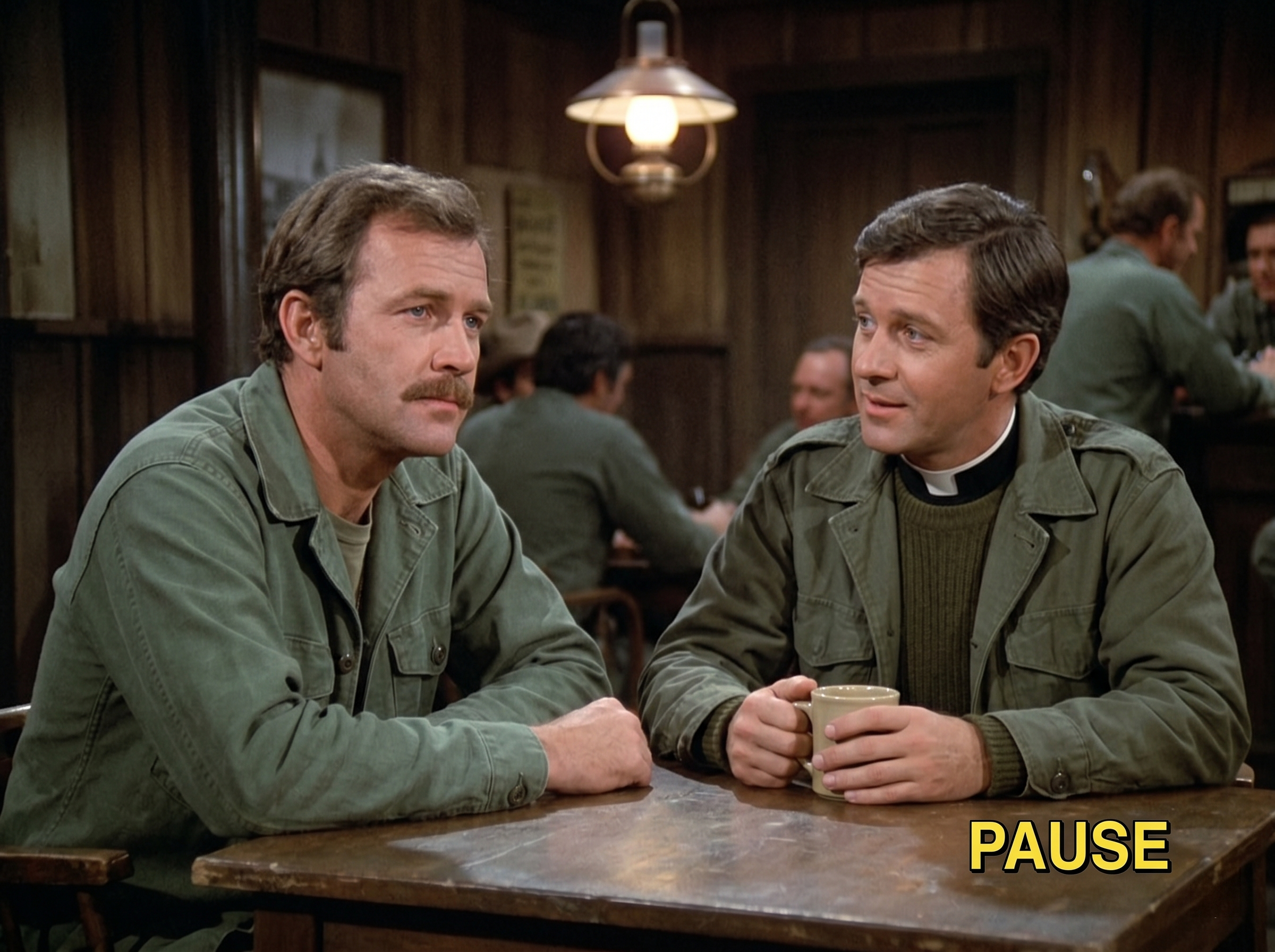
Inside Rosie’s Bar, the atmosphere was loose and intimately dim. It was a rustic, makeshift sanctuary built out of raw wood, canvas, and the sheer desperate willpower of exhausted men and women who just needed to be anywhere else for a while.
The air smelled faintly of stale beer, damp wool, and whatever questionable meat Rosie was stewing in the back room. Practical lamps cast a warm, soft yellow glow across the room, leaving the corners draped in comfortable shadows.
At a scarred wooden table near the center of the room, Captain B.J. Hunnicutt sat staring at nothing in particular.
He wore his standard-issue green fatigue jacket, the fabric faded and worn soft from countless cycles through the camp laundry. His shoulders were slumped, completely devoid of their usual easygoing, California posture.
B.J. leaned forward heavily, his forearms resting on the sticky table. His dark hair was a little messy, his mustache shadowing a tight, weary expression. He looked like a man trying to solve a complex math problem entirely in his head, or a man trying desperately to remember a dream that was slipping away.
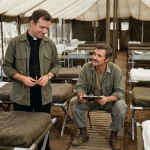
Across from him sat Father Francis Mulcahy.
The chaplain wore his thick, olive-drab wool sweater layered over his crisp white clerical collar. Unlike B.J., who looked like he was slowly sinking into the floorboards, Mulcahy sat with a quiet, attentive stillness.
Both of Mulcahy’s hands were wrapped gently around a chipped ceramic mug, absorbing whatever meager heat the liquid inside had left to offer. He wasn’t talking. He was simply offering his presence, his head tilted slightly, his eyes resting on the surgeon with a look of profound, hopeful warmth.
In the background, a few enlisted men muttered over a game of cards. A glass clinked against a bottle at the bar. But at their table, the silence stretched out, thick and heavy.
“You’re a long way from Mill Valley, Beej,” Mulcahy finally said softly, his voice barely rising above the low murmur of the room.
B.J. didn’t look up immediately. He traced the deep, irregular grain of the wood with his thumbnail. “I think I crossed the border from ‘missing it’ to ‘hallucinating it’ somewhere around Tuesday, Father.”
Mulcahy offered a small, gentle smile. “The mail call this morning?”
“Yeah,” B.J. sighed, his voice tight. “A letter from Peg. A long one.”
He finally looked up, meeting the priest’s eyes. The exhaustion in B.J.’s face wasn’t just from a thirty-hour shift in the OR; it was a deep, spiritual fatigue. It was the crushing, cumulative weight of time stolen from his family.
“She wrote about Erin,” B.J. continued, his voice dropping into a rough whisper. “She said Erin found a caterpillar in the garden. Named it ‘Gus.’ She said Erin was laughing so hard she fell over into the tomato plants.”
“That sounds like a beautiful moment,” Mulcahy murmured, his hands tightening slightly around his mug.
“It is,” B.J. said, but his jaw clenched. The muscles in his neck tightened. “It is beautiful. But Father…”
B.J. leaned closer across the table, the calm exterior finally cracking, revealing a raw, quiet panic underneath.
“I sat on my cot for an hour trying to hear that laugh in my head,” B.J. whispered, his eyes wide and suddenly terribly vulnerable. “I closed my eyes, and I tried to hear my daughter’s voice. And I couldn’t do it. The sound is gone. I can see the photograph on my footlocker, but I can’t hear her. The war is too loud, Father. It’s drowning them out.”
Father Mulcahy did not flinch. He did not offer a quick, practiced platitude about how everything would be fine, or how God had a grand design that required B.J. to be half a world away while his daughter grew up without him.
Instead, the chaplain held his gaze. The soft, practical light from the hanging lamp reflected in Mulcahy’s eyes, underscoring the deep well of empathy he carried for every broken soul in the 4077th.
Mulcahy took a slow, deliberate breath. He looked down at his mug for a brief second, gathering his thoughts, before looking back up at the terrified father sitting across from him.
“When I was a boy,” Mulcahy began, his voice taking on that familiar, melodic cadence of a storyteller, “my sister—the Sister—and I used to spend our summers near a railroad track. Freight trains would come through at all hours.”
B.J. blinked, his brow furrowing slightly, but the sheer panic in his eyes stopped expanding. He listened.
“For the first week of summer, those trains were deafening,” Mulcahy continued, a fond, wistful smile touching the corners of his mouth. “They would shake the floorboards. They would rattle the teacups in the cupboards. We thought we would never sleep. We thought the noise would simply swallow us whole.”
Mulcahy lifted his mug, taking a small, almost ceremonial sip, before resting it back on the table, keeping his hands wrapped around the warmth.
“But you know what happened, Captain?” Mulcahy asked gently.
“You got used to it,” B.J. guessed, his voice still a bit rough, but the tightness in his shoulders was marginally less severe.
“No,” Mulcahy corrected softly. “We didn’t just get used to it. The mind is a miraculous, protective thing, B.J. It learns to filter out the trauma. Eventually, we stopped hearing the trains entirely. But we could always, always hear our mother calling us for supper from two streets away.”
B.J. let out a long, shaky breath, leaning back slightly in his wooden chair. The tension didn’t vanish—it never did in this place—but it shifted, becoming something he could carry again.
“You think my brain is just filtering out the noise?” B.J. asked, a hint of dry, desperate humor finally returning to his tone.
“I think,” Mulcahy said, leaning in, his expression radiating that steadfast, hopeful warmth, “that your mind is exhausted. Your heart is exhausted. You spend twelve, fourteen, sometimes twenty hours a day surrounded by the sounds of sirens, and metal, and pain. It builds a callous, Captain.”
Mulcahy reached across the table, his hand resting lightly on the scarred wood near B.J.’s arm.
“The inability to conjure a memory perfectly on demand does not mean the memory is gone,” Mulcahy said firmly. “It means you are tired. It means you are surviving. The love you have for Peg and Erin is not a photograph that can fade in the sun. It is the very foundation of who you are. And a foundation doesn’t disappear just because the house is currently covered in mud.”
B.J. stared at the priest for a long moment. The background noise of Rosie’s Bar—the shuffling of boots, the low hum of conversation, the distant, muffled sound of a jeep starting up—seemed to fade slightly.
Slowly, the corners of B.J.’s mustache twitched upward. It wasn’t one of his trademark, booming laughs, but it was a genuine, grounded smile.
“You missed your calling, Father,” B.J. said quietly. “You should have been a surgeon. You just bypassed all the ribs and went straight for the heart.”
Mulcahy chuckled, a warm, modest sound. “I assure you, B.J., if I ever had to hold a scalpel, Colonel Potter would have me court-martialed for sheer clumsiness. I’ll stick to the spirit. The mortality rate is slightly more forgiving.”
B.J. picked up his own glass, which had been sitting ignored for twenty minutes. The drink was warm and probably tasted like gasoline, but he didn’t care. He held it up slightly.
“To foundations,” B.J. said softly.
“To foundations,” Mulcahy agreed, tapping his ceramic mug against B.J.’s glass with a dull, reassuring clink. “And to the letters that keep them strong.”
They sat together in the dim, yellow light of the bar. The homesickness hadn’t been cured—there was no medicine in the world for that—but the sharp, terrifying edge of it had been filed down.
B.J. took a sip of his drink. He closed his eyes for just a second. He still couldn’t perfectly hear Erin’s laugh, but he could feel the warmth of the sun on his face in Mill Valley. He could feel the reality of his family waiting for him.
He opened his eyes and looked at the gentle, brave man sitting across from him. He realized, not for the first time, that while he was a million miles from home, he was sitting right in the middle of a family.
It was a strange, worn-out, olive-drab family, but it was enough to keep a man anchored until the war finally let them go.
Even in the darkest corners of a forgotten war, a single quiet moment with a friend can build a bridge all the way back home.