The Unofficial Delivery of the 4077th
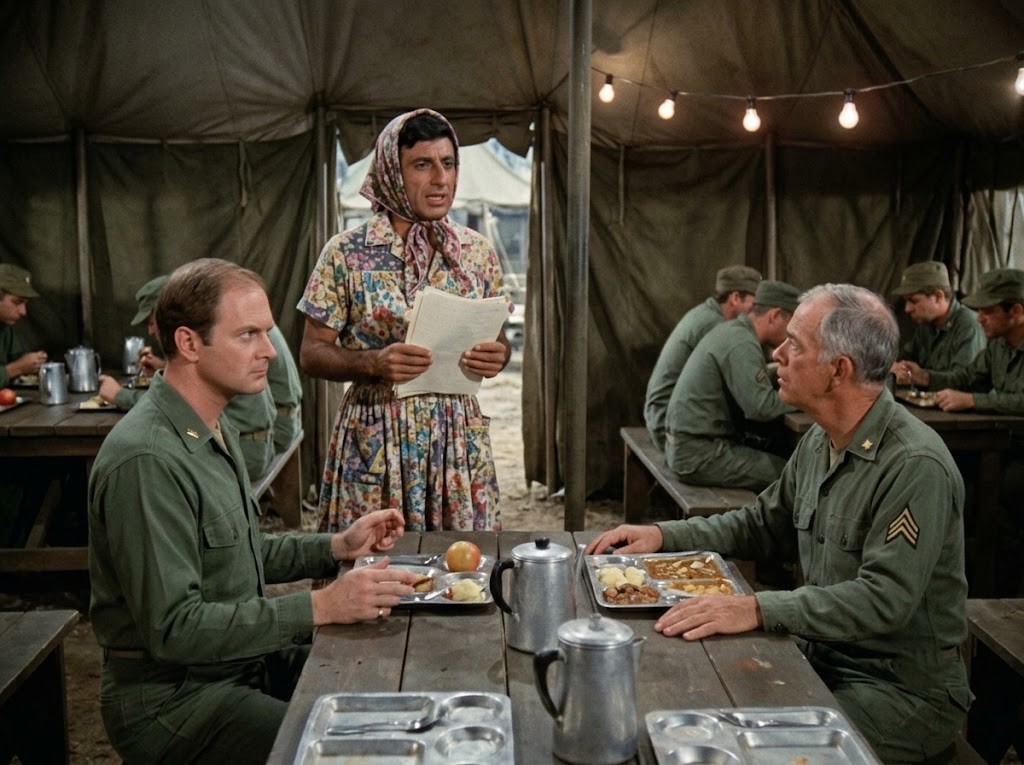
Some days in Korea didn’t feel like a war; they just felt like an endless, exhausting Tuesday. Inside the canvas walls of the 4077th Mess Tent, the air was thick with the scent of boiled cabbage, damp wool, and the low, rumbling murmur of tired men.
At one of the long wooden picnic tables, Major Charles Emerson Winchester III sat with his posture impeccably rigid, staring down at his tin tray as if trying to banish its contents through sheer aristocratic willpower. Across from him sat Sergeant Miller, an older enlistee with graying hair and the permanently slumped shoulders of a man who had seen too many muddy roads.
The relative quiet of the noon lull was broken by the distinct, rhythmic rustle of crinoline and starch.
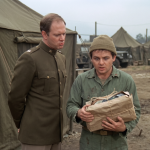
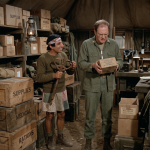
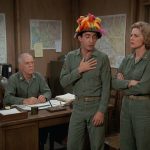
Corporal Max Klinger marched down the center aisle of the tent, clutching a thick sheaf of official-looking papers against his chest. Today’s ensemble was a vibrant, short-sleeved floral print dress, perfectly accessorized with a matching headscarf tied neatly under his chin.
He didn’t stop to joke or grandstand for a Section 8 discharge. Instead, he stopped dead in his tracks right between Charles and Sergeant Miller, his dark eyes wide and filled with an urgent, solemn intensity.
“Major, Sergeant,” Klinger announced, his voice dropping its usual theatrical pitch to a hushed, breathless register. “I need you both to look at this right now.”
Charles didn’t look up immediately. He slowly exhaled, his hand hovering near his fork with practiced dignity. “Corporal Klinger, if this is another petition demanding the Army replace our standard-issue footwear with silk slippers from Toledo, I must remind you that my patience is currently as thin as this morning’s broth.”
“It’s not a stunt, Major,” Klinger said, his voice cracking slightly. He held the papers tighter, his knuckles turning white against the floral fabric of his dress.
Sergeant Miller stopped chewing, looking up from his tray with a cautious, tired curiosity. The old sergeant had a wife and three kids back in Ohio, and any time the company clerk held papers with that specific look on his face, it usually meant a change in orders, a shortage of penicillin, or a letter that required a quiet corner and a box of tissues.
“What is it, kid?” Miller asked softly, his gruff voice carrying the weight of the whole camp’s exhaustion.
Klinger looked down at the documents, then back at the two men. The entire tent seemed to grow a fraction quieter, the clinking of metal utensils fading into the background as the tension subtly shifted.
“It’s the mail from the late shift supply truck that crashed near Uijeongbu last week,” Klinger whispered, tapping the papers. “The regular pouches were burned, but these… these were stuffed under the driver’s seat. They’re all the letters we thought were gone forever.”
Charles finally raised his eyes, his aristocratic brow furrowing as he looked at the singed edges of the pages in Klinger’s hands. The haughty, defensive mask the Boston Brahmin usually wore began to slip, replaced by something raw and dangerously vulnerable.
—
The silence stretched across the table, heavy and sudden. In a camp where a single envelope from home was worth more than a box of gold watches, the mention of lost mail brought a sudden, sharp ache to everyone within earshot.
“Are they… readable, Corporal?” Charles asked, his voice losing its usual booming resonance, replaced by a quiet, hesitant tremor.
“Most of them,” Klinger said, carefully sliding into the space between the tables, his floral skirt rustling against the rough wood. “The edges are scorched, and the water from the radiator leaked on a few. But I’ve spent the last four hours in the office with a magnifying glass and a roll of tape trying to piece the addresses back together.”
Sergeant Miller reached out a rough, calloused hand, his fingers stopping just short of touching the papers. “Any for the motor pool, Klinger? My oldest boy… he was supposed to send his first report card from high school. His mother said he was failing algebra, and I’ve been sick about it for a month.”
Klinger smiled, a warm, genuine expression that completely erased the absurdity of his outfit. He flipped through the stack with practiced ease, pulling out a slightly crumpled envelope with a charred corner.
“Toledo’s finest intuition tells me this one’s yours, Sergeant,” Klinger said softly, handing it over. “The algebra grade is a B-minus, by the way. I checked the margins.”
Miller’s face cracked into a wide, tearful grin. He grabbed the envelope like it was made of spun glass, holding it against his olive-drab shirt as if he could feel his son’s heartbeat through the paper. He didn’t say another word; he just nodded to Klinger, his eyes shining under the dim string of lightbulbs overhead.
Charles watched the exchange, his eyes darting from the sergeant’s joy back to the remaining stack in Klinger’s hands. For all his bluster about Boston society, the symphony, and his family’s impeccable lineage, Charles was just as stranded in the mud of Korea as any nineteen-year-old draft-dodger. He missed the smell of old books in his study; he missed the crisp autumn air of Massachusetts; he missed a world that made sense.
“And for the rest of the camp?” Charles inquired, trying to sound detached, though his fingers tapped a nervous rhythm against the tabletop.
“I’ve got three for Captain Hunnicutt, two for Father Mulcahy from his sister the sister, and a whole catalog for Colonel Potter about breeding quarter horses,” Klinger said, his eyes scanning the pages. He paused, looking directly at Charles. “And… I have one here postmarked from Beacon Hill.”
Charles froze. He looked at the envelope Klinger was gently sliding toward him across the grease-stained wood. The upper-left corner bore the elegant, sweeping calligraphy of his sister, Honoria. The edges were black with soot, but his name—*Major Charles E. Winchester III*—was perfectly legible.
“It was at the very bottom of the pile,” Klinger murmured, his tone filled with a quiet, unexpected reverence. “The water didn’t touch it.”
Charles picked up the letter. His hands, usually so steady and precise during delicate arterial surgery, shook just a fraction. He looked up at Klinger, his gaze lingering on the ridiculous, bright headscarf and the floral dress that seemed so wildly out of place in a zone of war. Yet, in that moment, Klinger didn’t look absurd at all. He looked like an angel of mercy in a terrible, beautiful disguise.
“Thank you, Corporal,” Charles said, his voice thick, dropping the ‘Klinger’ he usually used to distance himself. “Your… attention to detail is highly commendable.”
“Just doing my job, Major,” Klinger replied with a soft nod, his theatricality entirely gone, replaced by the simple dignity of a man who loved his makeshift family. “Can’t let the brass think the 4077th doesn’t care about its own.”
Across the tent, the low murmur of the mess hall began to pick up again, but the energy had completely shifted. Word was already spreading. A few tables over, Hawkeye Pierce looked up from his coffee, catching Charles’s eye and offering a rare, quiet nod of solidarity instead of his usual sharp-witted banter.
Sergeant Miller was already deep into his letter, a soft laugh escaping his lips as he read about his son’s antics in Ohio.
Charles carefully slipped his thumb under the flap of Honoria’s letter, inhaling the faint, sweet scent of lavender that somehow survived the smoke, the fire, and the long journey across the sea. He looked up one last time at Klinger, who was already moving toward the next table, his floral dress swaying as he brought another piece of home to another lonely soldier.
In the middle of nowhere, surrounded by the constant threat of the next incoming chopper, the 4077th had found its own small, fragile peace, delivered by a man in a dress who refused to let the world forget them.
Sometimes the best medicine at the 4077th didn’t come in a vial, but in a singed envelope handed over by a friend.