A Tale of Two Boots (And a Pile of Laundry)
If there’s one thing they teach you in the Army, it’s that everything is temporary.
But sometimes, when the guns are quiet and the only sound is the crickets, it feels like the dust and the fatigue are the only constants in the universe.
Especially the fatigue. It settles in your bones like a persistent chill, a silent companion that follows you through the operating room, into the mess tent, and right into your bunk.
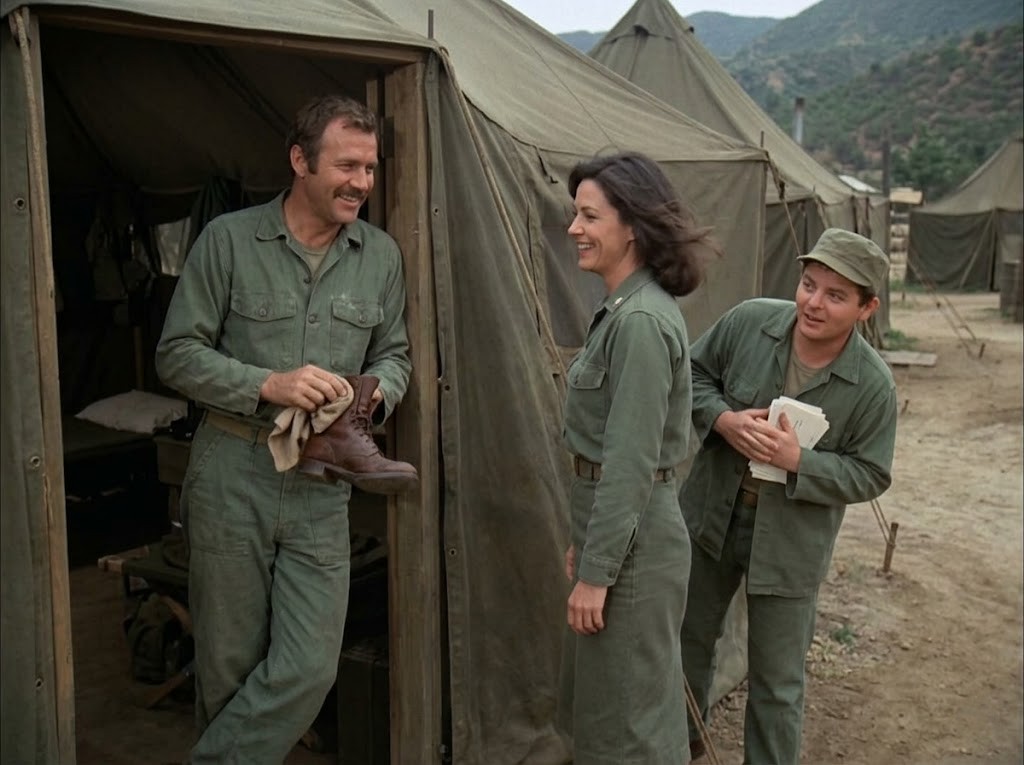
It was one of those rare afternoons. The OR was empty for once, a minor miracle we didn’t dare question. Hawk had crashed into his cot, snoring before his head hit the pillow. I was standing in the doorway of the Swamp, trying to salvage one serviceable pair of boots from the wreckage of the last three weeks.
The mud of Korea has a personality, and it was currently trying to consume my favorite combat boot.
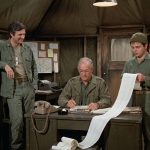
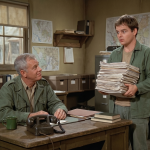
Radar had appeared, a ghostly blur with a stack of paperwork clutched like a lifesaver. He’d just stood there, blinking, looking like he’d personally offended the supply sergeant.
“B.J.,” he’d managed, his voice barely a squeak. “You can’t just… have a pile of laundry like that. It’s against regulations. Paragraph seven, section four, subsection b…”
I’d looked at the mountain of shirts and socks that had slowly eaten the floor of the Swamp. I’d given my boot another wipe. “It’s a strategic defense, Radar. The enemy will never find the bourbon.”
Then we heard her. Margaret. It wasn’t the usual sharp, authoritative click-clack of her heels, but a softer, more purposeful step.
She was looking for Klinger. He’d apparently been using the officers’ latrine again.
Margaret was a force of nature, a blizzard of efficiency and iron-clad discipline. She commanded respect, and often, a healthy dose of terror. You didn’t just casually interact with Major Houlihan; you navigated her mood like a minefield.
But then, as she reached the door, something shifted. Her steps faltered. She looked not at the Swamp, or the boot, or the pile of dirty laundry. She looked right at me.
And I saw the exhaustion. The shadow under her eyes that mirroring my own. The slight slump in her shoulders that wasn’t there ten seconds ago. She didn’t look like a major; she just looked… tired.
She didn’t say a word. She just stopped, and for a heartbeat, the world felt a little less certain, a little more fragile, right before everything felt like it was about to fracture.
Radar held his breath. I could practically hear his heart hammering in his chest. A Major seeing a pile of laundry *and* an off-duty surgeon with a boot and a rag in his hand? It was a court-martial waiting to happen.
Margaret’s eyes softened, and a small smile touched the corner of her lips. Not her sharp, victory smile. It was a gentle, almost sad expression.
She looked at the boot in my hands, then at the chaotic mess behind me. “The strategic defense, Hunnicutt?”
“Yes, Major,” I said, matching her smile. “It’s a classic manœuvre, right out of the manual. Page thirty-eight, paragraph two.”
She chuckled, a low, warm sound that seemed to chase away the tension. “I believe it was designed to protect the whiskey, actually.”
Her eyes moved to Radar, who was now clutching his papers so tightly they were starting to crinkle. “Don’t worry, Radar. I won’t tell anyone. It can be our little secret. Until Klinger is found using the latrine again, that is.”
The relief on Radar’s face was comical. His entire body sagged, and a huge grin spread across his face. He even managed a polite nod of gratitude, which Margaret returned with a wink.
It was a small thing. A shared joke, a fleeting moment of vulnerability, a simple human connection. In a place where everything was measured in liters of blood and minutes of surgery, that connection felt more valuable than all the bourbon in Korea.
Later that evening, after a particularly difficult surgery, I found a clean pair of socks, folded neatly, on my bunk. Margaret never mentioned it, and neither did I.
It was just another one of those secret understandings that made the endless days in Korea just a little more bearable, a little more human.
Sometimes the strongest connections aren’t made in the OR, but in the quiet, shared understanding of a tired smile.