A Matter of Utmost Importance at the 4077th
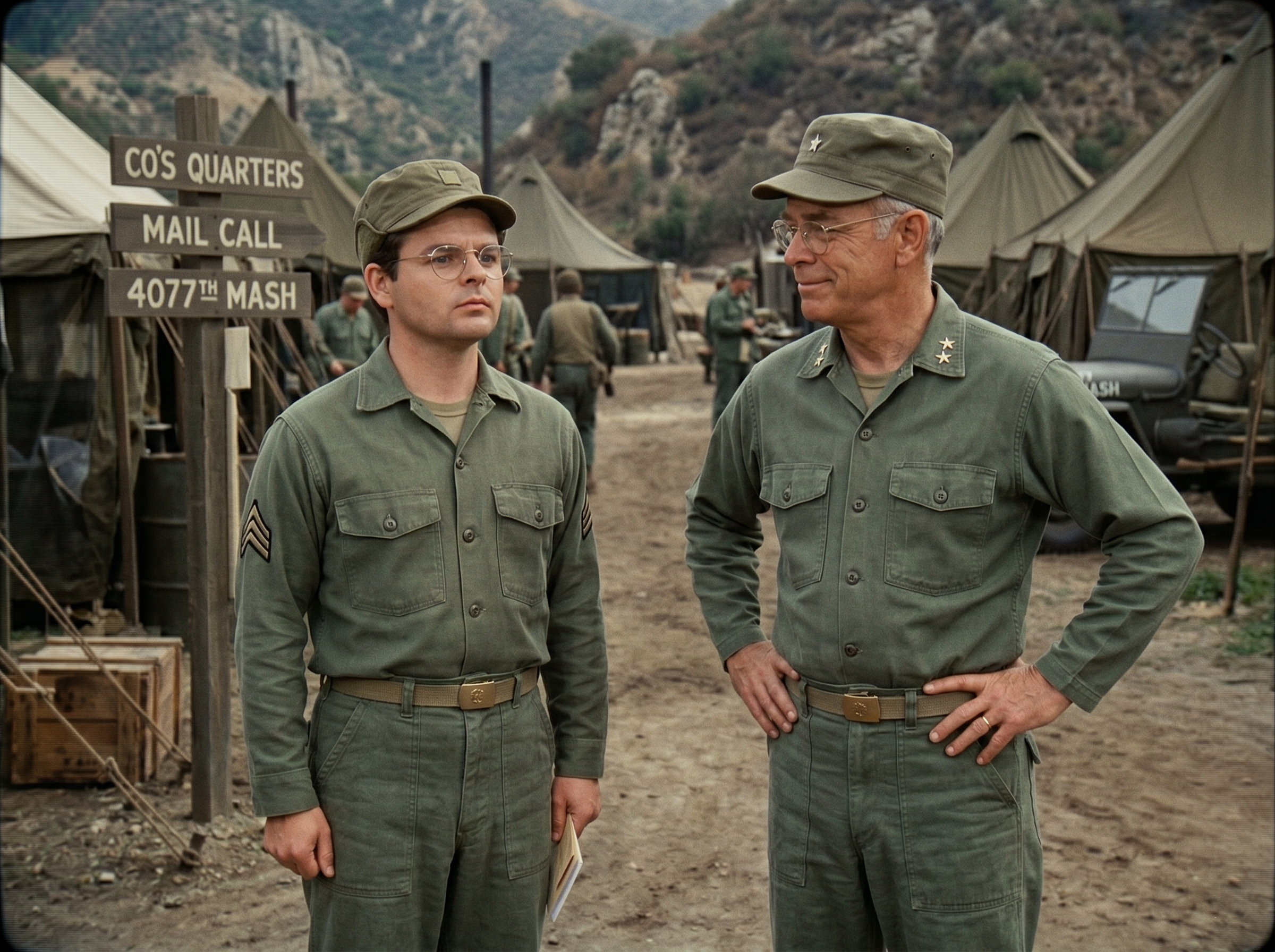
The afternoon sun hung low over the 4077th, casting long, dusty shadows across the compound.
It was one of those rare, quiet pockets of time in the middle of a war. The helicopters were silent, the generators were just a low hum in the background, and the air smelled faintly of pine needles and motor oil.
Colonel Sherman T. Potter stood near the center of the camp, right by the wooden directional signpost. He was taking a moment just to breathe, letting the muted, warm daylight wash over his tired shoulders.
His uniform was practical and lived-in, the faded olive drab a testament to the endless dust of Korea. For a fleeting second, the camp almost felt peaceful.
Then came the familiar, rapid-fire sound of scuffing boots on the dirt path.
“Uh, Colonel? Sir? Excuse me, Colonel?”
Potter didn’t even need to turn his head to know who it was. The rhythmic, anxious cadence belonged to only one person in all of South Korea.
He turned slowly, his face settling into a dryly amused, deeply patient expression.
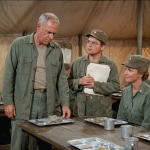
Radar O’Reilly stood before him. The young corporal was hovering politely at attention, though his posture was slightly unsure.
Radar looked exactly as he always did—like a boy wearing his older brother’s clothes. His cap was pulled down near his glasses, his uniform worn and modest, clutching a single sheet of paper to his chest like it was a live grenade.
His expression was a portrait of earnest, intense focus. He had just run from the clerk’s office, and he looked as though the weight of the entire United States Army was resting entirely on his small shoulders.
“Take a breath, son,” Potter said gently, his voice a low, steady rumble. “You look like you just outran a jeep. What’s the crisis?”
“It’s a teletype, sir,” Radar stammered, his eyes darting nervously around the empty compound. “It just came over the wire from I-Corps. Marked ‘Urgent and Confidential.’ I decoded it myself.”
Potter’s amused expression faded slightly, replaced by the mild, exhausted annoyance he reserved for military bureaucracy. “Let me guess. General Hammond wants to know why we used too much gauze last month, or they’re sending us another shipment of left-handed winter gloves.”
“No, sir,” Radar swallowed hard, his knuckles turning white around the paper. “It’s worse. Much worse.”
Potter frowned, studying the boy. Radar wasn’t just doing his usual nervous routine. There was a genuine, deep panic swimming behind those thick glasses.
“Spit it out, Corporal. We haven’t got all day.”
Radar stepped closer, lowering his voice to a frantic whisper. “It’s from the Inspector General’s office in Seoul. They’re doing a blind audit of our casualty evacuation records.”
“We keep impeccable records,” Potter said firmly. “You make sure of that.”
“I know, sir! But they found a discrepancy,” Radar’s voice cracked slightly. “A big one. They claim we treated a soldier three days ago, but there’s no record of him being discharged, transferred, or… or sent to Graves Registration.”
Potter’s eyes narrowed. The wind picked up, rustling the canvas of the mess tent nearby. A missing soldier was not a clerical error; it was a disaster.
“Who is the soldier?” Potter asked, his tone dropping an octave.
“Private First Class Thomas Miller, sir,” Radar read from the sheet.
“And where is he, Radar?”
Radar looked up, terrified. “That’s just it, Colonel. The brass says if we don’t produce him or his official transfer papers by 1800 hours… they are sending the Military Police to lock down the camp and suspend our surgical operations until a full criminal investigation is completed.”
Potter stared at the young corporal. The soft television light of the afternoon suddenly felt a little colder.
“Suspend surgical operations?” Potter repeated, the words tasting like ash in his mouth. “What do those brass hats in Seoul think this is? A dry-cleaning service? We don’t close our doors just because some pencil-pusher lost a file.”
“They’re serious, Colonel,” Radar whispered. “The teletype is signed by a two-star general. They think we lost a man.”
Potter let out a heavy sigh, running a hand over his face. The fatigue of the war seemed to settle deeply into his bones.
“Alright, Radar. Let’s not panic until we have all the facts. Get me the master log. We’ll find out exactly what happened to Private Miller, write up the paperwork, and get these hounds off our scent.”
Radar didn’t move. He stood perfectly still on the dirt path, clutching the paper. His earnest, focused expression cracked slightly, revealing a deep, painful vulnerability.
“I… I can’t do that, sir,” Radar said softly.
Potter paused. He looked closely at the boy. Radar was trembling, just a little.
“Why not?” Potter asked, his voice losing its gruff edge, replaced by a fatherly caution. “Radar, what aren’t you telling me?”
Radar looked down at his scuffed boots. The familiar, communal sounds of the camp echoed around them—someone laughing near the Swamp, the clatter of pots from the kitchen. It was an ordinary day, hiding an extraordinary secret.
“Private Miller isn’t missing, Colonel,” Radar confessed, the words rushing out of him in a desperate exhale. “I know exactly where he is. He’s on a transport ship halfway back to San Francisco.”
Potter blinked. “San Francisco? Did he have a million-dollar wound? Why isn’t it in the logbook?”
Radar finally looked up, his eyes shining behind his glasses. “He didn’t have a wound at all, sir. He had a fake ID.”
Potter went completely still. He waited, letting the young man find his words.
“When he came through triage three days ago, he was shell-shocked,” Radar explained, his voice thick with emotion. “Captain Pierce checked him out. Not a scratch on him, but he couldn’t stop crying. I had to take his dog tags to process his chart. I recognized the high school on a letter in his pocket. It’s from a town near Ottumwa.”
Radar swallowed hard. “Colonel, I know guys from that town. I know how old they are. Private Miller isn’t eighteen, sir. He’s barely sixteen. He lied to the recruiter. He’s just a kid.”
The silence hung between them, heavier than the dusty Korean air.
“So,” Potter said quietly, piecing it together. “You found out we had a sixteen-year-old boy in a combat zone.”
“Yes, sir,” Radar nodded rapidly. “If I processed him normally, he would have been sent back to his unit on the line in two days. I… I couldn’t let him go back up there, Colonel. He was so scared. He looked just like my cousin.”
“What did you do, Corporal?”
“I hid his file,” Radar admitted, his voice dropping to a terrified whisper. “I forged a transfer order. I used the camp stamp to authorize an emergency psychiatric evacuation to Tokyo, and I slipped him onto the chopper while everyone was busy in the OR. I made him disappear from the war.”
Radar stood rigidly at attention, his eyes squeezed shut, bracing himself for the explosion. He had committed a court-martial offense. He had stolen from the United States Army. He had altered official records.
He waited for the Colonel to yell, to strip him of his rank, to call the very MPs he had been warning about.
But the yelling never came.
Instead, there was only the gentle rustle of the wind against the wooden signpost.
When Radar finally dared to open his eyes, Colonel Potter was just looking at him. There was no anger in the older man’s eyes. Instead, there was a profound, quiet tenderness. A deep, melancholic respect.
Potter had spent a lifetime in the military. He had seen the worst of what men could do to each other. And here was this farm boy from Iowa, risking his own freedom to save a terrified teenager he didn’t even know.
Potter sighed, a soft, weary sound. He reached out and took the teletype from Radar’s shaking hands.
“You’re a terrible clerk, O’Reilly,” Potter said softly.
“I know, sir. I’m sorry, sir.”
Potter pulled a pen from his breast pocket. He clicked it open and began to write directly on the urgent message from Seoul.
“You’re sloppy,” Potter continued, his voice completely level as he wrote. “You clearly misfiled the paperwork. Private Miller wasn’t evacuated to Tokyo. He was officially discharged due to a previously undocumented heart murmur, signed off by the commanding officer of the 4077th.”
Radar gasped, his mouth falling open. “Colonel…?”
“It’s a crying shame,” Potter said, not looking up from the paper. “The kid had a bad valve. Completely unfit for service. The brass at I-Corps must have lost my original medical discharge form in their own messy filing system. Typical Seoul bureaucracy.”
Potter finished writing with a flourish, signed his name, and handed the paper back to a stunned Radar.
“Send that back to the Inspector General,” Potter said, his dryly amused expression returning. “Tell them to check their own desk drawers before they come barking up my tree. And tell them if they ever threaten to shut down my OR again, I’ll drive down there and personally operate on their filing cabinets.”
Radar stared at the paper. The massive, crushing weight of the military machine had just been effortlessly swatted away by the stroke of the Colonel’s pen.
“Sir,” Radar breathed, his voice trembling with overwhelming gratitude. “If they find out you lied for me…”
“I didn’t lie for you, son,” Potter said gently, placing a warm, steady hand on Radar’s shoulder. “I corrected an administrative error. That boy had no business being in this war. You did good, Radar. You did real good.”
Radar’s posture finally relaxed. The nervous tension melted away, leaving only a tired, deeply human relief. He looked at Potter, his eyes full of absolute loyalty.
“Thank you, Colonel,” Radar whispered.
“Get back to work, Corporal,” Potter smiled softly. “Before I find a reason to put you on latrine duty.”
Radar offered a sharp, crisp salute—not out of military obligation, but out of pure respect. He turned and jogged back toward the office, his step noticeably lighter.
Colonel Sherman Potter watched him go. He slipped his hands into his pockets and looked out over the dusty compound, the canvas tents glowing warmly in the fading afternoon light.
It was a terrible, beautiful place. Full of madness, full of pain, but held together by the quiet, defiant humanity of the people who lived there.
Potter smiled to himself, turning his face back up toward the fading sun. The war would still be there tomorrow, but tonight, one kid was going home.
In a place built to mend broken bodies, it was the quiet acts of mending broken rules that truly saved their souls.