A Michelin Star in the Mud
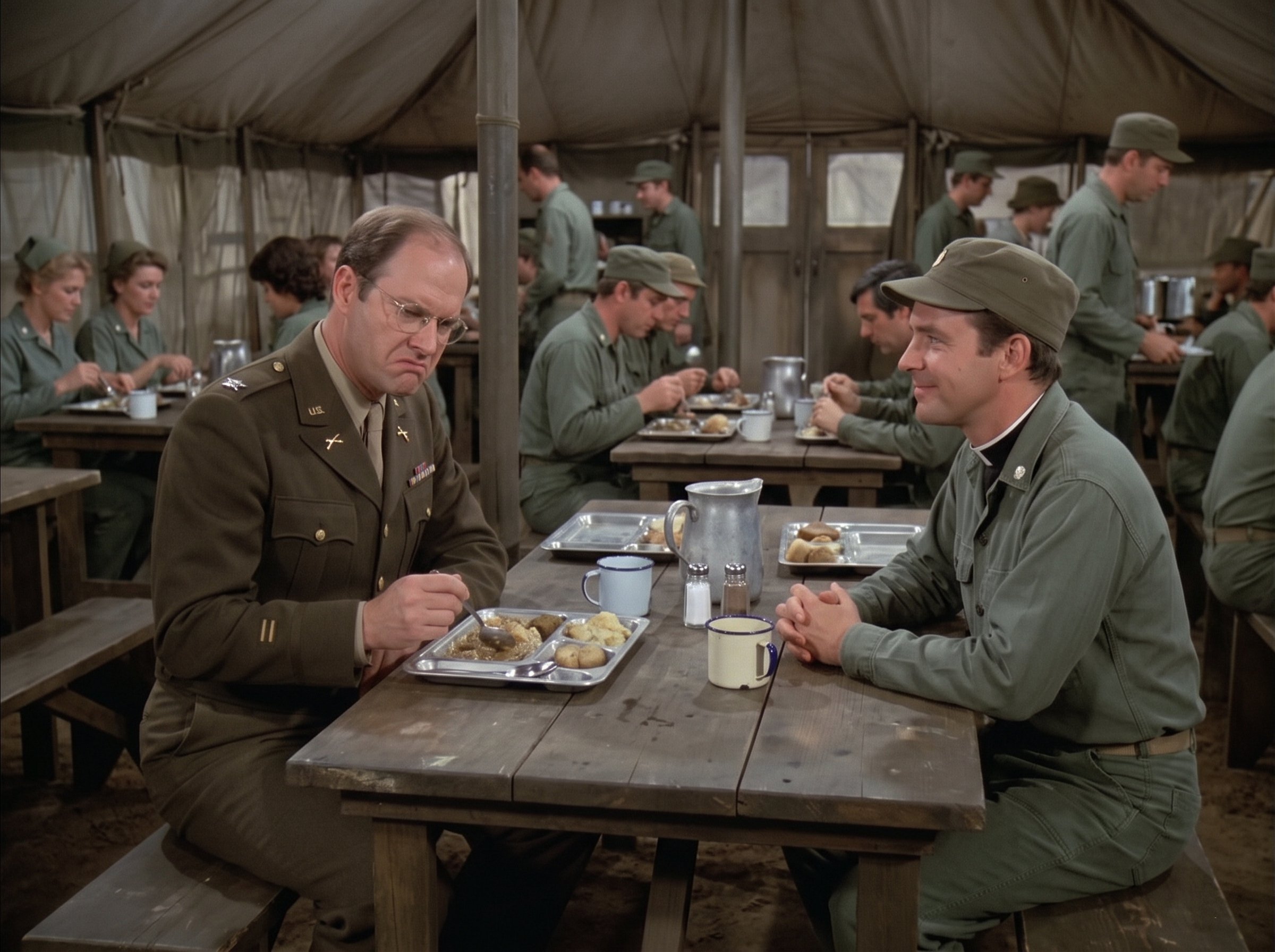
The mess tent of the 4077th was an assault on the senses even on its most triumphant days. Today, however, it was a tragedy served on a dull, dented tin platter.
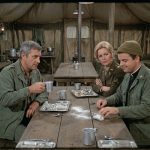
The canvas walls flapped gently in the Korean wind, allowing a draft of bitter cold to sweep across the long, scarred wooden tables. The air smelled strongly of damp wool, burnt coffee, and whatever culinary catastrophe Corporal Igor had decided to unleash upon the camp.
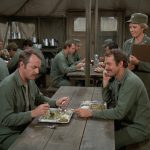
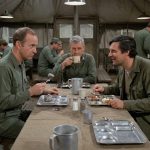
Major Charles Emerson Winchester III sat perfectly upright, his posture refusing to yield even a fraction of an inch to the exhaustion of a grueling eighteen-hour shift in the operating room. He wore his fatigue shirt like a tailored suit, but the dark circles under his eyes betrayed the truth.
Before him sat his metal food tray.
Charles stared down at it with a mixture of profound sorrow and aristocratic outrage. One eyebrow crept slowly upward, disappearing into his hairline as he inspected the grayish, gelatinous lump occupying the main compartment of the tray.
Across the narrow wooden table sat Father Francis Mulcahy.
The priest had his hands gently folded in front of him, resting near his own tin mug. He wasn’t eating. He was simply watching Charles, a soft, hopeful, and entirely serene smile playing on his lips.
“Tell me, Father,” Charles began, his voice a low, theatrical purr that vibrated with refined sarcasm. “In all your years of theological study, in all your quiet meditations on the nature of suffering and sin… have you ever encountered a substance quite so fundamentally opposed to the concept of human joy?”
Father Mulcahy’s smile widened just a fraction. He leaned forward slightly, looking at the tray. “I believe Igor called it Salisbury steak, Major.”
Charles picked up his metal fork as if it were a contaminated scalpel. He poked the lump. It did not yield.
“Salisbury steak,” Charles repeated, rolling the words around his mouth as if tasting them. “A dish named after a physician, Dr. Salisbury, who advocated for a meat-centered diet to cure illness. I can assure you, Father, whatever this is… it is the cause of illness, not the cure.”
He dropped the fork. It hit the tray with a hollow, depressing clatter.
Charles looked around the dreary, olive-drab tent. He saw the exhausted nurses huddled over their coffee. He saw Hawkeye and B.J. asleep in the corner, their heads resting on their arms. He looked back at his tray, and suddenly, the theatrical indignation vanished.
The sarcastic armor cracked.
Charles closed his eyes, and a sudden, terrifying wave of pure homesickness washed over him. He thought of Boston. He thought of the heavy mahogany dining table, the gleam of polished silver, the smell of roasted pheasant, and the sound of civilized conversation.
When he opened his eyes again, they were dangerously bright.
His hands began to tremble slightly. The relentless flow of wounded, the blood, the mud, the noise of the choppers—it all suddenly pressed down on his shoulders with the weight of a physical blow. He gripped the edge of the table, his knuckles turning white.
“I cannot do this, Francis,” Charles whispered, his voice suddenly stripped of all its pompous volume.
He stared at the terrible food, but he wasn’t seeing it anymore. He was seeing the young boys they couldn’t save.
“I simply cannot swallow another bitter pill in this godforsaken purgatory.” Charles shoved the tray away, the metal screeching harshly against the wood, and half-rose from the bench, desperate to flee into the cold, empty night.
Father Mulcahy did not reach out to grab the Major’s arm. He did not tell him to sit down, and he did not offer a grand, booming prayer for strength.
Instead, the priest simply kept his hands folded, maintaining his quiet, steady presence.
“My sister, Sister Angelica,” Mulcahy said softly, his voice cutting gently through the ambient noise of the mess tent. “She once tried to bake a rhubarb pie for the parish bake sale in Philadelphia.”
Charles froze, hovering halfway between sitting and standing. He looked down at the priest, his face a mask of confusion. The absolute non-sequitur caught him entirely off guard.
“She was a brilliant woman, my sister,” Mulcahy continued, looking fondly at his own terrible cup of coffee. “But she was famously distracted. She mistook a large canister of salt for powdered sugar.”
Charles slowly lowered himself back onto the hard wooden bench, his rigid spine slumping just a fraction.
“I assure you, Major, it was a weapon of mass destruction,” Mulcahy said, chuckling softly at the memory. “Father O’Malley took one bite and I thought we were going to have to administer the Last Rites right there in the church gymnasium.”
Charles stared at the priest, taking a slow, shaky breath. The sharp edge of his panic was beginning to blunt, replaced by a weary curiosity.
“Why are you telling me this, Father?” Charles asked softly.
Mulcahy looked up, his kind eyes meeting Charles’ exhausted gaze. “Because, Charles, sometimes the things that are the hardest to swallow are the very things that remind us we are still alive to taste them.”
The priest reached across the table and gently tapped the edge of Charles’ metal tray with his index finger.
“It is a terrible, terrible piece of meat, Major,” Mulcahy said, his voice brimming with quiet compassion. “But it is hot. And it is here. And more importantly… so are you.”
Mulcahy glanced toward the doors of the mess tent, out toward the surgical ward where they had spent the last eighteen hours fighting a desperate, bloody war against death.
“There are a dozen young men in post-op right now who would give absolutely everything they have for the privilege of sitting at this table and complaining about Igor’s cooking,” Mulcahy said gently.
Charles looked toward the doors, and then back down at his tray.
The silence stretched between them, thick and heavy, but no longer suffocating. The frantic energy that had nearly driven Charles out into the freezing night slowly dissipated, melting into a profound, shared exhaustion.
Charles sighed. It was a long, deep sound, the sigh of a man who was carrying a heavy burden but had just found a brief place to set it down.
He looked at Father Mulcahy. The priest’s smile was still there. It wasn’t mocking, and it wasn’t pitying. It was simply a smile that said, I know it’s awful, but we are in this together.
Slowly, Charles reached out and pulled the dented tin tray back toward him.
He picked up his fork. He adjusted his posture, sitting up a little straighter, squaring his shoulders against the chill of the tent. The aristocratic mask slipped back into place, but this time, it was softer, worn at the edges, and fitted with a quiet dignity.
One eyebrow crept slowly upward once again.
“Father,” Charles said, his refined Bostonian drawl returning in full force. “If the Almighty truly intended for the human body to endure this… this gelatinous masonry, He would have equipped us with the digestive tracts of billy goats.”
Mulcahy let out a warm, genuine laugh that seemed to chase a bit of the cold out of the air.
“The Lord works in mysterious ways, Major,” Mulcahy replied, picking up his tin mug. “And so, quite unfortunately, does Corporal Igor.”
Charles scoffed delicately. He cut a tiny, precise piece of the gray meat, lifted it to his mouth, and chewed with his eyes tightly closed, grimacing as if he were taking terrible medicine.
He reached for his own tin mug to wash it down, swallowing hard.
They sat together in the noisy, drafty tent, surrounded by the clatter of tin cups and the exhausted murmurs of their friends. They were thousands of miles from home, wearing muddy green clothes, and eating something entirely unidentifiable.
The war was still waiting outside the canvas flaps. The choppers would inevitably come again.
But for now, in this quiet, shared moment over bad camp food, the terrifying loneliness of the 4077th was held briefly at bay by the simple grace of a stubborn friendship.
Even in the darkest of places, a little warmth and a terrible meal shared with a friend can be the feast that saves your soul.