The Soft Glimmer of Sanity
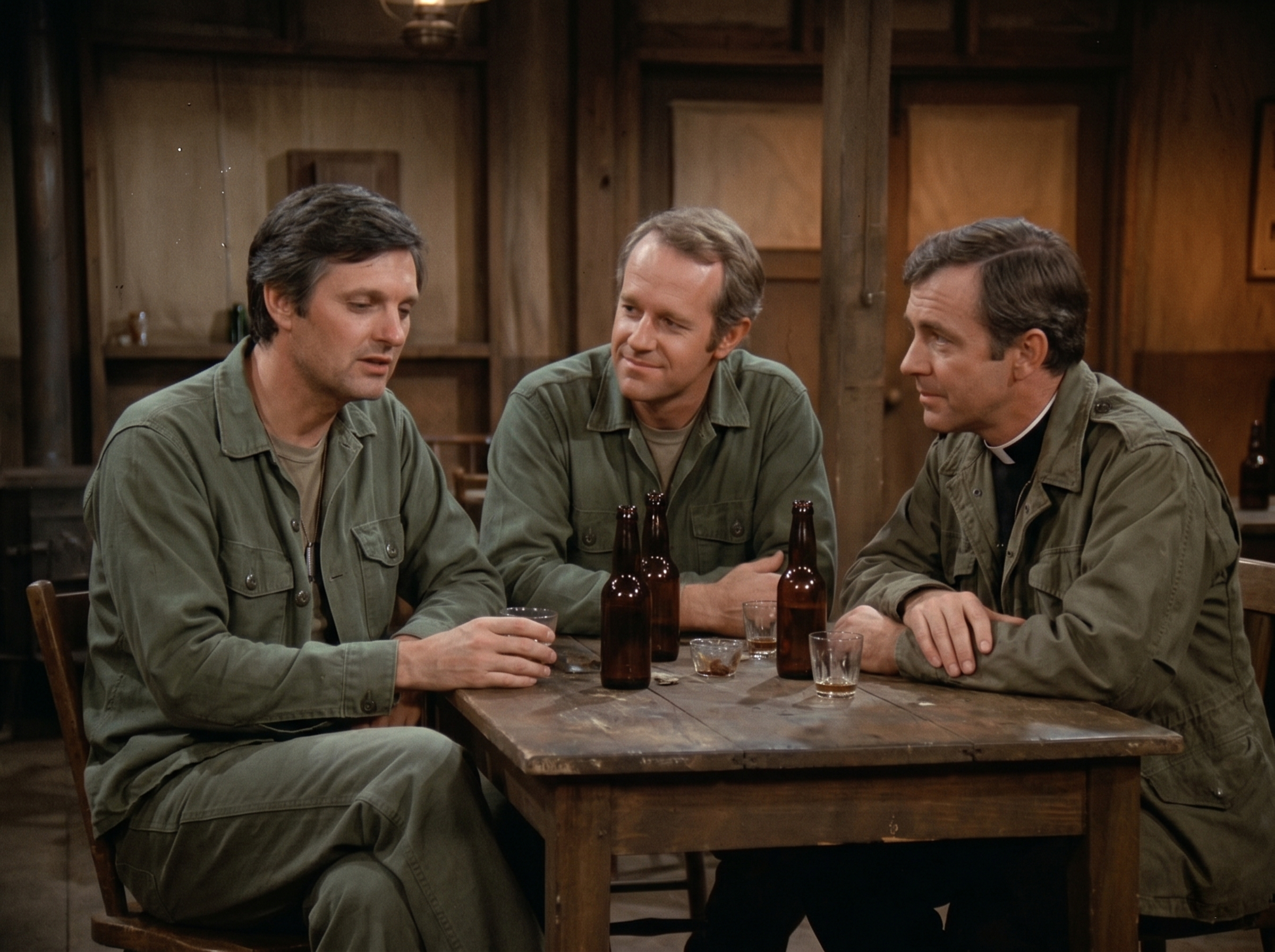
If there is one thing that holds this madhouse of a 4077th together, it’s not the orders from Seoul, nor the supply chains, nor the chain of command.
It’s the quiet moments. It’s when the shelling has stopped for just a few hours.
The Operating Room is quiet. The pre-op tents are mostly empty.
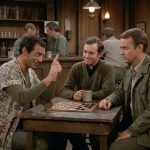
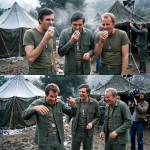
And three very different men gather in the dim light of the Swamp, sharing a few sips from a very suspect bottle.
It’s in these pockets of shared silence that we find the strength to keep doing what we do.
You can see the fatigue in Hawkeye’s shoulders. B.J. isn’t cracking jokes. And Father Mulcahy, as always, is listening, offering a patient ear that holds no judgement.
Tonight, the quiet is heavier than usual.
“It’s not just the surgery, Father,” Hawkeye said, holding his glass of the infamous ‘gin’ against the weak lantern light. “It’s the absurdity. The absolute lack of reason.”
His face was thoughtful, almost weary, looking down as if searching for an answer in his tumbler. “Did you see the latest requisition? We got a shipping container of paper index cards and two packs of penicillin.”
He swirled the pale liquid.
“They are sending us thousands of index cards while we need thousands of cubic centimeters.”
B.J., ever the pragmatist, leaned back, trying to stretch out his long legs in the cramped space of the Swamp.
He didn’t smile, but his expression was soft, understanding. “Look at it this way, Hawk: with enough index cards, maybe we could build a fort that protects us from the red tape.”
A faint, tired smile finally appeared on his face.
The bottles between them were nearly empty. Just two remained upright, sentinels guarding the small table. They had been nurse-maided through the shift.
Father Mulcahy, in his neat clerical collar, had his arms resting on the table.
He looked from one man to the other, his gaze gentle but observant.
“The paper will arrive, Captain Hunnicutt. In time. And sometimes, the smallest supplies have purpose, even if it is simply to organize our notes.”
“Notes? Our notes are about human life, not inventory!” Hawkeye snapped, the tiredness suddenly sharpening his voice.
“They treat us like clerks and then hand us the scalpels!”
He raised the glass again, this time with a definitive tilt, the motion jerky.
It wasn’t a toast; it was an act of frustration.
But that single, forceful motion, executed with a hand that had spent too many hours guiding precise sutures, was a small tragedy in itself.
The glass, slick with condensation and the residual grit of the camp, was already poorly grasped.
His thumb slipped. His finger failed to catch the base.
The remaining gin sloshed violently. The tumbler pivoted in his hand, a tiny centrifuge.
The small event was entirely silent. No crash, no drama.
Just a low, liquid spill, pooling dark on the rough, weathered grain of the wooden table they used for everything.
Hawkeye looked down at it.
He looked at his empty hand.
He looked up, and for the first time in an hour, his eyes met theirs.
The spill wasn’t large. It wouldn’t flood the Swamp. It would barely stain the wood, which had absorbed more than its share of memories.
But for Hawkeye, in that fragile moment of quiet and shared vulnerability, it felt like the entire crumbling infrastructure of his world had just given way.
It was the final straw. It was the penicillin that didn’t arrive. It was the index cards that did. It was the sleep he hadn’t had. It was the sanity that felt like it was slipping.
The silence that followed the spill was heavier than the one that preceded it.
B.J. didn’t move. He continued to watch Hawkeye, his steady gaze offering an invisible kind of support that needed no words.
He didn’t make a crack. He just remained grounded, a beacon of simple human presence.
Mulcahy looked down at the pool of gin, then looked back to Hawkeye, his eyes full of the kind of empathy that is only earned by witnessing profound human suffering day after day.
His lips didn’t move. No comforting words were offered. He understood.
Hawkeye remained still, his hand hovering in mid-air, a statue of regret.
He took a slow, deep breath, the sound of it echoing softly in the cramped space.
Then, he did something small, and perhaps profound.
Instead of swearing, or making a joke, or even just leaving the spill alone, he slowly lowered his index finger.
He dipped the very tip of his finger into the small pool of gin.
He touched the surface of the wood.
And very carefully, with surgical precision, he drew a tiny, perfect circle in the spill.
Then he looked up and managed a faint, sheepish grin.
“A requisition form,” he whispered. “For one refill, please.”
The smallest chuckle escaped B.J., a relief of tension. Mulcahy allowed a smile.
It was a perfect, vintage M*A*S*H moment: humor, however dry, was the only thing holding back the tidal wave. It was their armor.
B.J. reached over and silently nudged the other, nearly full, bottle closer to Hawkeye.
“We don’t need the form,” he said, his voice quiet. “Supply lines are still good.”
Hawkeye reached out and took the bottle. This time, he gripped it with a very steady hand.
He poured a measured splash into his empty tumbler. He didn’t fill it. He just poured enough for another shared, careful sip.
Then he leaned back in his chair, mirroring B.J., and relaxed his shoulders.
The frustration was still there, but the edges were softened.
“I’m sorry, guys,” he said, and it wasn’t just about the spill. It was about the pressure, the fatigue, the frustration.
“Don’t apologize for being human, Hawkeye,” Mulcahy said.
“This place was not designed to keep us sane. It was designed to keep us here.”
He paused, looking at both of them. “But we are here. And as long as we have each other, and small moments like this, perhaps we can hold back the darkness just a little longer.”
Hawkeye raised the new glass.
“To the index cards,” he said.
“May they be useful for something,” B.J. added.
“Amen,” Mulcahy whispered.
They all took a slow sip.
The quiet had returned, but it was different now. It was no longer a heavy burden. It was a shared refuge.
It was the warmth of being found by others when you felt lost.
The wood of the table would dry, the gin stain would fade, and new wounds would arrive tomorrow.
But tonight, for a brief hour, they were not soldiers or surgeons or even victims of a bureaucratic war. They were simply friends.
And that was enough.
Here’s to the 4077th, where a shared moment of frustration can turn a lost glass into a found friendship.