The Toledo Gold Standard of the 4077th
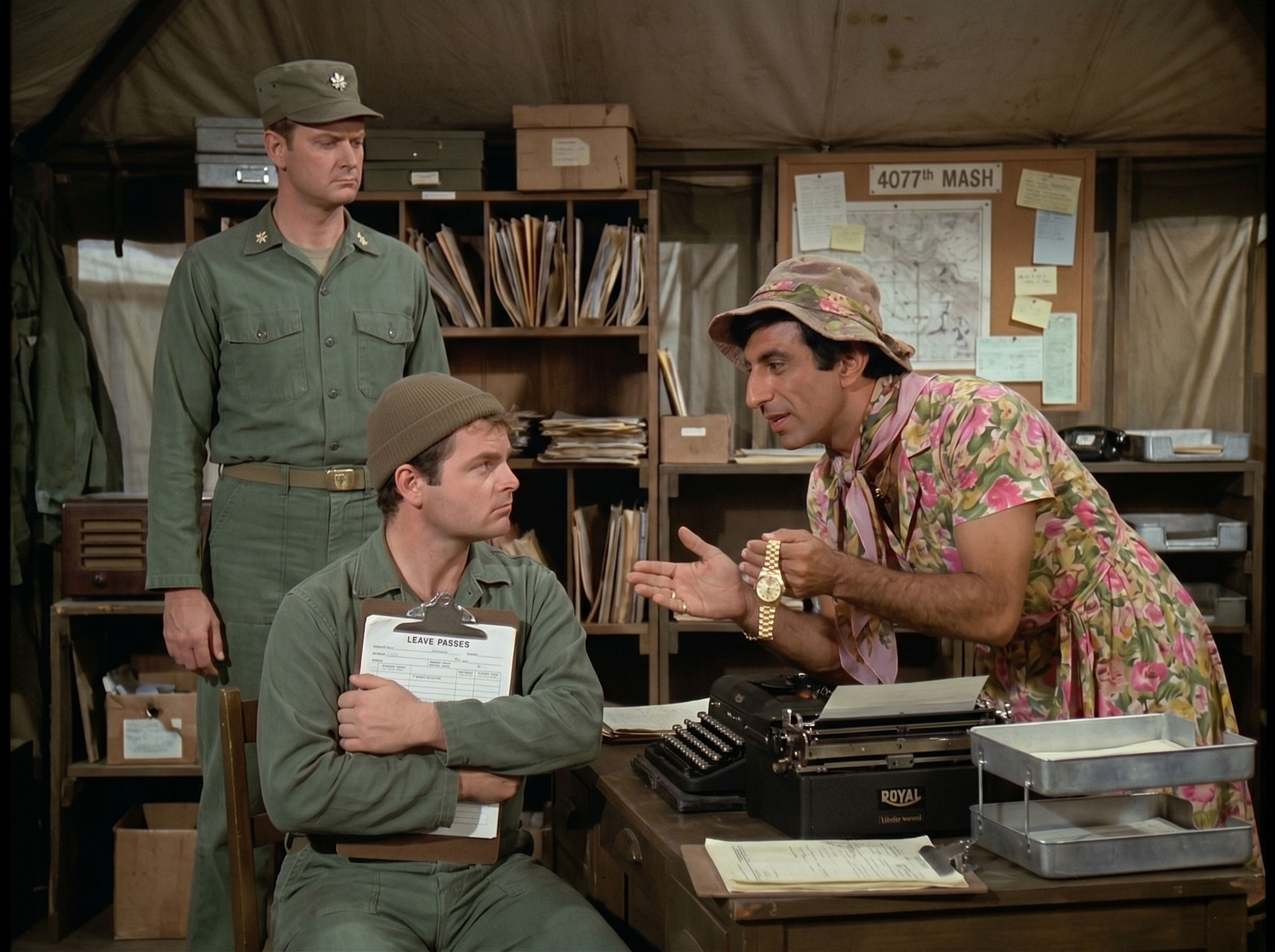
The war in Korea was fought with scalpels, bandages, and an endless, crushing mountain of paperwork.
Outside the canvas walls of the clerk’s office, the 4077th Mobile Army Surgical Hospital was locked in its usual rhythm of mud, misery, and roaring chopper blades. But inside, among the wooden mail slots and dull metal filing trays, a different kind of battle was taking place. It was a war of attrition, fought over a single stack of paper.
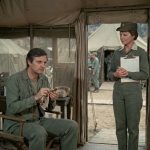
Corporal Maxwell Klinger leaned aggressively across the battered Royal typewriter. He was dressed in his finest summer floral—a vibrant pink and green dress paired with a matching bucket hat that had seen better days. A pink chiffon scarf was tied elegantly at his throat.
Despite the feminine attire, Klinger’s posture was all Toledo street hustler.
In his right hand, he held out a chunky, incredibly shiny gold watch. He dangled it in the air, his expressive face shifting into a mask of pure, used-car-salesman charm. He was pushing his luck, and he knew it.
Sitting across from him behind the desk, Corporal Walter “Radar” O’Reilly looked like a cornered rabbit.
Radar was bundled in his standard olive-drab fatigues, his trademark knit cap pulled low over his forehead. He sat rigidly in his chair, both arms wrapped tightly around a wooden clipboard pressed flat against his chest.
Printed across the top of the forms on the clipboard, in bold, unmistakable letters, were the words: LEAVE PASSES.
“I’m telling you, Radar, this is the genuine article,” Klinger whispered, his voice smooth and persuasive. “Twenty-four karat Toledo gold. Guaranteed to impress the ladies, the generals, and anyone else who appreciates the finer things in life.”
Radar didn’t blink. His face was a picture of earnest, sweet skepticism. He squeezed the clipboard a little tighter, guarding the holy grail of the camp.
“It’s ticking so loud I can hear it over the generator, Klinger,” Radar said softly, his voice wavering just a little. “And it’s leaving a shiny gold dust on your fingers.”
“Patina, my innocent friend! That is the mark of true European craftsmanship!” Klinger insisted, pushing the watch closer to Radar’s nose. “I am offering you a king’s ransom here. A timeless family heirloom. All I need in return is one little signature on one of those beautiful, blank pieces of paper you’re hugging.”
Standing just a few feet behind them, Major Charles Emerson Winchester III observed the entire sordid transaction.
Winchester stood with his usual upright, stiff posture. His green officer’s fatigues were pressed as neatly as conditions would allow, the silver oak leaves gleaming on his collar. He looked down at the two enlisted men with an expression of intense, sarcastic impatience.
To Charles, the entire camp was an undignified assault on his senses, but this—this petty, back-alley bartering taking place over a typewriter—was a special kind of agonizing.
“Klinger, Colonel Potter said absolutely no three-day passes until the supply trucks arrive,” Radar pleaded, shaking his head. “If I give you a pass, he’ll have me standing at attention until my ankles snap.”
“Radar, have a heart,” Klinger dropped his voice, the theatrical charm slipping just a fraction to reveal the exhaustion underneath. “I just need forty-eight hours in Seoul. I have a connection. A guy who knows a guy in the psychiatric board. I can taste my Section 8, Radar. I just need to get on that truck.”
“I can’t do it,” Radar said, his bottom lip jutting out in stubborn defense. “It’s against regulations. And the watch is fake.”
Klinger slammed his free hand on the desk, rattling the typewriter keys. He leaned in closer, the floral hat dipping low, his dark eyes wide with desperate intensity.
“You’re breaking my heart, O’Reilly,” Klinger said, his voice cracking with a sudden, heavy fatigue. “You’re keeping a desperate bird trapped in a cage of khaki.”
Before Radar could formulate another apology, a deeply refined, incredibly annoyed sigh echoed through the small canvas room.
Winchester took a single step forward, finally breaking his silence.
“Gentlemen, please,” Winchester drawled, his voice dripping with Bostonian superiority. “The sheer volume of this peasant commerce is giving me a profound and lingering migraine.”
Klinger stood up a little straighter, though the floral dress somewhat ruined the military effect. “Major, this is a private negotiation.”
“There is nothing private in a canvas tent, Corporal,” Charles replied crisply. He reached out with two fingers, delicately plucking the shiny gold watch from Klinger’s grasp as if it were a soiled bandage.
Charles held the watch up to the harsh light of the bare bulb hanging from the ceiling. He inspected it with the practiced eye of a man who actually knew what a king’s ransom looked like.
“Twenty-four karat Toledo gold, you say?” Charles murmured, a dry, mocking smile playing at the corners of his mouth.
“My uncle acquired it in a highly exclusive poker game,” Klinger said, lifting his chin with bruised dignity.
“Fascinating,” Charles replied smoothly. “Because unless your uncle was playing poker with a traveling carnival, he was terribly misled. This is base brass, coated in a lacquer so cheap I can smell the lead from here. Furthermore, the second hand appears to be moving backward.”
Radar couldn’t help it; a tiny, stifled giggle escaped him. He quickly hid his smile behind the clipboard.
Klinger’s shoulders slumped. The flamboyant energy drained out of him all at once. He didn’t argue. He didn’t launch into another wild tale about his family.
He just looked tired.
They had all just come off a brutal, thirty-six-hour shift in the Operating Room. The mud outside was freezing, the food was terrible, and the wounded just kept coming. The dresses, the schemes, the loud bravado—it was all just armor.
Right now, standing in his floral dress with his fake watch exposed, Klinger just looked like a terribly exhausted man thousands of miles from home.
“I just wanted to sleep in a real bed,” Klinger said quietly, not looking at either of them. “Just for one night. A bed with sheets. In a room that doesn’t smell like ether.”
The silence in the small clerk’s office grew heavy. The distant hum of the camp seemed to fade away.
Radar lowered the clipboard slightly. His big, round eyes softened behind his wire-rimmed glasses. He looked at Klinger, then glanced nervously up at Winchester. Radar knew the rules, but he also knew his friends. He wanted to help, but he didn’t have the authority.
Charles lowered the fake gold watch. The sarcastic amusement faded from his aristocratic features. He looked at Klinger, really looked at him, and saw the same crushing fatigue that was currently settling deep into his own bones.
Winchester would rather walk barefoot over broken glass than admit he cared for anyone in this godforsaken medical outpost. But in the quiet, desperate moments between the choppers, the 4077th had a strange way of making family out of strangers.
Charles placed the cheap watch gently on top of the typewriter.
“Corporal O’Reilly,” Charles said, his voice returning to its usual commanding clip, though stripped of its previous mockery.
Radar jumped slightly in his chair. “Yes, sir?”
“It has come to my attention that the surgical wards are critically low on… specialized suturing thread,” Charles announced, looking directly at the wall above Radar’s head. “The kind of thread that can only be procured from the central quartermaster in Seoul.”
Radar blinked, confused. “Sir? We just got a crate of silk sutures yesterday.”
Charles sighed, shooting Radar a withering look. “I am speaking, O’Reilly, of a highly specific, very delicate thread. The kind required for… advanced arterial repairs. I simply cannot perform my duties without it.”
Radar stared at the Major. Slowly, a small, knowing smile began to form on the young clerk’s face.
“Oh,” Radar said, catching on. “Right. The, uh, special delicate thread, sir.”
“Exactly,” Charles said smoothly. “And as I am far too busy maintaining the meager standards of this camp, I require someone to travel to Seoul immediately to retrieve it. Someone highly skilled in the art of… aggressive procurement.”
Charles slowly shifted his gaze to Klinger.
Klinger’s head snapped up. His eyes widened, a spark of life returning to his exhausted features.
“I shall require you to draft a travel authorization immediately, O’Reilly,” Charles commanded, adjusting his collar. “Assign Corporal Klinger to the task. Give him forty-eight hours to scour Seoul for these vital supplies. I shall sign the authorization myself as the acting senior surgical officer.”
Radar didn’t hesitate. He pulled a blank leave pass from his clipboard, rolled it into the Royal typewriter, and began hunting and pecking the keys with renewed enthusiasm. The loud clacking filled the small room, a joyful sound of bureaucratic defiance.
Klinger stood frozen, staring at the Boston aristocrat in stunned disbelief.
“Major,” Klinger said, his voice thick with genuine emotion. “I… I don’t know what to say.”
“Don’t say anything, Corporal,” Charles replied briskly, turning toward the door. “And for heaven’s sake, change out of that appalling floral arrangement before you leave. If you are going to represent me in Seoul, you will at least wear standard issue fatigues. I will not have my personal courier looking like a deranged bridesmaid.”
Klinger snapped a crisp, perfectly executed salute, the pink chiffon scarf fluttering around his neck.
“Yes, sir, Major Winchester, sir,” Klinger said softly. “And… thank you.”
Charles paused at the door of the tent. He glanced back, his eyes briefly flicking to the shiny, worthless brass watch sitting on the desk. A tiny, almost imperceptible smile touched his lips.
“Just bring back the thread, Klinger,” Charles said quietly. “And perhaps… find a real bed for a night.”
Winchester turned and stepped out into the muddy compound, his posture as stiff and unyielding as ever.
Inside the office, Klinger picked up his fake gold watch and slipped it into his pocket. He looked at Radar, who was happily stamping the newly forged travel orders. For a moment, the war didn’t seem so loud, and the mud didn’t seem so deep.
They were thousands of miles from home, but they were not alone.
In the madness of a war they never asked for, their greatest weapon was always each other.