A Toast in the Amber Light of Rosie’s
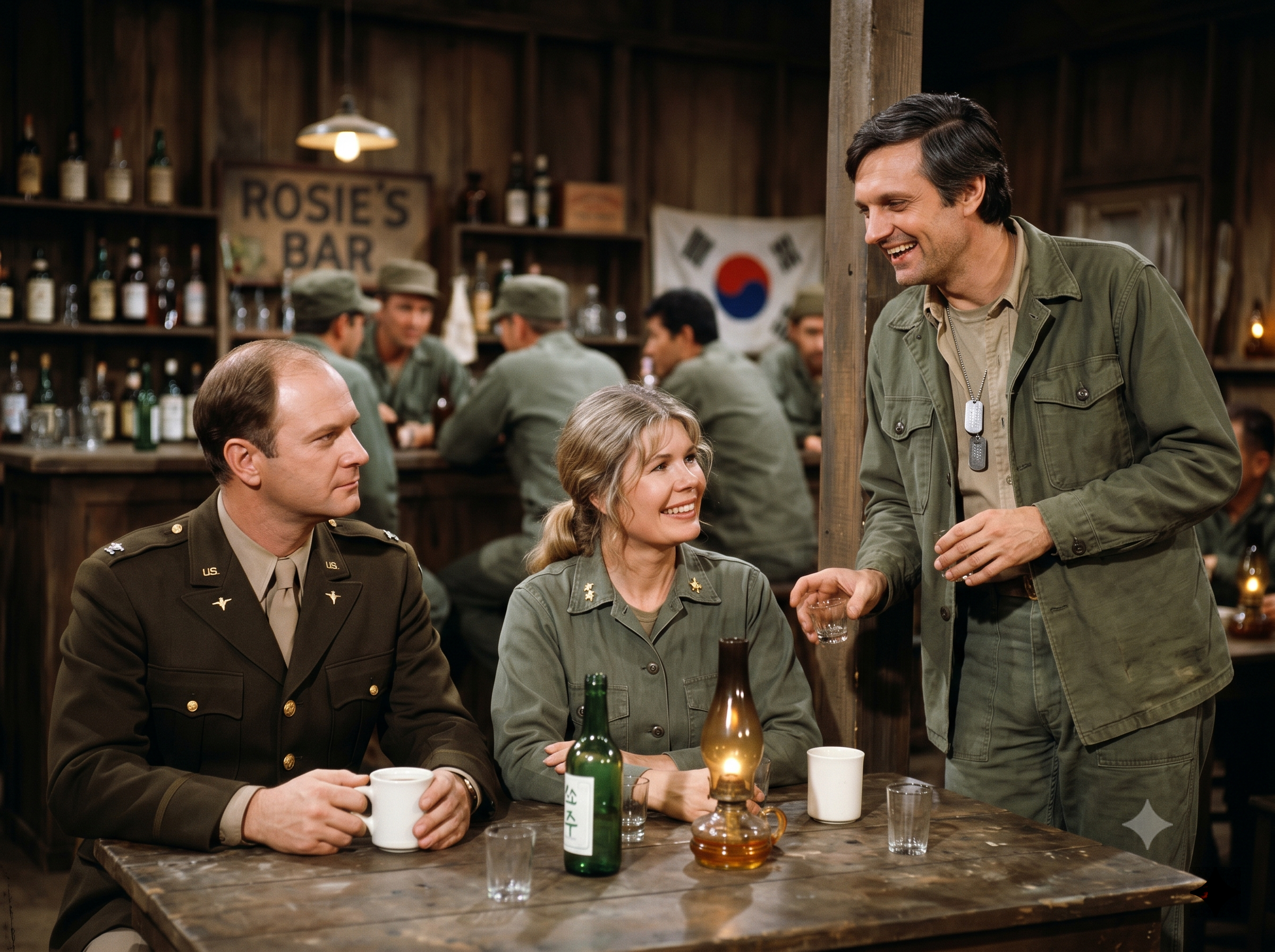
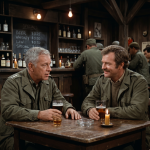
The smell of Rosie’s Bar was a complicated, unforgettable vintage: stale beer, cheap cigars, damp canvas, and the undeniable scent of people desperately trying to forget where they were.
It was a modest, chaotic sanctuary, but tonight, it was the only piece of the world that made any sense. The 4077th had just dragged themselves out of the operating room after a grueling thirty-six-hour marathon.
The kind of session that hollowed out your bones and left your spirit bruised.
In the back corner, away from the boisterous crowd of enlisted men drinking near the South Korean flag, a quieter kind of recovery was taking place. The amber glow of a practical kerosene lamp carved out a small, warm haven against the dark wooden walls.
Major Charles Emerson Winchester III sat rigidly at the battered table.
Even here, amid the sawdust and the rotgut, Charles managed to maintain the posture of a man waiting for his table at the Somerset Club. He was dressed meticulously in his wool uniform, a stark contrast to the mud and misery just outside the door.
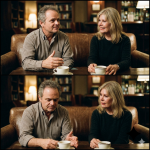
Both hands were wrapped tightly around a thick, white ceramic mug. He stared into the dark, questionable coffee as if willing it to magically transform into a fine, aged brandy.
His face carried his trademark aristocratic disdain, but beneath the pride, there was a subtle, unmistakable vulnerability. The war was wearing him down, sanding away the polished edges, no matter how hard he tried to brace himself against it.
Across from him, Major Margaret Houlihan leaned forward, resting her arms on the rough wood.
She was still in her green fatigues, the brass oak leaves catching the flicker of the lamp. For once, the strict, unyielding head nurse was completely off duty. Her guard was down. She looked utterly exhausted, yet her face held a quiet, relaxed peace that she rarely let the camp see.
Then, Captain Benjamin Franklin “Hawkeye” Pierce materialized beside their table.
He hadn’t even bothered to button his fatigue shirt properly. His dog tags swung freely against his chest, catching the low light as he leaned casually against the wooden post.
In one hand, he held a small, cloudy shot glass. On the table between Charles and Margaret sat a green bottle of local soju—the kind of liquor that could strip the paint off a jeep.
Hawkeye had been trying to coax Charles into a drink for the last five minutes, spinning a ridiculous, elaborate yarn about a fictional bartender in Maine.
“I’m telling you, Charles,” Hawkeye said, a clever, spontaneous smile breaking across his tired face. “It’s all about the bouquet. You just have to get past the initial aroma of airplane fuel and regret.”
Charles looked up from his mug. His jaw tightened.
“Pierce,” Charles said, his voice dripping with dry, exhausted sarcasm. “I would rather willingly consume surgical spirit strained through one of Klinger’s unwashed stockings than let that… that industrial solvent cross my lips.”
The air in the corner suddenly felt a little heavier.
Charles wasn’t just annoyed; he was at the end of his rope. The horrors of the O.R. were still lingering right behind his eyes. He gripped his white mug tighter, his knuckles turning pale. He was one smart remark away from snapping, retreating completely behind his emotional walls, and leaving the bar.
Hawkeye paused. The wisecrack he had locked and loaded died on his tongue.
He stood there, holding the small glass, looking down at his bunkmate. The humor in Hawkeye’s eyes shifted into something sharply observant. He recognized the look on Charles’s face because it was the exact same feeling sitting heavily in his own chest.
The tension stretched taut across the table, fragile as a surgical thread.
Hawkeye didn’t push the bottle closer. He didn’t fire back with a sharper insult.
Instead, his posture softened. The manic, desperate energy he usually used to keep the horrors of the war at bay melted into something quieter. He leaned down just a fraction closer to the table, keeping his eyes on Charles.
“You know, Winchester,” Hawkeye said, his voice dropping its theatrical volume. “I think you’re absolutely right.”
Charles blinked, clearly thrown off guard by the immediate surrender. He loosened his death grip on his coffee mug, just a millimeter. “I… I beg your pardon?”
“I said you’re right,” Hawkeye repeated, a genuine, warm smile touching the corners of his mouth. “It is industrial solvent. And it has no business being in the same zip code as a palate that has experienced true Boston hospitality. It’s an insult to your tongue, and frankly, it’s an insult to my stomach.”
Margaret let out a short, quiet laugh.
She leaned further into the table, her face breaking into a beautiful, emotionally unguarded smile. It was a look of pure, hidden warmth. She watched Hawkeye weave his magic, not with a scalpel, but with a perfectly timed emotional tourniquet. She knew exactly what he was doing, and she loved him for it.
Hawkeye raised his shot glass, holding it up toward the flickering oil lamp so the harsh liquid caught the light.
“So, I will take the bullet for the table,” Hawkeye announced, looking back and forth between Margaret and Charles. “But before I poison myself in the name of morale, I think a toast is in order.”
Charles sighed, a long, weary sound, but the haughty irritation had left his face. The subtle vulnerability remained, but it was no longer guarded by anger. It was just human fatigue, shared equally among the three of them.
“Make it brief, Pierce,” Charles murmured, though his tone was surprisingly gentle. “My coffee is achieving the consistency of wet cement.”
“To the finest, most stubborn, most impeccably dressed snob in the entirety of the United States Armed Forces,” Hawkeye said, looking right at Charles. His smile was clever, but his eyes were entirely sincere. “Who, despite his constant, whining protests, stood on his feet for twelve straight hours today and didn’t lose a single patient.”
Charles’s eyes widened slightly. The dry sarcasm failed him completely. He stared at Hawkeye, the unexpected praise hitting him square in the chest.
Hawkeye then turned his glass toward Margaret.
“And to the iron major,” he continued, his voice thick with quiet affection. “Who somehow manages to keep the rest of us from falling apart, even when she’s too tired to stand up straight. Which, for the record, is a terrible posture for a military officer, Houlihan.”
Margaret’s smile deepened. She didn’t offer a reprimand. She just looked at him, her eyes shining with a deep, unspoken gratitude for the friendship that kept them all tethered to the earth.
“To us,” Hawkeye said softly. “The luckiest miserable people in Korea.”
Hawkeye tossed the soju back in one swift motion. He grimaced, his eyes watering instantly as the terrible liquor burned its way down. He gasped, slapping his chest. “Wow. That actually tastes like a jeep tire.”
Margaret chuckled warmly, picking up her own small, empty glass and turning it over in her hands.
Charles looked at Hawkeye, watching the captain recover from the awful drink. Slowly, deliberately, Charles lifted his heavy white ceramic mug.
He didn’t say a word. He didn’t need to.
With a posture full of quiet dignity, Charles tapped his mug gently against the green soju bottle on the table. It was a microscopic gesture, a tiny concession from a proud man, but in the amber light of Rosie’s Bar, it spoke volumes.
It was an acknowledgment of survival. An acknowledgment of respect. An acknowledgment that, three thousand miles away from anything that felt like home, they had somehow managed to find one another.
Hawkeye grinned, leaning back against the wooden post, the heavy weight of the day finally beginning to lift. Margaret stayed leaned in, basking in the rare, peaceful quiet of the table. And Charles took a slow, deliberate sip of his terrible coffee, looking almost content.
Outside, the war was still waiting for them, but inside the dim, wooden walls of the bar, the world was alright.
In the heart of the madness, the best medicine they ever prescribed to each other was just a moment of quiet understanding.