A Blossom in the Canvas
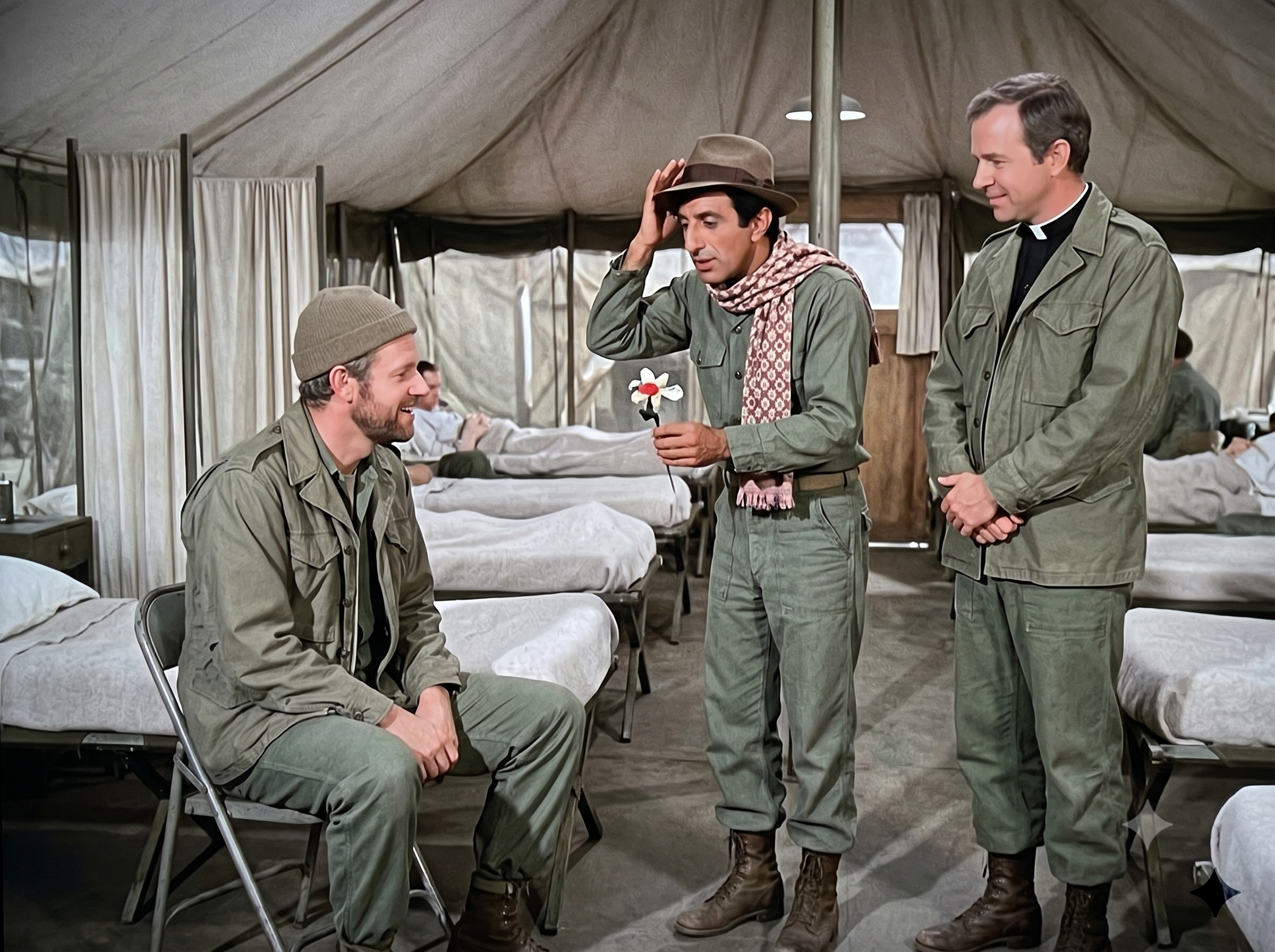
The war rarely bothered to knock, but occasionally, it had the decency to fall quiet.
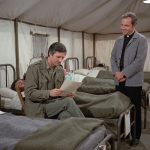
In the Post-Op ward of the 4077th Mobile Army Surgical Hospital, the frantic, bloody chaos of the operating room had finally settled into a muted, exhausted hum. The canvas walls of the tent seemed to breathe in the damp Korean air, exhaling the sharp, clinical scents of iodine, ether, and strong, terrible coffee.
It was mid-afternoon, though time in a windowless tent was measured only by the changing of IV drips and the restless shifting of wounded boys in their narrow cots.
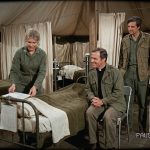
Captain B.J. Hunnicutt sat slumped in a metal folding chair beside one of the beds. He was wearing his standard olive drab jacket, zipped halfway against the perpetual draft, and a green knit cap pulled low over his forehead.
He looked like a man who had just run a marathon in combat boots. His posture was heavy, his shoulders rounded with the immense, invisible weight of the last forty-eight hours of meatball surgery.
But it wasn’t just physical fatigue that was pinning B.J. to the chair. It was the quiet, creeping ache of homesickness. It always hit him hardest when the O.R. doors finally swung shut and the adrenaline drained away.
His mind was drifting across the Pacific, wandering the sunny streets of Mill Valley. He could almost smell the California eucalyptus. He could almost hear Peg humming in the kitchen, almost feel the soft weight of his daughter Erin in his arms. The stark contrast between his vibrant memories and the bleak rows of pale green canvas and muted white blankets was a bitter pill to swallow.
A few feet away, standing quietly in the shadows of the ward, was Father John Patrick Francis Mulcahy.
The chaplain stood with his hands gently clasped in front of his fatigue jacket, the bright white of his clerical collar peeking out from the rough green fabric. He was observing B.J. with a soft, knowing smile and a look of profound, gentle concern.
Mulcahy knew the landscape of a soldier’s broken heart better than anyone. He recognized the distant, glassy look in the surgeon’s eyes. He knew that right now, B.J. was marooned on an island of his own longing, trying to find a reason to keep going.
The priest was just taking a breath, preparing to step forward and offer a few quiet words of comfort, when the canvas flaps at the entrance of the ward parted.
Corporal Maxwell Klinger stepped inside.
Today, Klinger was not wearing a velvet evening gown, a feathered boa, or a fruit-basket headdress. He was dressed in standard military fatigues, his worn boots laced tight against the dust. But Klinger was never truly out of uniform when it came to his own theatrical standards.
Draped elegantly around his neck was a beautifully patterned silk scarf, adding a sudden splash of civilian defiance to the dreary military green. On his head sat a crisp, brown fedora, tilted at a rakish angle.
He moved with exaggerated stealth, his steps carefully placed so as not to wake the sleeping patients. He had spotted B.J. from across the compound and knew immediately that a rescue mission was required.
Mulcahy caught sight of the corporal and paused. The chaplain’s smile widened just a fraction, radiating moral warmth. He took a subtle half-step back, yielding the floor to the master of visual comedy. Sometimes, spiritual healing required a bit of vaudeville.
Klinger approached B.J.’s chair, hiding something carefully behind his back. He stood up straight, adopting a posture of supreme, wounded dignity.
He cleared his throat with a polite, theatrical little cough.
B.J. blinked, his eyes slowly focusing as he was pulled violently back from California to the gray reality of Korea. He looked up, his face deeply tired, his beard scruffy.
Klinger didn’t say a word. With the dramatic flair of a stage magician, he brought his hand out from behind his back and offered his prize to the exhausted doctor.
It was a small, handmade flower.
The petals were fashioned from pristine white medical tape, folded over a crude wire stem. In the center was a small, bright red disc.
With his free hand, Klinger reached up and gracefully tipped the brim of his fedora, holding the pose like a tragic hero offering a rose to a weary king.
B.J. stared at the fake blossom hovering in front of his face. The heavy, oppressive silence of the ward seemed to freeze, the fragile balance between crushing grief and absurd comedy hanging entirely on the tired surgeon’s next breath.
For a long, agonizing moment, nobody moved. The tableau was perfectly still.
Klinger held his theatrical pose, his dark eyes locked on B.J., radiating an earnest, desperate hope. His eyebrows were slightly arched, his expression a masterpiece of Toledo-born resilience masked as wounded pride. He was willing the doctor to take the bait, refusing to let the heavy atmosphere of the ward swallow them whole.
Father Mulcahy continued to watch from the sidelines. He didn’t make a sound, but his gentle presence anchored the moment. He knew the risk Klinger was taking. When a man is buried deep in the trenches of his own homesickness, a joke can either be a ladder out or a shovel digging him deeper.
B.J.’s eyes moved slowly from Klinger’s earnest, ridiculous face down to the crude little flower.
He studied the clumsy craftsmanship. He could see the jagged edges where the medical tape had been hastily torn rather than neatly cut. He noticed that the stem was a piece of stiff baling wire, probably liberated from the motor pool under the cover of darkness.
And the bright red center—upon closer inspection—appeared to be a flattened piece of colored cellophane scavenged from a ration pack.
It was the most absurd, useless, beautiful thing he had seen in weeks.
The corners of B.J.’s mouth began to twitch. The heavy, dark cloud that had settled over his features started to finally fracture.
A slow, ragged breath escaped his lips, sounding loud in the quiet tent. The breath hitched, turned into a soft snort, and finally broke into a quiet, restrained laugh.
It wasn’t a booming belly laugh—the ward was too tired for that, and there were sleeping boys who needed their rest. It was a gentle, deeply appreciative chuckle that shook his shoulders and pushed the exhaustion back just a few inches.
B.J. reached out with a tired hand and gently took the wire stem from Klinger’s fingers.
“Max,” B.J. whispered, his voice raspy, laced with a quiet empathy that mirrored the corporal’s own. “What in the name of all that is holy is this?”
Klinger dropped the grand pose just a fraction, a proud, triumphant grin breaking through his dignified facade. He had won. The patient was recovering.
“That, Captain Hunnicutt, is a rare Korean Snow-Blossom,” Klinger whispered back, leaning in with the air of a black-market salesman sharing a precious secret. “Native entirely to the supply tent of the 4077th. It blooms exclusively when Major Houlihan is looking the other way.”
B.J. twirled the little tape-flower between his thumb and forefinger, a genuine smile finally warming his face. “It’s a botanical marvel. The white petals are exquisite. Though, I have to ask… is the red center made from a piece of my favorite hard candy wrapper?”
Klinger pressed a hand to his chest, looking deeply offended. “I assure you, sir, all materials were ethically sourced through completely unethical means. I traded a slightly dented spark plug for that cellophane.”
Klinger softened his tone, the comedy dropping away just for a second. “I figured you were looking a little gray around the gills, Doc. A man needs some flora to keep his humanity intact.”
B.J. looked up from the flower, meeting Klinger’s eyes. The comedy routine had served its purpose, but beneath the banter lay the rock-solid foundation of their shared survival. Klinger wasn’t just trying to get a laugh; he had seen a friend sinking and had thrown him a lifeline made of stolen office supplies.
“Thank you, Max,” B.J. said softly. The sarcasm was gone, replaced by a profound, tired gratitude. The ache for his family was still there—it would always be there—but the sharp, suffocating edge of it had been filed down. “I’ll make sure it gets plenty of artificial light. I think it will look very nice taped to the frame of Peg’s picture.”
“See that you do, Captain. Toledo orchids are notoriously sensitive to despair.”
Klinger offered one final, crisp tip of his fedora. His mission accomplished, he turned on his heel and marched quietly down the aisle between the beds, his colorful scarf trailing behind him like a flag of temporary victory.
As Klinger disappeared through the canvas flaps, Father Mulcahy finally stepped forward. His boots made no sound on the packed dirt floor. He stopped beside B.J.’s chair, his hands still folded, his soft smile lingering.
“He really is a remarkable young man, isn’t he?” Mulcahy said, his voice a soothing, quiet murmur.
B.J. looked at the priest, then back down at the flower resting in his palm. “He is, Father. Sometimes I think he’s the only truly sane one among us.”
“The Lord works in mysterious ways, Captain,” Mulcahy noted gently. “And occasionally, He works through a corporal in a silk scarf.”
The chaplain placed a warm, comforting hand on B.J.’s shoulder for a brief, silent second. It was a gesture of pure moral support, an acknowledgment of the heavy burden they all carried. Then, with a respectful nod, Mulcahy moved quietly away to check on a restless patient nearby.
B.J. sat alone again, but the heavy isolation was gone.
He looked around the Post-Op ward. The rows of muted white blankets and pale green canvas still looked exactly the same. He was still stuck in a field hospital in the middle of a war. He was still a lifetime away from his wife and daughter.
But as he carefully slipped the handmade flower into the breast pocket of his fatigue jacket, right over his heart, the air in the tent felt a little easier to breathe.
He leaned back in the folding chair, letting his eyes close for just a moment. He wasn’t home yet. But surrounded by the chaotic, beautiful, makeshift family of the 4077th, he knew he was going to make it there eventually.
In a place built for broken bodies, they always found a way to patch up each other’s souls.