The Custom Fit of the 4077th
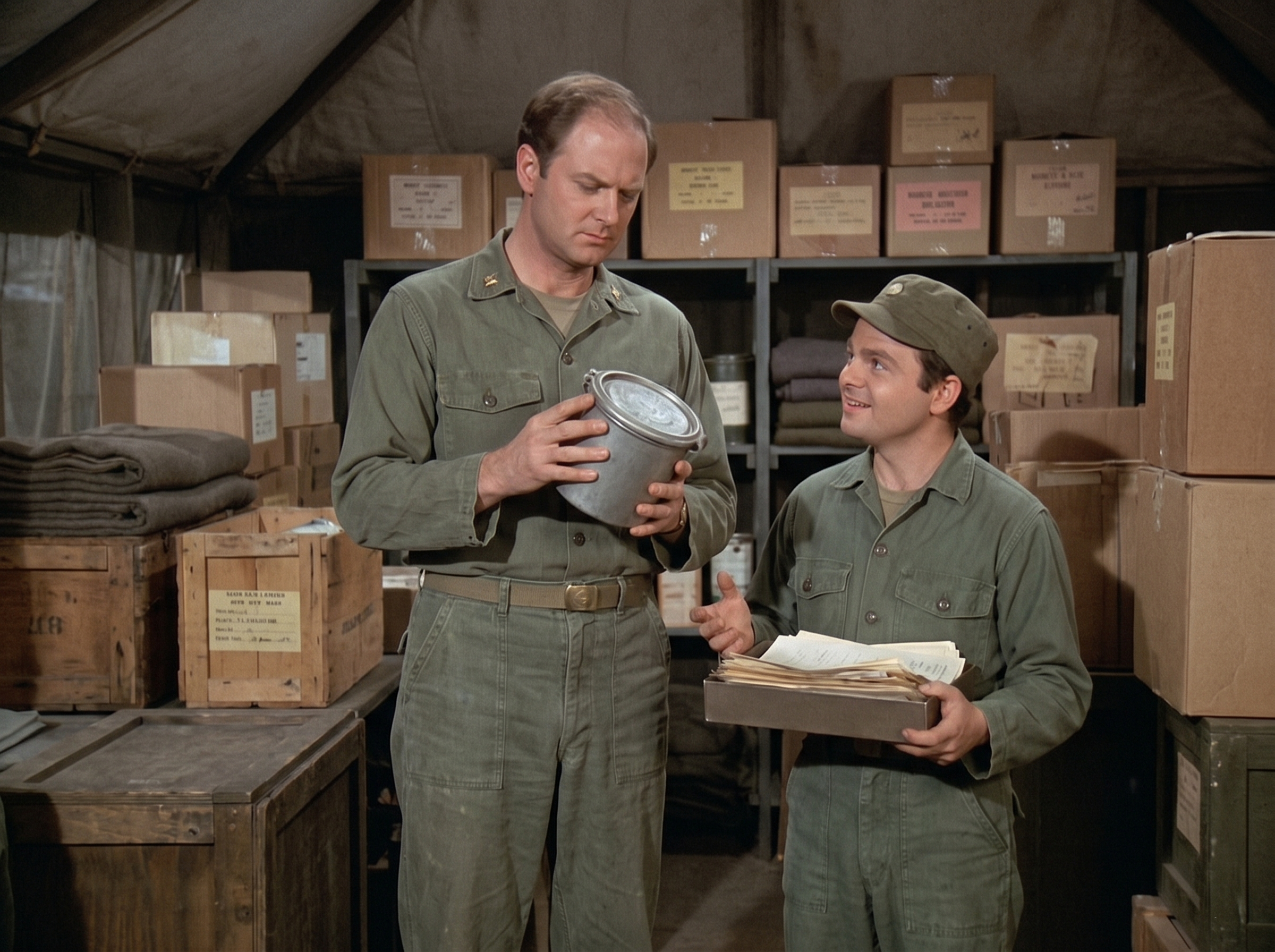
In a place built entirely on chaos, mud, and the terrifying roar of incoming choppers, the 4077th supply tent was the closest thing to a sanctuary.
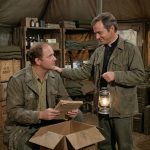
It was a quiet, dusty cavern made of canvas and wood. The air inside always smelled faintly of mothballs, canvas, and dried pine. All around, the walls were lined with the only true order the Army could manage: stacked wooden crates with faded black stencils, cardboard boxes filled with miles of gauze, and thick olive-drab blankets folded with geometric precision.
Standing in the center of this makeshift warehouse was Major Charles Emerson Winchester III.
His posture, as always, was impeccably upright. Even dressed in worn, standard-issue green fatigues, Charles managed to stand as though he were wearing a three-piece worsted wool suit in a Boston parlor. However, the expression on his face betrayed a deep, wounded pride.
In his hands, he delicately held a dull, cylindrical metal tin. He examined it with the cautious, profound disdain of a master jeweler who had just been handed a lump of coal.
“Corporal,” Charles began, his voice a low, theatrical rumble of aristocratic suffering. “I am trying to find the words. I am searching the vast, unparalleled archives of my vocabulary to adequately describe the sheer indignity of what I am currently holding.”
Standing just a few feet away was Corporal Walter “Radar” O’Reilly.
Radar had a metal file tray tucked against his chest like a lightweight piece of armor, brimming with the endless requisition forms that kept the hospital breathing. He looked up at the towering surgeon, not with fear, but with a warm, shy, incredibly earnest smile.
“It’s a medical supply container, sir,” Radar said mildly.
“A container?” Charles echoed, his voice dripping with dry superiority. He rotated the dull tin slowly, as if inspecting a highly infectious disease. “Corporal, a container implies that it is meant to hold something of value. This… this metallic insult… looks as though it should be holding yesterday’s beans.”
Radar’s smile didn’t waver. He shifted his weight, his oversized cap sitting slightly askew on his head. “Well, sir, it’s airtight.”
“I requested a velvet-lined, velvet-cushioned, custom-fitted surgical case from Tokyo for my personal thoracic instruments,” Charles lectured, tapping a finger against the tin. “My instruments, Corporal, were forged in Massachusetts. They require an environment of respect. The Army, in its staggering bureaucratic ineptitude, has sent me a soup pail.”
Charles sighed, a long, weary sound that carried the weight of too many hours at the operating table. The humor of his own complaining suddenly seemed to drain out of him, leaving only the bone-deep fatigue of a surgeon far from home.
“I cannot use this, Walter,” Charles said softly, the bluster fading. “My scalpels are getting dulled by the humidity in this wretched camp. If I lose my edge, I lose my patients. Who in the name of heaven authorized this pathetic substitution?”
Radar clutched his file tray a little tighter. His shy smile softened into something much more serious.
“Nobody at I-Corps authorized it, Major,” Radar said quietly. “It didn’t come from Tokyo. It came from me.”
Charles stopped. He froze entirely, his fingers still wrapped around the dull metal lid.
The silence in the supply tent stretched out, thick and heavy. The distant, muffled sound of a jeep driving through the compound felt a million miles away.
Charles looked down at Radar, his eyes narrowing slightly, trying to process the shift in reality. The aristocratic fury that had been building in his chest instantly evaporated, replaced by a sudden, awkward uncertainty.
“From… you?” Charles asked, his voice suddenly lacking its usual booming confidence.
“Yes, sir,” Radar explained, nervously shuffling a piece of paper in his tray before looking back up. “I saw the requisition form you filled out for the velvet case. I tried to push it through. I really did, Major. But the quartermaster in Tokyo took one look at it and laughed so hard he spilled coffee on the teletype machine.”
Charles stiffened, his pride taking a fresh, albeit distant, hit. “Philistines.”
“Yes, sir. But I knew you were upset,” Radar continued, his voice earnest and gentle. “I saw you in the scrub room yesterday. I saw you trying to clean the rust off your favorite scalpel because the wooden box you keep them in got damp from the rain last week.”
Charles looked away, staring at a stack of cardboard boxes. He hated being observed. He hated that this young, naive farm boy from Iowa had noticed the quiet, desperate panic of a surgeon trying to protect his only tools of salvation.
“So,” Radar said, pointing a finger at the tin in Charles’s hands. “I did a little trading. I gave the motor pool sergeant two cans of real peaches and a pair of gently used spark plugs for that tin. It’s an old sterile dressing container from a Navy surplus.”
Charles slowly looked back down at the dull metal cylinder.
“It’s completely waterproof, Major,” Radar said, a hint of pride creeping into his voice. “And if you open it up, sir… well, go ahead.”
With hesitant, careful movements, Charles twisted the lid. It popped off with a satisfying, airtight hiss.
Charles peered inside. At the bottom of the rough metal tin, perfectly cut to fit the circumference, was a thick, soft circle of deep green fabric.
“It’s not velvet from Boston, sir,” Radar said softly, his eyes watching Charles’s face. “It’s a piece of felt I cut out from the lining of an old, ruined poker table. I boiled it, washed it, and dried it in the sun so it’s completely sterile. Your instruments won’t rattle, and they won’t get damp.”
Charles stared into the tin. The dry superiority he had worn just moments before was completely stripped away, leaving only the raw, quiet humanity of a man who was profoundly touched.
He swallowed hard. For a man of endless words, Charles Emerson Winchester III suddenly found himself entirely without them.
He looked at Radar. The corporal was just standing there, holding his paperwork, asking for nothing in return. It was a simple, breathtaking act of pure grace in a place that had so little of it to spare.
Charles carefully placed the lid back on the container, twisting it until it sealed tight. He held it differently now. Not like a piece of garbage, but like a priceless artifact.
He cleared his throat, desperately trying to assemble his dignity.
“Well,” Charles murmured, his voice thick but controlled. “I suppose… I suppose this has a certain… robust, utilitarian charm.”
Radar’s shy smile returned, lighting up his young face. “You think so, Major?”
“Indeed,” Charles said, standing a little taller, tucking the tin securely under his arm. “While it lacks the aesthetic refinement of New England craftsmanship, it possesses a rugged, undeniable loyalty to its purpose. Much like the man who procured it.”
Radar blushed, looking down at his file tray. “Just doing my job, sir.”
“You do far more than that, Walter,” Charles said softly. It was the highest compliment the major could possibly give, delivered with a quiet sincerity that belonged only to the two of them.
Charles gave a sharp, formal nod, holding the tin close to his chest. He turned and walked out of the dim, dusty supply tent, stepping back out into the harsh reality of the Korean War.
Radar stood alone for a moment in the soft light of the shelves. He adjusted his glasses, looked down at his paperwork, and went back to running the hospital, one small, unseen miracle at a time.
In the mud and the madness of the 4077th, the greatest medicine they had wasn’t kept in a bottle; it was the quiet way they took care of each other.