The Longest Day
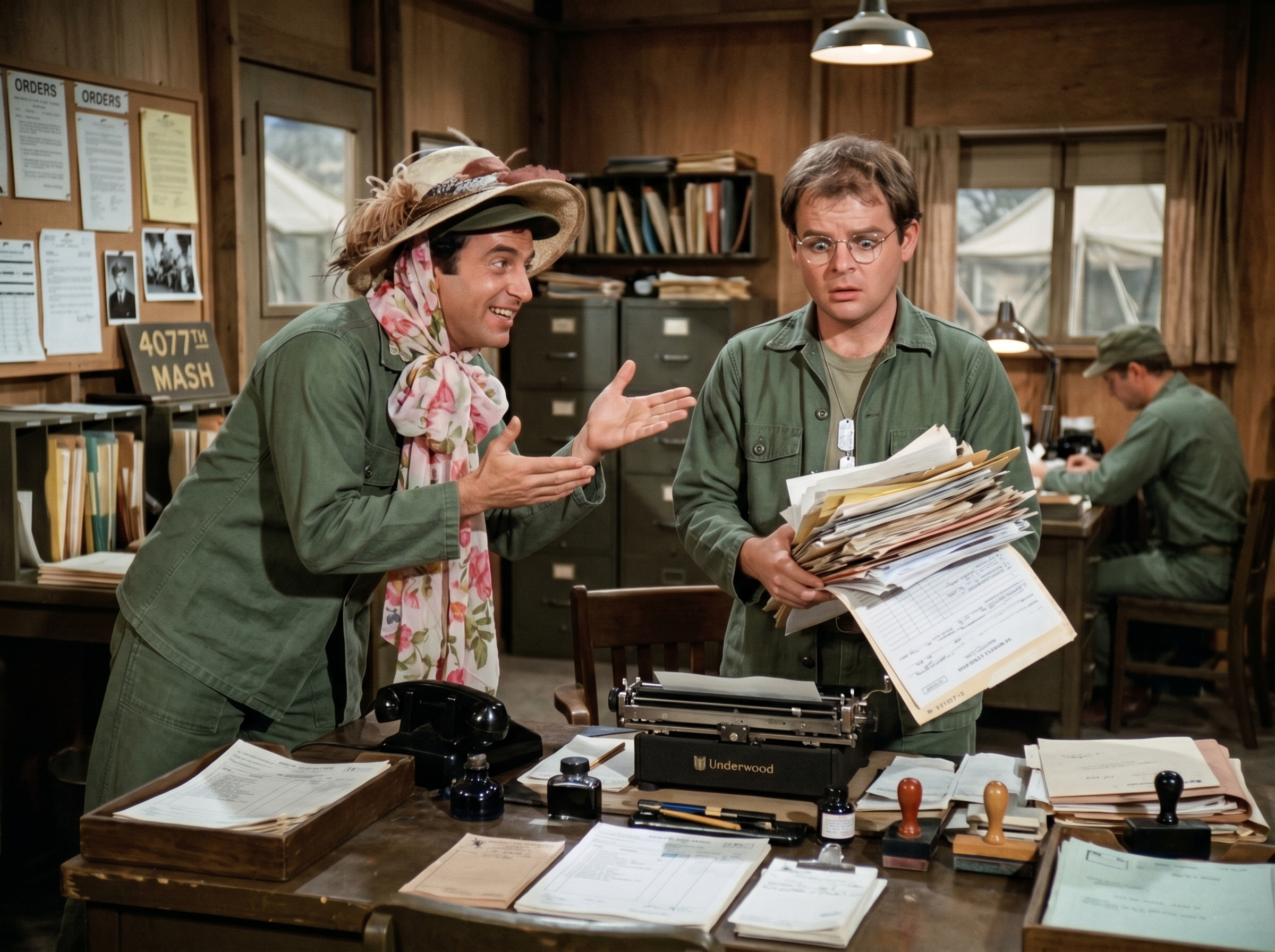
You knew it was going to be one of *those* days when the OR shift ended at 3 AM and the whole camp felt like it was sleepwalking through molasses by sunrise.
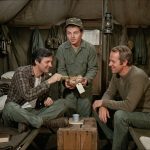
The Swamp smelled of exhaustion, cheap whiskey, and Iowa corn. Hawkeye Pierce and B.J. Hunnicutt were barely functional human beings, moving mostly on caffeine and the desperate hope of an incoming letter.
But down in the heart of the machine, the central nerve center where all the papers and problems eventually landed, things were far from sleepy. The *real* battle—the one involving ink, red tape, and the mysterious disappearance of three cases of canned peaches—was just heating up.
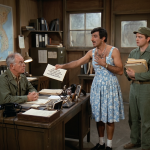
The 4077th Company Clerk’s office was a cramped universe of filing cabinets and typewriter ribbons, and right now, it was about three sizes too small for the tension radiating off Corporal Walter “Radar” O’Reilly.
Radar looked like he was about to burst. His round spectacles were slightly askew, and he was clutching a chaotic stack of papers that resembled a small, doomed paper tower. His knuckles were white.
A low buzz of worry (which Radar always felt first, like a weather system) was starting in his stomach. The stack was the monthly medical supply inventory, and it was… incomplete.
Three different clerks from three different shifts (and one very ambitious supply sergeant from the 8063rd) had all input conflicting data. Radar was left holding the messy bag.
He stood behind the cluttered main desk, looking wildly at the sheets of paper that seemed to be actively trying to escape his grasp. The Underwood typewriter stared at him, its keys ready to punch out the bad news. In the background, past the dusty window, the distant tents were still.
Then, the door to the office flew open, and a blur of olive drab and startlingly colorful fabric breezed in.
Corporal Maxwell Q. Klinger arrived with his usual dramatic flair. He didn’t just enter a room; he invaded it. Today, Klinger was presenting a look that he must have believed was the height of 1950s casual elegance, though “MESS HALL COUTURE” would have been more accurate.
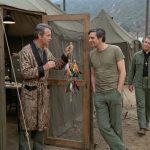
He wore his standard fatigues, but accessorized with a wide-brimmed straw sun hat adorned with fluffy brown feathers. Around his neck was a long, incredibly sheer scarf covered in bright, oversized pink flowers. It was the color of peacetime, and it looked absurd against the drab canvas and dust of Korea.
Klinger’s face was animated, beaming with an idea that had undoubtedly just struck him as sheer genius. He approached the desk with open arms, a salesman of hopeless hopes.
“Radar! My little friend from the farm! My Iowan saviour!” Klinger began, his voice a theatrical whisper. He made a grand gesture, sweeping his hand towards Radar’s precarious stack of paperwork.
Radar blinked, his face a mask of escalating panic. “Klinger, please. Not now. I’ve got an inventory crisis. A peach-shaped hole in the supply chain.”
“Exactly!” Klinger snapped, as if they were in perfect agreement. “Peaches. Morale. My *dress*! Listen to this…”
Klinger launched into an elaborate pitch. He had designed a new dress. Not just any dress, mind you. A dress designed specifically to emphasize his “delicate constitution.” He believed that if he could just get his hands on some specific fabric (of which he *coincidentally* knew a local merchant) and perhaps a small supply-clerk signing-off signature…
“If I wear *this* specific dress to the next Inspection,” Klinger declared, gesturing vaguely at his floral scarf, “Col. Potter will see I am clearly a conscientious objector of the highest aesthetic order. I’ll get my Section 8 by sundown. I just need you to approve one tiny requisition form…”
Radar squeezed his stack tighter. “Klinger, there is a missing case of peaches. And Col. Potter is expecting this *yesterday*. I can’t requisition fabric for dresses! I’m going under here!”
As Klinger started to elaborate on the *importance* of the fabric (it was essential for the structure of the collar, you see), and Radar’s face contorted into a grimace of pure, terrified distress, the office door swung open once more.
Both men froze. Standing there, still in his surgical greens and looking as if he hadn’t slept since the truce talks began, was Colonel Sherman T. Potter.
He paused just inside the doorway, took in the scene—the chaotic papers, the manic Klinger in his sun hat and pink scarf, and Radar, looking like he was about to collapse.
Colonel Potter fixed Klinger with a look that could melt artillery shells. “Klinger,” he said, his voice deceptively soft, “Explain that… thing… around your neck. And it better not involve anything I could have used in the war effort.”
Klinger’s theatrical hands froze in mid-air. The triumphant grin on his face faltered, then immediately reorganized itself into a desperate mask of innocent confusion.
He cleared his throat, a sound that cracked slightly. “This, sir? This, my dear Colonel, is not a garment. Oh, no. This is a crucial piece of morale-boosting equipment.”
Potter’s eyebrows ascended towards his receding hairline. “Morale, eh? Did the pink flowers inspire the surgeons in OR last night?”
Klinger nodded vigorously, causing the feathers on his hat to vibrate. “Precisely, sir! While my fellow GIs were saving lives, I was maintaining *aesthetic integrity*. Dr Pierce and Hunnicutt themselves commented on how it provided a ‘needed splash of humanity’ when they were working on Sergeant Murphy’s artery.”
Radar let out a small, high-pitched noise, like a wounded animal. “Sir, I’ve got the inventory mess and I’ve tried telling him…”
Potter raised a hand, silencing the clerk. He looked at Klinger, then at Radar’s papers. The silence stretched, the only sound the clatter of a typewriter from the neighboring desk where another soldier was trying to be invisible.
Finally, Potter exhaled a long, tired sigh, a sound that seemed to carry the weight of the entire war. “Klinger,” he said, his voice flat with fatigue but colored with that dry, Midwestern tolerance. “You are, and will remain, an enlisted man. And until I see an order signed by the President himself saying that pink floral scarves are approved field equipment, you will remove that thing. And the hat. It’s distracting the enemy. They’re laughing too hard to aim.”
Klinger’s shoulders slumped in dramatic defeat. “Yes, sir. As you wish, sir.” He sighed loudly, pulling the colorful scarf from his neck, carefully looping it over his arm. “The art world will just have to wait.”
He turned back to Radar, his expression shifting from crestfallen to quietly supportive. He looked at the massive, disorganized stack. “Looks like you’re in the soup, kid.”
Radar, still clutching the papers like a shield, nodded. “It’s a disaster. And I think the supply sergeant from the 8063rd has our canned peaches. I just can’t prove it.”
Klinger nodded, a thoughtful expression replacing the diva mask. He looked over the cluttered desk—the typewriter, the stack of stamps, the chaos. He reached into his pocket and pulled out a small, slightly dented tin of expensive sardines that a visiting nurse from Chicago had given him.
“Here,” Klinger whispered, sliding the tin across the desk toward Radar. “Brain food. It helps with the math. When I’m trying to plan my escape route from Toledo.”
He looked at Radar’s distressed expression, then at the pink scarf draped over his arm. With a small smile, he laid the scarf down gently on top of the precarious pile of papers. The bright fabric spilled over the edges, looking completely out of place amidst the serious paperwork.
“Sometimes,” Klinger said softly, “A little color is all we’ve got to keep the gray from winning. I’ll make you a deal. I’ll leave the scarf. It’s too pretty to hide. And when you get the peach situation figured out, maybe we can figure out a *legitimate* requisition for some decent coffee for this office. It’s starting to smell like a sock in here.”
He tipped his sun hat one last time and made his exit, no dramatic flourish this time, just a quiet solidarity.
Potter, who had been watching from the doorway, allowed himself a small, private smile. It was the smile of a father watching his difficult but good-hearted children find common ground.
He stepped fully into the office, the exhaustion still evident in his posture, but softened by the brief human exchange. He looked at the bizarre centerpiece of the desk: the pile of drab supply forms draped in a magnificent pink floral scarf, with a tin of sardines nestled near the inkwell.
Potter approached the desk and looked down at the documents, then at Radar. The young corporal, his face still pale from stress, finally relaxed his grip on the papers, letting them settle on the desk.
“Sir,” Radar whispered, gesturing to the scene. “I’m sorry it’s a mess. I’ll get it sorted.”
“Radar,” Col. Potter said, his voice now a steady, gentle rumble. “The papers are just papers. If we lose the peaches, the army will go on. If we lose *us*—if we forget that we are people and not just serial numbers on a form—then the other side wins. Regardless of what the generals say.”
He lightly touched the sheer pink fabric of the scarf that Klinger had left. “This camp can be a colorless, brutal place. A lot of gray, like Klinger said.” He met the clerk’s eyes. “Don’t you ever feel guilty about a little splash of pink. Not when it’s all we’ve got.”
He gestured to the pile. “Inventory looks awful. But the sardines are a good start. When you figure out that 8063rd supply sergeant did in fact take the peaches, I want you to draft a formal letter of complaint… and perhaps a personal request for some better quality stationery. For my correspondence with Mrs Potter. She despises this issue paper.”
Radar’s face finally broke into a small, relieved, tired grin. The knot of anxiety that always lived in his gut began to loosen. “Yes, sir. Right away, sir.”
Potter nodded, turning to go. He hesitated at the door, looking back one more time at the unlikely tableau on the desk—the symbol of the crushing, serious nature of the war, wrapped in the frivolous, colorful, hopeful reminder of home.
“And Radar,” Potter said softly, “Keep the tin of sardines. You always write better when you aren’t starving.”
He walked out, leaving Radar O’Reilly to the paperwork, the sardines, the Underwood typewriter, and the bright, useless, wonderful pink scarf. Radar looked at the object on top of the pile, touched it gently, then turned back to the Underwood, the first key of a new requisition form already in his mind.
It was just another day at the 4077th, where the line between chaos and humanity was often no wider than a sheer piece of floral fabric.
In a place built to count the cost of everything, they always found a way to value the things that didn’t make the list.