Directions for Home
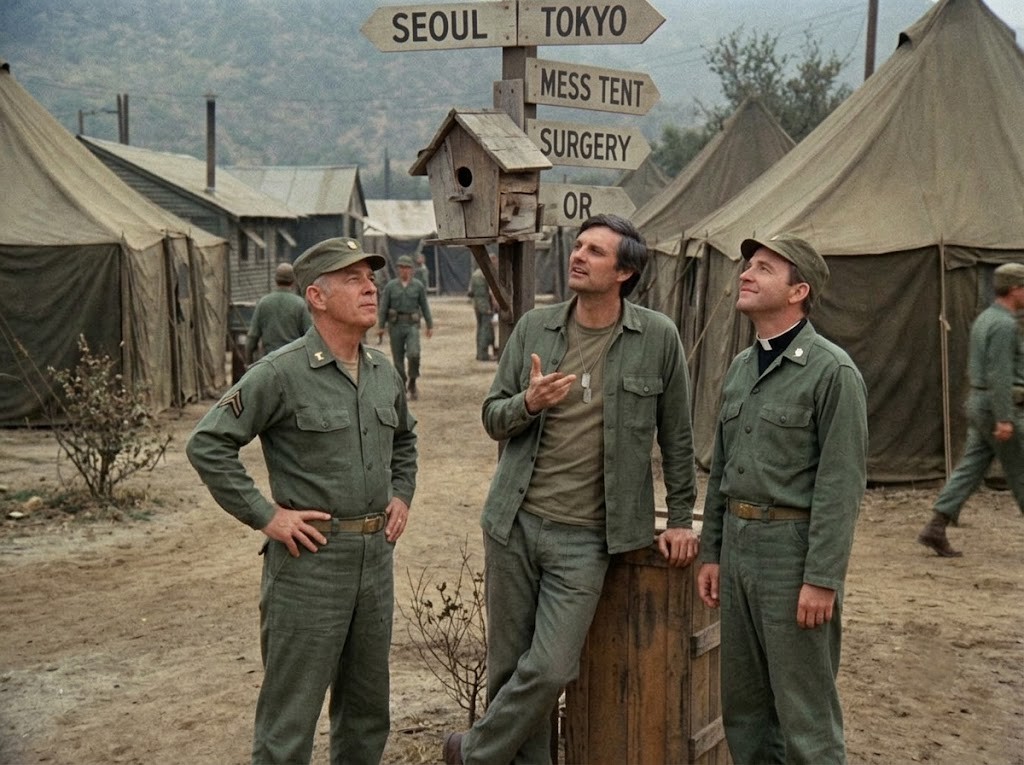
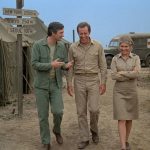
If these signs could talk, they’d tell you everything you need to know about this place. Where we’ve been, where we’re stuck, and where we desperately wish we were going.
Seoul. Tokyo. Mess Tent. Surgery. OR.
It’s just wood and paint, sure. A bunch of dusty arrows hammered onto a central post, looking as tired as we were.
But the story isn’t the signs themselves; it’s the simple wooden structure they’ve guarded for months.
You see that weathered little birdhouse? It looks like it belongs on a porch in Maine, not in the middle of a war zone.
Someone built that with painstaking care, probably in a rare moment of quiet. Radar, I think. Only he would remember that even the birds need a home out here.
For the longest time, though, it’s been empty. Just another small, vacant outpost in our camp.
Until today.
Suddenly, a pair of bright-eyed wrens were moving in.
Their frantic energy was impossible to ignore. They weren’t just visiting; they were building. Each tiny twig and dried blade of grass was a declaration of defiance.
It was more than enough to stop traffic.
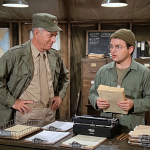
Or at least stop me, the Padre, and the Colonel from doing anything else for a solid five minutes.
We weren’t the only ones watching, of course.
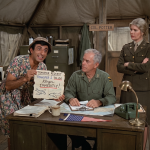
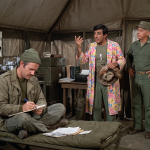
The 4077th might seem chaotic, but we notice everything. The nurses stopped by on their way to pre-op. Klinger paused, an orange chiffon scarf nearly slipping off his head, to whisper a prayer for the little homemakers. Winchester even grunted something that might have been a classic bird observation before remembering his dignity and walking away.
Even the wounded seemed to find a momentary reprieve in watching the feathered hustle.
For us, though, it felt personal. Like a small miracle we were chosen to witness.
A moment of pure, unexpected life.
Colonel Potter was the first to speak, breaking the comfortable silence.
He always could see the bigger picture, even when it was just a few scraps of wood and some hungry wrens.
“They know,” he said, his voice unusually soft, his fatherly hands resting firmly on his hips. “Animals know when the time is right.”
He took a slow drag from his cigar, looking up past the signs to the mountains.
I think he was remembering his own stable back in Missouri, the predictable rhythms of a quiet, peaceful life.
“The nesting instinct,” Father Mulcahy added, that gentle, moral smile lighting up his face.
He clasped his hands loosely, his clerical collar a stark reminder of his calling amidst the surrounding olive drab.
“It is a powerful thing, a desire for home, for family, for continuity. Even here. *Especially* here, isn’t it, Hawkeye?”
He looked over at me, expecting one of my patented cynical responses.
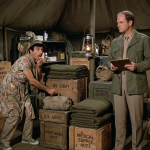
Instead, I was leaning against a wooden crate, hands in my pockets, trying to hide how much this little birdhouse was affecting me. My dog tags rattled slightly, a quiet metallic rhythm that matched my own restless thoughts.
A single wren, its beak full of soft feathers, landed right on the little perching peg. It took a tentative look around before disappearing into the tiny opening.
“You’re right, Padre,” I said, the typical quick-witted answer failing me.
I looked from the sign pointing to ‘Tokyo’ to the one pointing to ‘Seoul’ and finally back down at the little wren.
“They have it so easy. The birdhouse is right here. Home is just… five miles up, and then a hard right onto Elm Street. They don’t need a transfer. They don’t need a discharge. They just… move in.”
For a second, the dry wit I always use as a shield didn’t feel necessary.
There was just something profound about seeing that tiny, perfect life being planned, with absolute certainty, right next to our chaotic, temporary reality.
“I’ve had a dozen different requests to be moved in this camp,” Klinger chimed in, having stopped nearby, his latest fashion statement catching the dusty light. “But I can’t say I’ve ever requested a move into a birdhouse. Though at this rate, it might be the only way out.”
A few nearby soldiers cracked a smile. Even Margaret, walking past with a stack of patient files, let out a small, tired laugh.
Father Mulcahy just gave Klinger a sympathetic nod.
“They do seem content, don’t they?” he said. “Making a home with whatever they can find. Twigs, mud, a bit of lint from a uniform… it’s beautiful, really.”
For all of us, standing there, the dusty camp and the distant rumble of artillery felt just a little further away.
The little birdhouse wasn’t just a prop in our daily drama. It was a visible hope, a reminder that something other than war and surgery existed.
The wrens didn’t care about our politics or our strategies. They didn’t know about ‘Seoul’ or ‘Tokyo.’ They were just focused on building a safe place for their family.
And in that moment, all we wanted, more than any R&R or transfer order, was for that tiny nest to be complete.
Because maybe, just maybe, if that could happen here, it meant something for us, too. That we weren’t just stuck here, but that our own ‘nest’ was waiting, just a few signs away.
The Padre eventually excused himself for services. Potter went back to his office. Klinger returned to his latest letter to his mother.
I stayed a moment longer, watching the last bits of daylight catch the sign for the OR, then the birdhouse, and finally, my own hand.
It was just another typical, human day at the 4077th, where a few birds and a little wooden box could remind us what really matters.
Because home is always worth the directions.