A Flash of Color in the Khaki
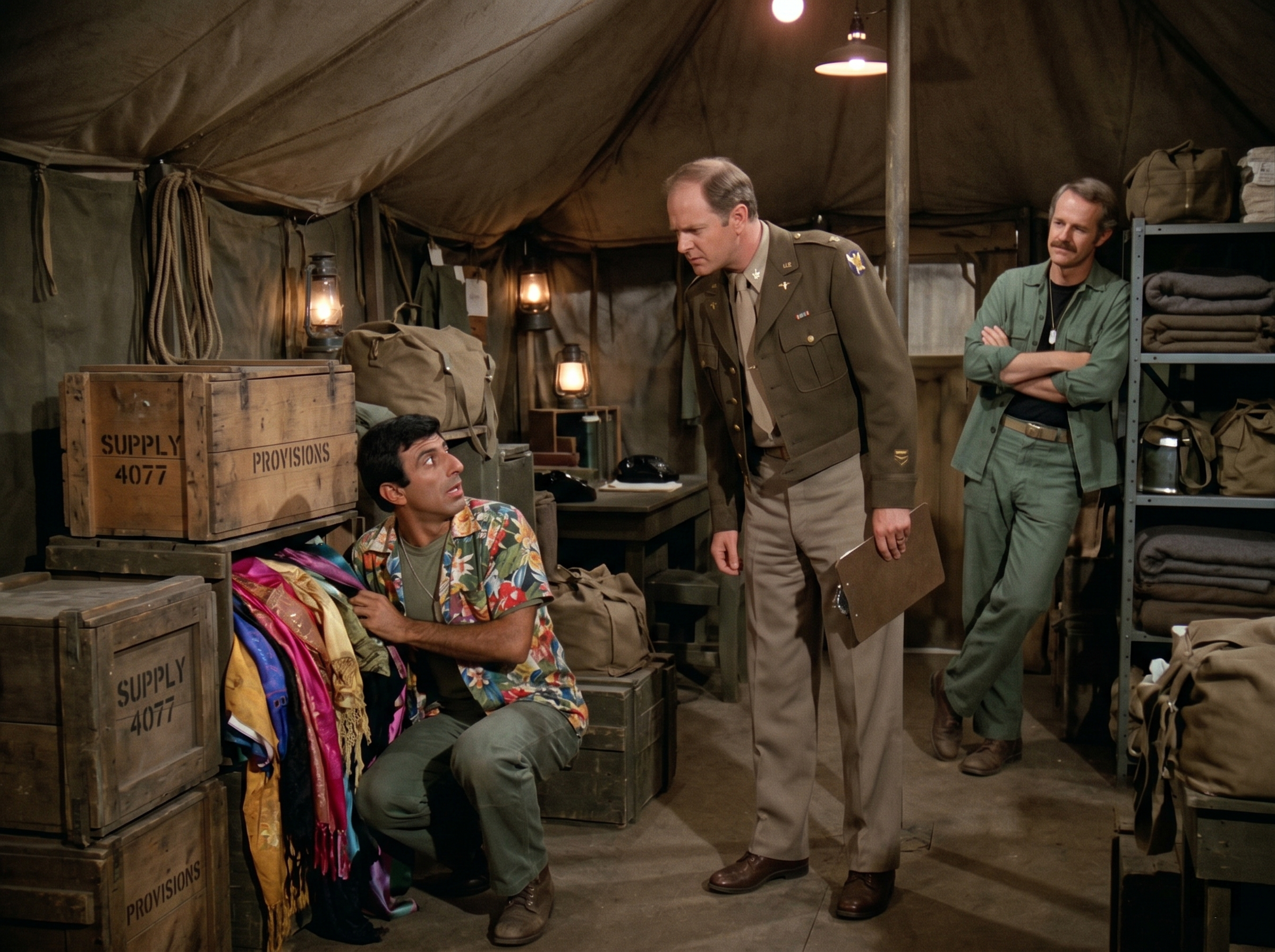
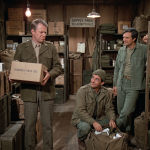
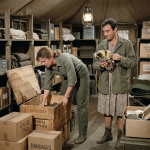
The 4077th supply tent was a monument to the endless, suffocating beige of the Korean War. It was a purely practical space, a canvas cave smelling permanently of mildew, old rope, and the sharp scent of mothballs. Wooden crates stamped with bold black letters reading “SUPPLY 4077” and “PROVISIONS” were stacked high, resembling the clumsy building blocks of a very depressed child.
Heavy canvas duffel bags sat slumped in the corners, and rows of neatly folded, scratchy wool blankets rested heavily on the metal shelves. The entire area was bathed in a slightly dim, warm glow from a single practical camp light hanging from the center pole and a few scattered kerosene lanterns. It was a room designed entirely for utility, leaving absolutely no space for beauty or surprise.
Captain B.J. Hunnicutt was currently using this dreary sanctuary exactly as intended: to hide out. He was leaning casually against a metal shelf in the background, his arms crossed over his chest, his posture completely relaxed. He wore his standard green fatigues over a dark undershirt, his boots dusty from the compound. B.J. had retreated here to escape the chaotic noise of the Swamp and the questionable aroma of the mess tent’s daily mystery meat. He was simply watching, a quiet observer to the theater of the 4077th, radiating an easygoing, quiet empathy.
The primary actor in today’s matinee was Corporal Maxwell Klinger. But Klinger was not currently engaged in his usual flamboyant theatrics or wearing one of his famous dresses. Instead, he was hunched low near a large wooden crate, trying to make himself as small as possible. He wore his standard green trousers and undershirt, but over it, an unbuttoned, loudly colorful floral Hawaiian shirt hung loose—a defiant splash of tropical vacation in the middle of a war zone.
Klinger was digging into a hidden gap between the supply boxes. B.J. watched with mild curiosity as the corporal carefully pulled out a concealed bundle. Suddenly, the dull, dusty air of the tent was broken by a shocking cascade of vibrant fabric. It was silk. Brilliant, shimmering hues of royal purple, bright magenta, and spun gold tumbled over Klinger’s hands. For a fleeting second, Klinger looked at the fabric with a profound, almost comic pride.
Then, the heavy canvas flap of the tent was thrown back.
Major Charles Emerson Winchester III stepped into the dim light. He was dressed meticulously, as always, in a pristine, olive-drab officer’s jacket with a perfectly knotted tie, looking entirely out of place in the dusty supply depot. He held a wooden clipboard tightly in one hand. Charles was clearly on a self-appointed mission of inventory, hunting down some minor logistical error that had offended his Bostonian sense of order.
Charles stopped dead in his tracks. His sharp blue eyes immediately locked onto Klinger. He leaned in slightly, closing the distance between them, his face a perfect portrait of restrained irritation and dry sarcasm.
“Corporal,” Charles practically purred, his voice heavy with upper-crust disdain. “Would you be so kind as to explain why the United States Army’s medical supply depot is currently harboring the remnants of a traveling burlesque show?”
Klinger reacted with sudden, unfiltered panic. He practically fell backward, instinctively clutching the colorful silks to his chest as if shielding them from enemy fire. “Major! It’s—it’s not what it looks like!”
“It never is with you, Klinger,” Charles replied, taking another step forward and towering over the crouching clerk. He tapped his pen against the clipboard, the sharp sound echoing in the quiet tent. “I am attempting to conduct a serious audit of our provisions, and instead, I find you hoarding unauthorized, kaleidoscopic contraband.”
B.J. remained perfectly still in the background, a faint, wry smile touching his lips. He knew Klinger’s routines better than anyone. He expected the corporal to launch into a wild story about a fictional uncle in the textile business, or perhaps claim the silks were essential religious garments for a newly invented faith.
But Klinger didn’t do any of that. The comic panic on his face melted away, replaced by something entirely different. Real desperation.
Klinger didn’t stand up to salute. He didn’t offer a joke. He just pulled the fabric tighter against his Hawaiian shirt, his knuckles turning white. “Major, please,” Klinger said, his voice dropping its usual theatrical pitch, sounding suddenly very small and very tired. “You can’t confiscate this. You just can’t take it away.”
Charles stiffened, surprised by the sudden lack of a punchline. He raised his clipboard, his pen poised firmly over the paper, ready to write the official infraction that could cost Klinger dearly. The dim, warm light of the lantern suddenly felt harsh and interrogative. The silence in the tent stretched out, heavy, fragile, and waiting to break.
“I assure you, Corporal, I possess both the authority and the inclination to do exactly that,” Charles said, his voice dropping into a colder, more dangerous register. “This is a mobile army surgical hospital, not a black-market bazaar. I am officially requisitioning this material.”
B.J. finally uncrossed his arms. He pushed himself off the metal shelf, his boots scuffing softly against the dirt floor. “Take it easy, Charles,” B.J. said gently, stepping into the pool of lantern light. “Let the man speak.”
Charles shot a sideways glare at B.J. “This does not concern you, Hunnicutt. Military regulations do not magically evaporate simply because you harbor a sentimental weakness for this man’s endless parade of lunacy.”
“It’s not for a Section Eight scheme, Major,” Klinger interrupted. He slowly stood up, letting the brilliant, shimmering silks drape over his arms. Against the backdrop of the rough, stenciled “PROVISIONS” crates and the worn canvas bags, the fabric looked almost violently beautiful.
Charles sighed heavily, pinching the bridge of his nose. “Enlighten me, then. To what grand military purpose does this garish yardage serve?”
Klinger swallowed hard. He looked down at the bright purple and gold material. “I traded for it. Two months of my cigar rations, three pristine issues of Stars and Stripes, and a tin of real coffee I’ve been saving since Christmas.”
“You bartered away your personal comforts for this… this inferior rayon?” Charles asked, genuinely perplexed. “For what earthly reason?”
“For the orphanage in Uijeongbu,” Klinger said softly.
The tent went dead silent. Even the distant, ever-present rumble of the camp generators seemed to fade away.
Klinger looked up, his dark eyes earnest and pleading. “Father Mulcahy told me the roof leaked during the last storm. A lot of the kids’ stuff got ruined. The army issued them those same scratchy wool blankets we have.”
Klinger gestured to the shelves behind B.J. “Have you ever felt those things, Major? They feel like they’re woven out of barbed wire and punishment. The little ones, they cry because it scratches their skin so bad.”
Charles remained frozen, his pen hovering above his clipboard.
“I found a tailor in Seoul,” Klinger continued, his voice picking up a desperate momentum. “He said if I brought him enough silk, he could line the inside of the wool blankets. Make them soft. Make them warm. And I figured… I figured with these colors, maybe when those kids go to sleep, they won’t just see the mud and the khaki. They’d have something pretty. Something that doesn’t look like the war.”
B.J. slipped his hands into his pockets. He looked at Klinger, his heart aching with that familiar, bittersweet affection he felt for everyone in this godforsaken camp. Beneath the dresses, the scams, and the loud shirts, Klinger possessed a humanity that the army simply couldn’t crush.
Charles stared at the corporal. The pompous, rigid posture of the Boston aristocrat seemed to falter, just for a fraction of a second. The deep, often heavily guarded compassion within Winchester was warring openly with his ingrained sense of protocol.
Slowly, deliberately, Charles reached out. He took a corner of the bright magenta fabric between his thumb and forefinger. He rubbed the material, his eyes analyzing it with practiced snobbery.
“Just as I suspected,” Charles said, his voice returning to its usual aristocratic drawl, though the biting edge was entirely gone. “The thread count is absolutely abysmal. The dye is clearly unstable and will likely run at the first sign of moisture.”
Klinger’s shoulders slumped. “It was the best I could afford, Major.”
Charles released the fabric. He smoothed the lapels of his immaculate jacket, adjusted his tie, and looked directly into Klinger’s eyes.
“Which is precisely why,” Charles declared, raising his chin, “this material holds absolutely zero value to the United States military. As the acting supply officer for this sector, I cannot in good conscience classify such utterly worthless rags as contraband. It would be an insult to the inventory ledger.”
Klinger blinked, his brain taking a moment to catch up to the major’s double-speak. A slow, tentative smile broke across his face. “You mean…?”
“I mean,” Charles interrupted smoothly, clicking his pen closed and sliding it into his breast pocket, “that I have found nothing out of the ordinary in this tent. The supplies are perfectly in order.”
B.J. let out a quiet, huffing laugh, shaking his head with fond amusement.
Charles turned on his heel to leave, but before he reached the tent flap, he paused. Without turning around, he reached into his trouser pocket and pulled out a small, crisp stack of military payment certificates. He tossed them backward over his shoulder. The colorful paper scrip fluttered down onto the wooden crate next to Klinger.
“If one is going to commission custom tailoring, Corporal,” Charles said over his shoulder, his tone incredibly dry, “one should at least ensure the seamstress uses proper thread. See that they do.”
With that, Charles swept out of the tent, the canvas flap falling shut behind him, leaving the supply room to its dim, warm light.
Klinger stared at the money on the crate, completely stunned. He looked over at B.J., his eyes wide. “Did… did Major Winchester just…”
“Yeah, Klinger,” B.J. said softly, pushing himself away from the shelves and walking over. “He just did.”
B.J. reached out and helped Klinger gather the sprawling yards of bright, hopeful silk. They folded the brilliant colors together, working in a comfortable, unspoken rhythm amidst the dull, dusty beige of the supply tent. For a few quiet minutes, shielded from the reality of the 4077th, the war felt a million miles away.
In a place built for mending bodies, sometimes the greatest medicine was just a small, stubborn piece of heart.