The Boy From Ottumwa
In a place where the worst news imaginable usually arrives by helicopter, descending from the sky with a deafening roar, it was a strange cruelty that the most painful blows often arrived in a quiet paper envelope.
Mail call at the 4077th was a sacred, fragile hour. It was a lifeline thrown across the Pacific, a brief window into a world that didn’t smell of antiseptic, canvas, and dust.
But sometimes, looking through that window only made the distance feel wider.
It was mid-afternoon in the Post-Op Ward. The canvas walls breathed slightly in the warm Korean wind. The lanterns were unlit, relying on the muted daylight filtering through the tent flaps.
Most of the recovering patients were asleep, their breathing a steady, quiet rhythm against the distant, ambient hum of the camp.
Corporal Walter “Radar” O’Reilly had slipped into Post-Op to deliver a stack of updated charts. He usually rushed through his duties, always two steps ahead of whatever Colonel Potter or the doctors needed.
But right now, Radar was completely frozen.
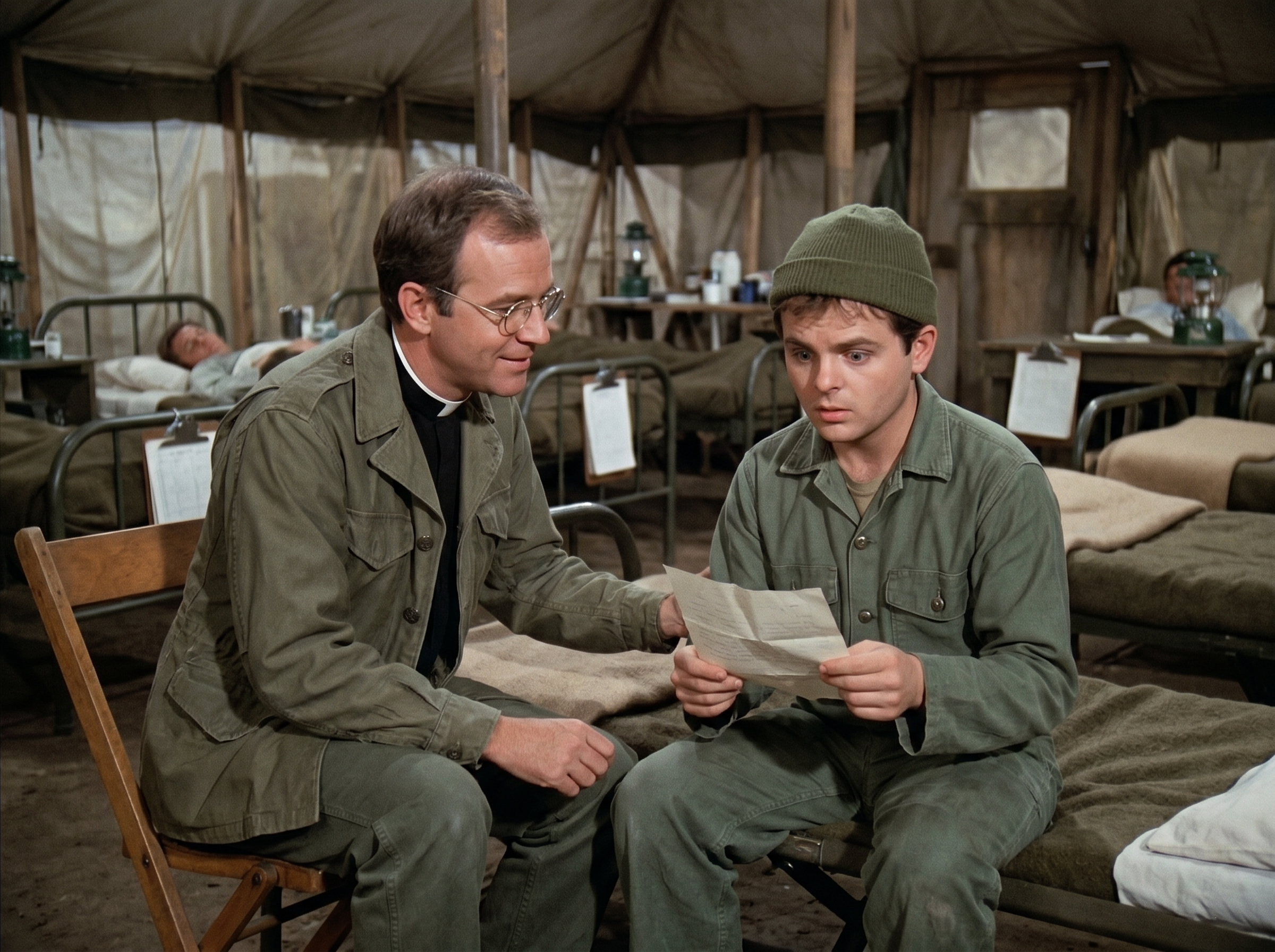
He sat on the edge of an empty cot, his green knit beanie pulled down close to his brow. His shoulders were slumped, and his hands were gripping a single, crumpled sheet of paper.
He was staring at the handwritten words with wide-eyed, unblinking concern. He looked like a small child who had just realized he was lost in a very dark woods.
Father John Mulcahy had been quietly making his rounds. He had just finished reading a psalm to a sleeping private with a bandaged shoulder when he turned and saw the company clerk.
The chaplain recognized that specific kind of silence immediately. It was the heavy, suffocating silence of a young man carrying something he didn’t know how to put down.
Mulcahy quietly pulled up a wooden folding chair and sat beside the cot. He wore his faded green fatigue jacket over his black clerical shirt, his white collar peeking out as a quiet reminder of his purpose.
He leaned in closely, resting his arms on his legs. He didn’t speak right away. He simply offered his presence, his expression settling into a soft, deeply compassionate smile.
“Mail from home, Walter?” Mulcahy asked. His voice was a gentle murmur, careful not to wake the sleeping soldiers around them.
Radar blinked, startled, as if he had forgotten where he was. He swallowed hard, his Adam’s apple bobbing nervously. “Uh… yes, Father. Just came in on the supply truck.”
“Is everything alright on the farm?” Mulcahy asked softly. In a war zone, a letter could hold anything from a broken heart to a tragic passing. Mulcahy braced himself, ready to offer whatever comfort the boy needed.
Radar didn’t look up. His eyes remained locked on the looping handwriting. His hands trembled just a fraction of an inch.
“It’s my mom, Father,” Radar whispered, his voice cracking slightly in the quiet tent. “She… she thinks I’m disappearing.”
Father Mulcahy’s warm smile faltered just slightly, replaced by a look of deep, pastoral focus. He adjusted his wire-rimmed glasses, leaning in just a fraction closer.
“Disappearing?” Mulcahy asked gently. “I’m not sure I understand, Walter. Is she having trouble getting your letters?”
Radar slowly shook his head. He finally tore his eyes away from the paper and looked at the chaplain. The earnest, naked vulnerability on the young clerk’s face was enough to break a man’s heart.
“No, sir. I write to her twice a week. And I send her a portion of my pay, and I sent her that silk kimono I traded a jeep tire for,” Radar explained, his voice tight.
“Then what does she mean, son?”
Radar took a deep breath, looking back down at the letter. “I sent her a photograph last month. Just a picture Klinger took of me standing by the mess tent. I wanted her to see that I was eating okay and keeping my boots clean.”
He smoothed the crumpled edge of the paper with his thumb.
“But she says… she says she put the picture on the mantelpiece next to my high school graduation photo. And she spent all evening looking at it.” Radar paused, his voice dropping to a harsh whisper. “She says my eyes look different, Father. She says I look like an old man wearing her little boy’s clothes. She wanted to know where her son went.”
A heavy, aching silence settled between them in the Post-Op tent. The only sound was the soft snoring of a wounded corporal two beds away.
Radar looked up again, and Mulcahy could see the unshed tears pooling in the boy’s wide eyes.
“Father… what if she’s right?” Radar asked, his voice shaking. “I try so hard not to let this place get to me. I drink my Grape Nehi. I read my comic books. I sleep with my teddy bear. I try to be the exact same guy who got on that bus in Ottumwa.”
Radar gestured helplessly around the ward, toward the rows of beds, the clipboards, the white blankets hiding terrible wounds.
“But then I stand in the OR and I watch Hawkeye and B.J. put a nineteen-year-old kid back together. And I hear the choppers coming in the middle of the night. And I know how to order plasma, and bone wax, and toe tags. You aren’t supposed to know about those things in Ottumwa.”
Radar looked down at his boots. “I feel like the Walter O’Reilly she knows is slipping away, and I don’t know how to stop it. What if I go home, and I don’t fit in my own life anymore?”
Father Mulcahy listened quietly, his heart aching for the boy. He had heard variations of this confession from colonels, from surgeons, from hardened infantrymen. But hearing it from Radar—the beating, innocent heart of the 4077th—felt especially cruel.
Mulcahy reached out and gently placed his hand over Radar’s trembling fingers, resting on the letter. The chaplain’s touch was warm and incredibly grounding.
“Walter, look at me,” Mulcahy said softly.
Radar slowly raised his head.
Mulcahy smiled, a genuine, luminous expression of pure kindness. “You are not disappearing. You are just growing. And growth, especially in a place like this, is a very painful thing to endure.”
Radar sniffled quietly. “But I’m changing.”
“Of course you are changing,” Mulcahy agreed softly. “It would be a tragedy if you didn’t. The things you have seen, the burdens you have helped carry… they leave a mark. But those marks don’t erase the boy you were. They just make the man you are becoming much stronger.”
Mulcahy gestured toward the sleeping patients.
“Your mother sees a shadow in your eyes because you have stood very close to the darkness, Walter. But you haven’t let it consume you. You still care for the stray animals. You still look out for the doctors. You still keep this entire hospital running on sheer willpower and a good heart. That takes a profound kind of strength.”
The panicked tension slowly began to drain from Radar’s shoulders. He looked at the chaplain, hanging onto every quiet word.
“You aren’t losing yourself, Walter,” Mulcahy promised, his voice steady and absolute. “The boy who left Iowa was a good boy. But the man who returns to that farm? He is going to be a remarkable man. And when your mother looks at you in person, she won’t just see the war. She will see the incredible kindness it took to survive it.”
Radar stared at Mulcahy for a long moment. The profound fear that had gripped him since reading the letter finally began to loosen its hold. He let out a long, shaky breath, wiping a smudge of dirt from his cheek.
“You really think so, Father?”
“I know so, Walter,” Mulcahy said, giving the boy’s hand a reassuring squeeze before leaning back in his wooden chair. “I have it on very good authority.”
A small, genuine smile finally crept onto Radar’s face. He looked down at the letter in his lap, the words no longer looking quite so terrifying.
“I guess… I guess I can’t expect everything to stay exactly the same,” Radar murmured. He flipped to the second page of the letter, his eyes scanning the remaining paragraphs.
The tense atmosphere in the tent evaporated, replaced by the familiar, comfortable exhaustion of the mobile hospital.
Radar suddenly frowned, his brow furrowing as he read the back of the page.
“Oh, for crying out loud,” Radar muttered.
Mulcahy raised an eyebrow. “Is there more news?”
“Yeah,” Radar sighed, shaking his head. “Mom says Uncle Ed tried to fix the tractor with a coat hanger and a stick of dynamite. Now Mrs. O’Malley’s prize-winning rooster is stuck on the roof of the Methodist church and refuses to come down.”
Father Mulcahy couldn’t help it; a soft, delighted chuckle escaped him, echoing quietly in the canvas ward.
Radar looked at the chaplain, a wry, tired smile returning to his young face. “I guess some things in Ottumwa never change, Father.”
“And thank heavens for that, Walter,” Mulcahy smiled, resting his hands on his knees. “Thank heavens for that.”
Sometimes, the greatest medicine dispensed at the 4077th didn’t come from a bottle, but from a quiet moment of grace between two friends in the fading afternoon light.