The Weight of the Spoon and the Dress in the Mess Tent
Some days in Korea don’t end when the sun goes down; they just bleed into the next morning, carrying the same mud, the same exhaustion, and the same lukewarm coffee.
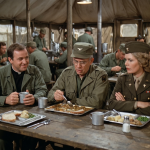
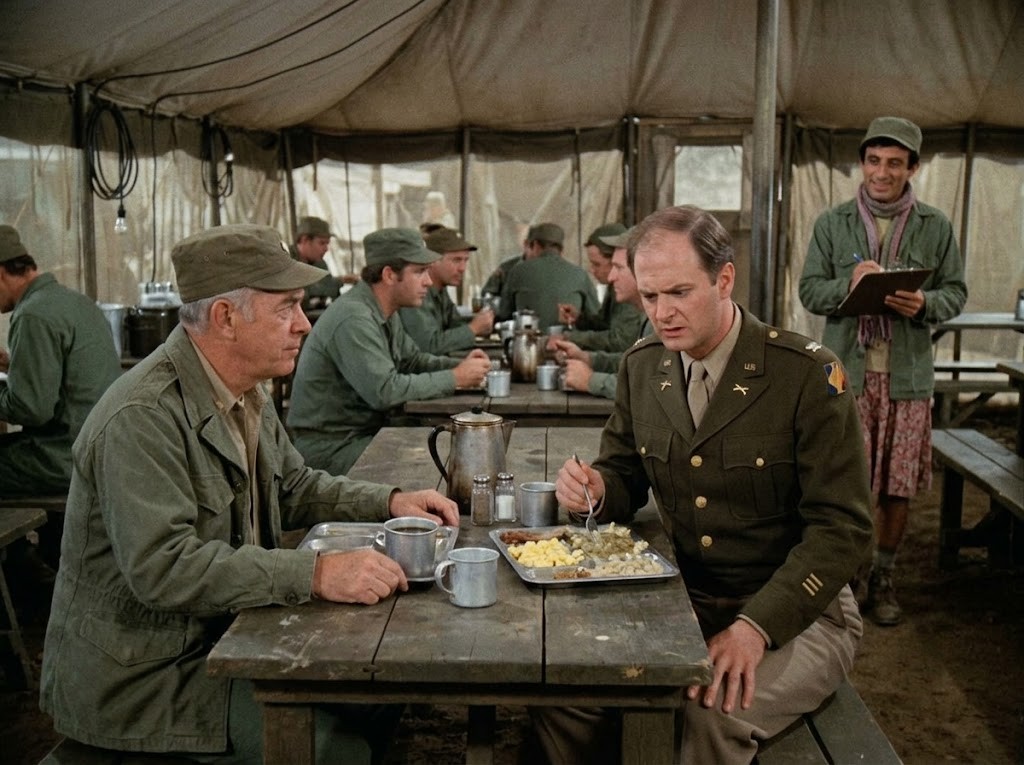
The Mess Tent of the 4077th was uncharacteristically quiet, save for the scraping of metal forks against tin trays and the distant, low drone of a generator that desperately needed oil.
We had been in the OR for fourteen straight hours, a non-stop parade of broken boys who looked far too much like our own brothers, sons, or nephews back home.
Colonel Potter sat at the end of the long wooden picnic table, his cap pulled low over his eyes, his weathered hands wrapped around a dented tin mug of black coffee as if it were the only anchor keeping him grounded.
Across from him sat Charles Emerson Winchester III, looking utterly out of place in his crisp dress uniform, staring down at his tray with an expression that hovered somewhere between profound disgust and deep, existential despair.
“If this is supposed to be creamed corn, Colonel,” Charles muttered, his voice carrying that familiar, haughty Boston cadence, though it lacked its usual booming authority, “I can assure you the cow died in vain, and the corn was harvested under a dark omen.”
Potter didn’t look up, merely taking a slow sip of his mud-colored brew. “Eat it, Charles. It’s got calories. Calories keep your hands steady, and steady hands keep kids alive.”
“I am a surgeon, not a garbage disposal,” Charles snapped weakly, poking a fork into the gray-green pile of unidentifiable vegetables next to the yellow clump of cold eggs.
He lifted a spoonful of the mush, staring at it intensely, his brow furrowed, his eyes glassy with a fatigue he refused to admit aloud.
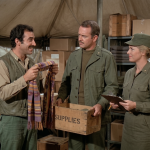
Behind them, leaning against a post with a clipboard in hand, was Klinger, wearing a floral-print skirt and a heavy wool scarf wrapped around his neck, looking on with a mixture of amusement and genuine concern.
Charles raised the spoon higher, his hand trembling just a fraction—a rare, terrifying sight for a man who prided himself on absolute surgical perfection.
“I cannot do it,” Charles whispered, his voice suddenly cracking, the arrogance completely vanishing to reveal a raw, frightened human being beneath the starch. “I simply cannot put this into my body, nor can I face another hour in that room.”
The silence that followed was heavy, the kind that settles over men who have seen too much and said too little.
Potter finally looked up, his sharp, fatherly eyes locking onto the aristocratic surgeon, seeing right through the Boston armor to the breaking heart underneath.
“Nobody’s asking you to love it, Winchester,” Potter said softly, his voice dropping the commanding edge and adopting the gentle tone of a father who had seen three wars’ worth of tired boys. “We’re just asking you to survive it.”
From the back of the tent, Klinger stepped forward, the floral skirt rustling softly against the dirt floor as he tapped his pencil against the clipboard.
“You know, Major,” Klinger said, a wry, comforting smile breaking through his tired face, “if it makes you feel any better, I hear the chef prepared this specifically with the Boston elite in mind. He called it *’Le Purée de Despair’*.”
A faint, breathless chuckle escaped Potter’s lips, and even Charles’s shoulders dropped an inch, the tension in his jaw loosening just a bit.
“Your attempts at levity, Klinger, are as dreadful as your sense of fashion,” Charles muttered, though he didn’t lower the spoon.
“Hey, this skirt is a classic, Major,” Klinger replied, adjusting his scarf with a theatrical flourish that brought a flicker of light into the drab, canvas tent. “And frankly, it’s the only thing keeping my morale from hitting the floor.”
Charles looked from Klinger’s ridiculous outfit back to Potter’s steady, unblinking gaze, realizing that this—this absurd, beautiful, broken family—was all he had out here in the middle of nowhere.
He slowly lowered the spoon back to the tray, took a deep breath, and picked up a piece of dry toast instead, taking a small, deliberate bite.
Potter gave a single, approving nod, sliding his own untouched canteen of fresh water across the rough wood toward Charles.
Outside, the faint sound of incoming choppers began to thump against the sky, a cruel reminder that their brief respite was already coming to an end.
But for that one quiet moment in the mess tent, surrounded by cold eggs, a man in a dress, and a colonel who refused to let his people drift away, the 4077th held the line against the darkness.
In a place where everything was broken, it was the small, ridiculous moments of shared humanity that kept us whole.