A Safe Place to Land at the 4077th
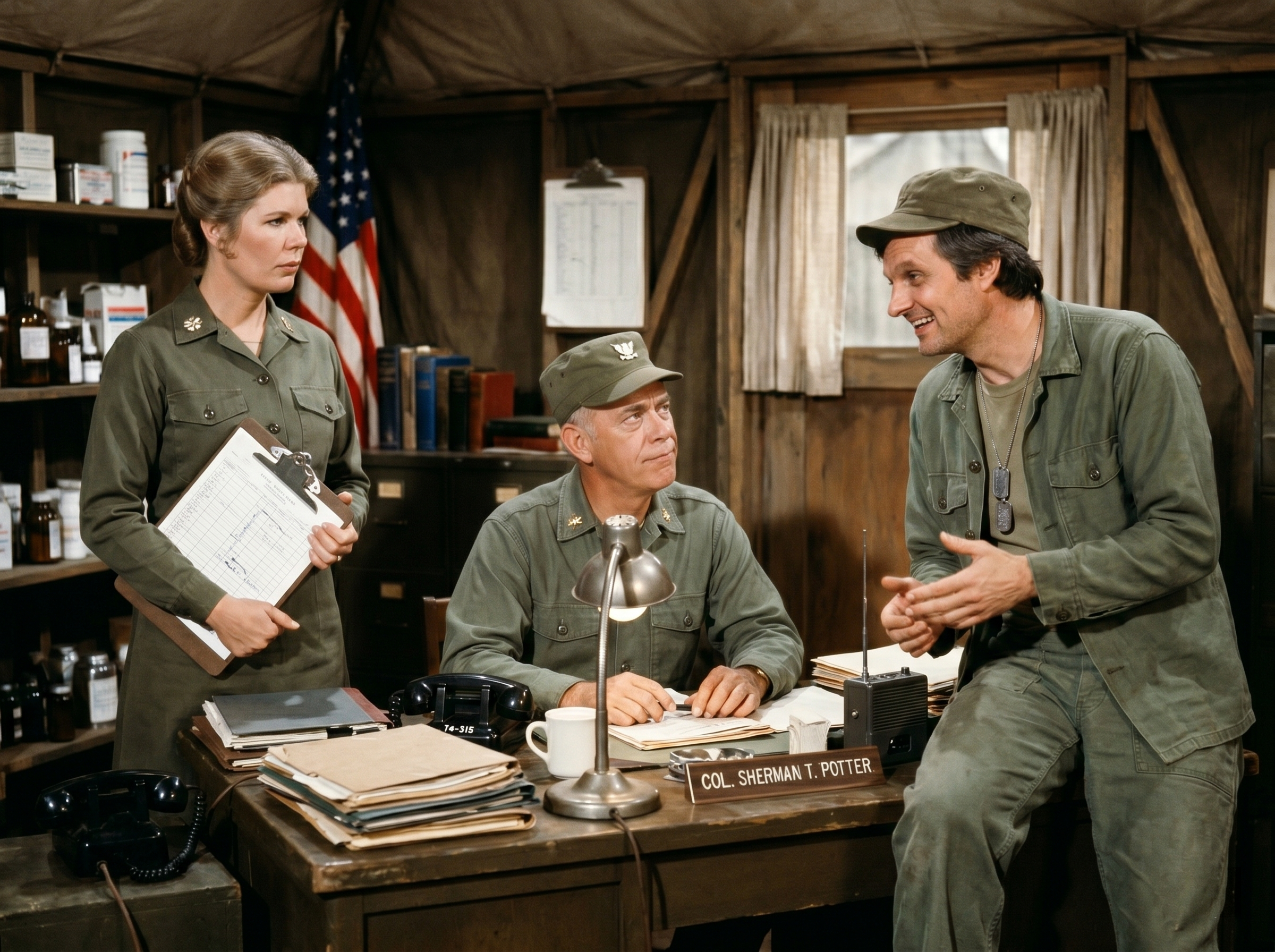
The war was currently taking a coffee break, which at the 4077th Mobile Army Surgical Hospital meant the madness had to come from inside the camp.
Dust settled lazily in the late afternoon shafts of light that pierced the window of Colonel Sherman T. Potter’s office.
It was a quiet Tuesday, a rare anomaly that usually left the medical staff feeling more anxious than relieved.
The distant rumble of artillery had faded into a nervous silence, leaving the camp to bake in the Korean sun.
Inside the office, the atmosphere was a mix of practical military administration and exhausted domesticity.
Behind his sturdy wooden desk, Colonel Potter was attempting to make sense of a towering stack of supply requisition forms.
He held his pen with the grim determination of a cavalryman trying to defuse an unexploded shell.
The soft, warm glow of the practical desk lamp illuminated the faded paper and the rich, worn brown wood of his desk.
Major Margaret Houlihan stood at attention to his left, crisp, professional, and composed in her olive drab fatigues.
She clutched a medical chart against her chest like a shield, ready to deliver the afternoon nursing report with absolute military precision.
But military precision was currently being hijacked by the swamp’s most notorious resident.
Captain Benjamin Franklin Pierce was draped comfortably over the right corner of the Colonel’s desk.
Hawkeye was leaning in, his hands gesturing wildly as he spun his latest web of nonsense.
His silver dog tags dangled from his neck, catching the light as he shifted his weight.
He was wearing a grin so bright, clever, and mischievous that it could only be hiding profound, bone-deep exhaustion.
“I’m telling you, Colonel,” Hawkeye pleaded, his voice laced with theatrical desperation.
“The powdered eggs are organizing. I heard them whispering in the mess tent this morning.”
“They are planning a full-scale mutiny, Sherman. And frankly, considering their texture, I’m siding with the eggs.”
Margaret stiffened, her spine rigid, her eyes narrowing at the interruption.
“Colonel,” she began, her tone clipping the air, “if Captain Pierce is quite finished turning your office into a cheap vaudeville stage…”
“Vaudeville is dead, Margaret,” Hawkeye shot back without missing a beat.
He turned his dazzling, playful smile toward her, breaking the tension with sheer charisma.
“This is pure, unadulterated Greek tragedy. The tragedy being my digestive tract after three days of SOS.”
Potter leaned forward slightly, planting his elbows on the cluttered desk.
He looked up at Hawkeye from beneath the brim of his field cap, his lined face a perfect picture of fatherly exasperation.
Yet, there was a familiar twitch at the corner of Potter’s mouth—the dry, subtle amusement he could never quite hide when his best surgeon was on a roll.
“Pierce,” Potter rumbled, his voice gravelly and calm, “if you don’t remove your elbows from my morning reports, I am going to have Klinger sew you into a burlap sack and mail you to Tokyo.”
“Promise?” Hawkeye leaned even closer, his eyes twinkling with fake anticipation.
“Because I hear the weather in Tokyo is lovely this time of year, and I wouldn’t mind a sack with a view.”
The banter was quick, sharp, and practiced.
It was the rhythm of their daily survival, the comedic armor they wore to protect themselves from the reality outside the tent flaps.
But beneath the clever words and the playful smiles, a heavy, suffocating fatigue hung in the air.
They had all just come off a brutal, soul-crushing forty-eight-hour marathon in the operating room.
The blood, the noise, the smell of ether, and the endless, heartbreaking line of stretchers had taken their toll on every soul in the compound.
Hawkeye’s jokes were a defense mechanism, a desperate wall of words built to keep the ghosts of the OR at bay.
He kept talking, pivoting from the eggs to an elaborate plan to requisition a Venetian gondola for the camp’s swamp.
But suddenly, mid-sentence, Hawkeye’s expressive hands dropped to the desk.
His manic smile faltered for a fraction of a second.
His shoulders sagged beneath the weight of his unbuttoned green shirt, revealing the terrible strain hiding just beneath the surface.
He swayed, just slightly, his eyes losing their spark as the adrenaline that had kept him upright finally began to crash.
The silence in the office was immediate, sudden, and deafening.
Potter’s pen stopped moving across the paper.
Margaret stepped forward, her strict military demeanor evaporating into thin air.
“Hawk?” Margaret’s voice was quiet, almost a whisper.
It completely lacked the sharp, demanding edge of the head nurse.
Instead, it carried the gentle, unprotected concern of a friend who had seen too much and cared too deeply.
Hawkeye blinked rapidly, shaking his head as if to clear away a sudden, dark fog.
He immediately tried to paste the clever smile back onto his face, pushing off the desk to stand straight.
“Just… just visualizing the gondola, Major,” he deflected, his voice wavering slightly.
“Thinking about the sheer logistical nightmare of importing authentic Italian canal water to a war zone.”
But the joke fell entirely flat. The manic energy was gone, leaving only a hollow shell of exhaustion.
Colonel Potter slowly, deliberately, set his pen down on the desk.
The dry amusement vanished from the older man’s eyes, instantly replaced by a deep, perceptive, fatherly warmth.
He had commanded men in two world wars before this one.
He knew exactly what it looked like when a soldier had run entirely out of gas and was running on fumes and sheer willpower.
“Major Houlihan,” Potter said softly, deliberately not taking his eyes off Hawkeye. “What was in that afternoon nursing report?”
Margaret looked down at her clipboard, though she didn’t really need to read the faded paper.
“Post-op is stable, Colonel,” she replied smoothly, seamlessly covering for Hawkeye’s momentary lapse in strength.
“All patients from the last marathon session are resting comfortably and recovering.”
She paused, glancing sideways at the exhausted surgeon who was now leaning heavily against the wooden edge of the desk for support.
“However, my report also explicitly notes that our Chief Surgeon hasn’t slept in over seventy-two hours.”
“I’m fine, Margaret,” Hawkeye muttered, his voice raspy and completely devoid of its usual theatrical flair. “Just catching my breath. Just… enjoying the view of the paperwork.”
“Horse hockey,” Potter said gently.
The Colonel leaned back in his chair, folding his hands comfortably over his stomach.
He looked at Hawkeye not as a commanding officer addressing a subordinate, but as a father looking at an exhausted, over-burdened son.
“Pierce, you didn’t come in here to complain about the mess tent food,” Potter observed quietly.
“You came in here because you were too tired to walk all the way back to the Swamp, and you knew I wouldn’t throw you out.”
Hawkeye opened his mouth to protest, to offer another quick quip to deflect the truth, but the words wouldn’t come.
He just looked at Potter, the heavy, defensive walls finally crumbling under the weight of the Colonel’s quiet understanding.
Hawkeye gave a slow, defeated nod, his eyes dropping to the floor.
“It’s loud in my head, Colonel,” Hawkeye confessed quietly, stripping away the jokes.
“Every time I close my eyes, I hear the choppers coming over the hill. I just… I needed to stand somewhere quiet for a minute.”
The truth hung in the air of the small tent, vulnerable, raw, and incredibly heavy.
This office, with its faded files, its practical landline field phone sitting silently, and the steady, unshakeable presence of Sherman Potter, was the safest place in the camp.
It was a refuge from the madness, a temporary sanctuary where the war couldn’t quite reach them.
Margaret moved a half-step closer, reaching out to lightly touch Hawkeye’s olive-drab sleeve.
It was a fleeting gesture, entirely unprofessional by army standards, but completely necessary for human survival.
“You did incredible work in there today, Captain,” she said softly, her eyes filled with a subtle, profound warmth. “You saved a lot of boys. You all did.”
Hawkeye looked up at her, a genuine, tired, remarkably soft smile touching his lips.
“Thanks, Margaret,” he whispered. “You too. We couldn’t do it without you.”
Potter cleared his throat, picking up his pen once more to break the heavy emotional spell.
“Alright, listen to me,” the Colonel ordered, his tone officially gruff but unmistakably laced with deep affection.
“Captain Pierce, by the supreme authority vested in me by the United States Army, I am giving you a direct order.”
Hawkeye pushed himself entirely off the desk, his movements slow, stiff, and aching.
“I am ordering you,” Potter continued, pointing the pen at him, “to go to your tent, lie down on your cot, close your eyes, and sleep for no less than twelve hours.”
“If I catch you awake before tomorrow morning, I’ll have Klinger serenade you with his tuba while wearing a Carmen Miranda fruit hat.”
“That’s cruel and unusual punishment, Colonel,” Hawkeye whispered, turning slowly toward the door.
“It violates at least three sections of the Geneva Convention.”
“I’ll take my chances with the international tribunals,” Potter replied, a small, genuine smile returning to his lined face. “Dismissed, Son.”
Hawkeye paused at the tent flap, looking back at the two of them over his shoulder.
He looked at the gruff, wise Colonel anchoring the room behind the desk, and the strong, compassionate Major standing vigil beside him.
He didn’t offer a mocking salute or a final joke. He just gave a quiet, incredibly grateful nod.
“Goodnight, Colonel. Goodnight, Margaret.”
As the canvas tent flap fell shut behind him, the office returned to its quiet, dusty stillness.
Margaret looked at Potter, a shared, silent understanding passing between the two career soldiers.
“He’s going to crash the second he hits that cot,” she noted, a fond, slightly worried smile lingering on her lips.
“Let’s hope so,” Potter sighed, looking down at his endless stack of requisition forms.
He picked up a folder, adjusting his glasses, but his mind was clearly no longer on the paperwork in front of him.
“He carries too much of it on his own shoulders, that boy,” Potter murmured softly to the empty room.
“He does,” Margaret agreed quietly, her posture softening as she held her medical chart.
“But he doesn’t have to carry it all,” she added, her voice full of quiet conviction. “Not while we’re here.”
Potter looked up at her, his eyes shining with a quiet, fierce pride for the broken, beautiful people under his command.
They were a family, thrown together by a senseless war, bound together by mud, blood, and a desperate, beautiful need to keep each other whole.
“No, Major,” Potter said softly, the afternoon sun casting a warm, golden, nostalgic glow over the tired office.
“He certainly doesn’t.”
In a place surrounded by war, the greatest medicine they had was always each other.