A Quiet Moment at the Canvas Doorway
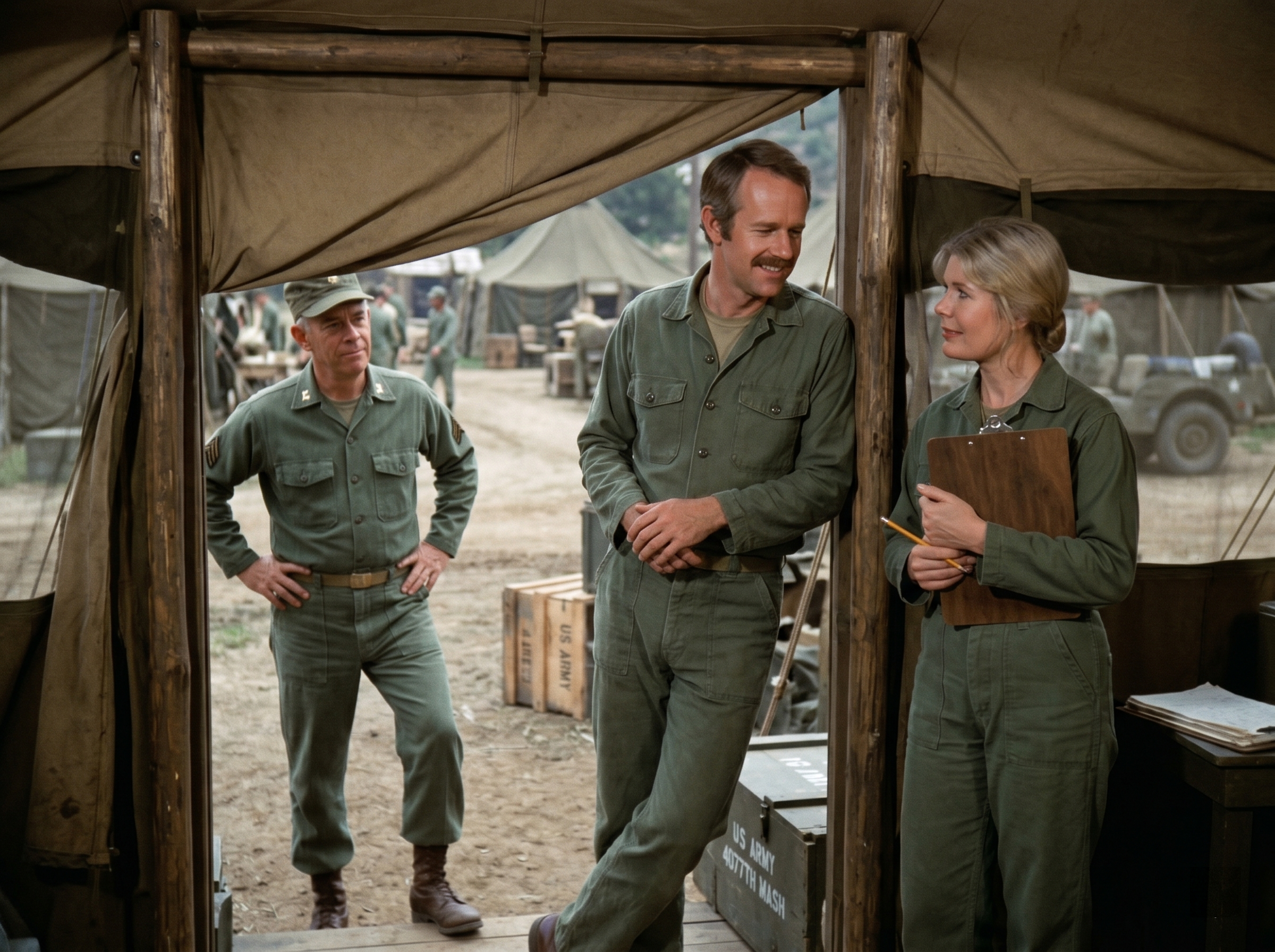
The silence at the 4077th was always temporary, a fragile thing you had to hold carefully before the choppers broke it again.
It was late afternoon, the kind of heavy, golden hour where the Korean sun finally decided to stop punishing the camp and simply baked the dust into the olive drab canvas instead. Inside the supply tent, the air was thick with the smell of warm pine, iodine, and endless fatigue.
Major Margaret Houlihan stood just inside the doorway, holding a battered wooden clipboard like a shield. She had been staring at the same inventory list for ten minutes, the yellow pencil in her hand hovering over the paper. They were short on plasma again. They were short on bandages. They were short on sleep.
Most days, Margaret carried the weight of the camp’s shortages on her shoulders with rigid, Regular Army pride. She was the Head Nurse; she didn’t have the luxury of looking tired.
But today, the lines of exhaustion were etched softly around her eyes, and her impeccable posture had yielded just a fraction to the sheer, bone-deep weariness of a three-day OR session.
That was when Captain B.J. Hunnicutt quietly appeared at the threshold.
He didn’t announce himself with a loud joke like Hawkeye usually did, nor did he barge in demanding supplies. B.J. simply stopped at the doorway, resting his shoulder comfortably against the rough wooden frame of the tent.
He was wearing his standard, lived-in green fatigues, the fabric soft and faded from too many trips through the camp laundry. He crossed his arms loosely, leaning in with that familiar, steady ease that made him the quiet anchor of the Swamp.
For a moment, neither of them said a word. The distant hum of a jeep engine out in the compound was the only sound.
Margaret finally looked up from her clipboard, expecting a requisition form or a wisecrack. Instead, she met B.J.’s eyes. He was looking at her with a profound, quiet empathy.
He didn’t see Major Houlihan, the strict disciplinarian. He just saw Margaret, a brilliant nurse who was running on empty.
“You know, Margaret,” B.J. said softly, his voice carrying the gentle, rolling cadence of a California afternoon. “If you stare at that clipboard any harder, the numbers are going to surrender.”
Margaret opened her mouth to deliver a standard reprimand about proper procedure, but the words wouldn’t come. The utter lack of mockery in B.J.’s voice disarmed her completely.
He gave her a subtle, knowing smile, the kind of smile that said he understood exactly how heavy the clipboard really was.
Slowly, the strict military composure melted from Margaret’s face. She lowered the yellow pencil. A warm, incredibly vulnerable smile touched her lips, softening her features into something beautiful and real.
For a fleeting second, the war disappeared. It was just two exhausted friends finding a brief harbor of understanding in the middle of a dusty nightmare.
Then, the heavy canvas flap of the tent was pushed aside.
Colonel Sherman T. Potter stood squarely in the opening, his cap pulled low against the afternoon sun. His hands were planted firmly on his hips, his green fatigues dusted from a walk across the compound.
Margaret stiffened instantly, her eyes widening as she clutched the clipboard to her chest. She was caught off guard, her professional armor stripped away, exposed in a moment of completely unmilitary softness.
Potter stood silent, his sharp eyes darting from B.J.’s relaxed lean to Margaret’s startled face, the tension suddenly sucking the air right out of the tent.
The silence stretched tight across the canvas doorway. Margaret’s knuckles went white against the edge of her clipboard.
She opened her mouth, her voice catching as she tried to summon her brass-tacks persona. “Colonel Potter, sir. I was just—Captain Hunnicutt and I were reviewing the—”
“Save your breath, Major,” Potter interrupted, his voice a low, gravelly rumble.
Margaret froze. B.J. didn’t move from his spot against the doorframe, but his relaxed posture tensed ever so slightly, ready to draw the fire away from Margaret if the Old Man was on the warpath.
Potter stood at the threshold, framed by the dusty path and a stack of wooden U.S. Army crates behind him. He looked at the two of them, taking in the scene. He saw the drooping shoulders. He saw the faint smudges of dark circles under their eyes. He saw the lingering ghost of the genuine smile that had just been on Margaret’s face.
The harsh line of Potter’s jaw slowly relaxed. The stern glare in his eyes melted into a weary, deeply affectionate half-smile.
“If you two are going to hold up this tent frame,” Potter said dryly, “I’ll have the engineers come by and take the poles down. Heaven knows we need the wood for the mess tent stove.”
Margaret let out a breath she hadn’t realized she was holding. Her shoulders dropped an inch.
B.J.’s mustache twitched as his warm smile returned. He tipped his head slightly. “Just structural support, Colonel. The Major here was making sure the roof doesn’t cave in on the tongue depressors.”
“I see,” Potter said, leaning his weight onto one leg. He didn’t move to enter the tent, nor did he leave. He just lingered at the boundary, a father checking on his kids in the middle of the night.
“Actually, Colonel,” Margaret said, her voice softer now, entirely stripped of its usual rigid volume. “We were just… taking a breath.”
It was a startling admission from the Head Nurse. To admit a need for rest was something the old Margaret Houlihan would have viewed as a court-martial offense. But this wasn’t the old Margaret. This was a woman who had bled, cried, and fought alongside the men in this camp until they had become her unlikely, permanent family.
Potter’s eyes softened even more. He knew the toll this place took. He had commanded men in two wars before this one, and he knew that the spirit broke long before the body did.
“A breath,” Potter repeated, nodding slowly. He looked out over his shoulder at the compound, at the olive-drab tents baking in the dirt, at the nurses and corpsmen moving like ghosts through the heat.
“It’s a rare commodity around here, Major,” Potter said, turning his gaze back to her. “Harder to come by than penicillin. And usually more effective.”
B.J. shifted his weight, his eyes crinkling at the corners. “The way I figure it, Colonel, if we don’t stop and remember what we’re trying to save every now and then, we’re just fixing up bodies to send back to a meat grinder.”
Potter let out a short, huffing laugh. “That’s awfully philosophical for a Tuesday afternoon, Captain.”
“It’s the lack of sleep, sir,” B.J. replied smoothly. “Makes me sound like a fortune cookie.”
Margaret looked between the two men. The warmth in her chest, the feeling that had made her smile just moments before, bloomed again. She looked down at the clipboard, tracing the edge of the paper with her pencil.
She didn’t have to be perfect for them. She just had to be Margaret.
“Colonel,” Margaret said, looking back up, her eyes shining with a quiet, grounded strength. “Did you need me for something? A new casualty report?”
Potter unhooked his thumbs from his belt and gave a dismissive wave of his hand. “No, no. I was just taking a walk. Trying to get the smell of creamed chipped beef out of my nose. Thought I’d see who was still standing.”
He looked at B.J., still leaning comfortably in the doorway, and then at Margaret, standing safely within the shadows of the canvas.
“I’m glad to see you both are,” Potter added softly.
He reached up and adjusted the brim of his cap. The paternal warmth radiating from the old cavalry officer was palpable, a steadying force in a world gone mad.
“Carry on with your structural support, Captain,” Potter ordered, a twinkle of dry humor returning to his eyes. “And Major?”
“Yes, Colonel?”
“When you finish staring down that clipboard, put it in a drawer. Take five minutes. That’s a direct order.”
Margaret smiled, and this time, she didn’t try to hide it. “Yes, sir.”
Potter gave a sharp, satisfied nod, turned on his heel, and marched back out into the dusty camp path, leaving them to their quiet corner of the war.
B.J. looked over at Margaret. The tension was gone from the tent. The air felt a little lighter, the heat a little less oppressive.
“He’s a good man,” B.J. said quietly.
“The best,” Margaret agreed, her voice barely above a whisper.
She looked at her clipboard one last time. Then, with a decisive motion, she tossed it onto a nearby supply crate. The wood clattered softly in the quiet tent.
B.J. pushed off the doorframe, offering her a respectful nod before turning to head back to the Swamp. Margaret watched him go, feeling the deep, enduring comfort of the eccentric, brilliant, maddening family she had found in the middle of nowhere.
The choppers would come again. The war would demand its pound of flesh before the sun went down. But for right now, in the shadow of a canvas doorway, they were okay.
In a place designed for breaking, the quiet moments of grace were the only things holding them together.