The Arithmetic of War and the Grace of a Quiet Room
The war had a peculiar way of silencing even the loudest voices in the 4077th. When the operating room finally emptied after a brutal thirty-hour marathon, the camp didn’t celebrate; it simply collapsed into itself.
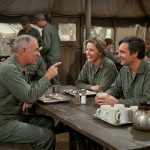
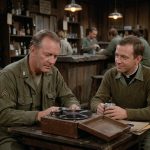
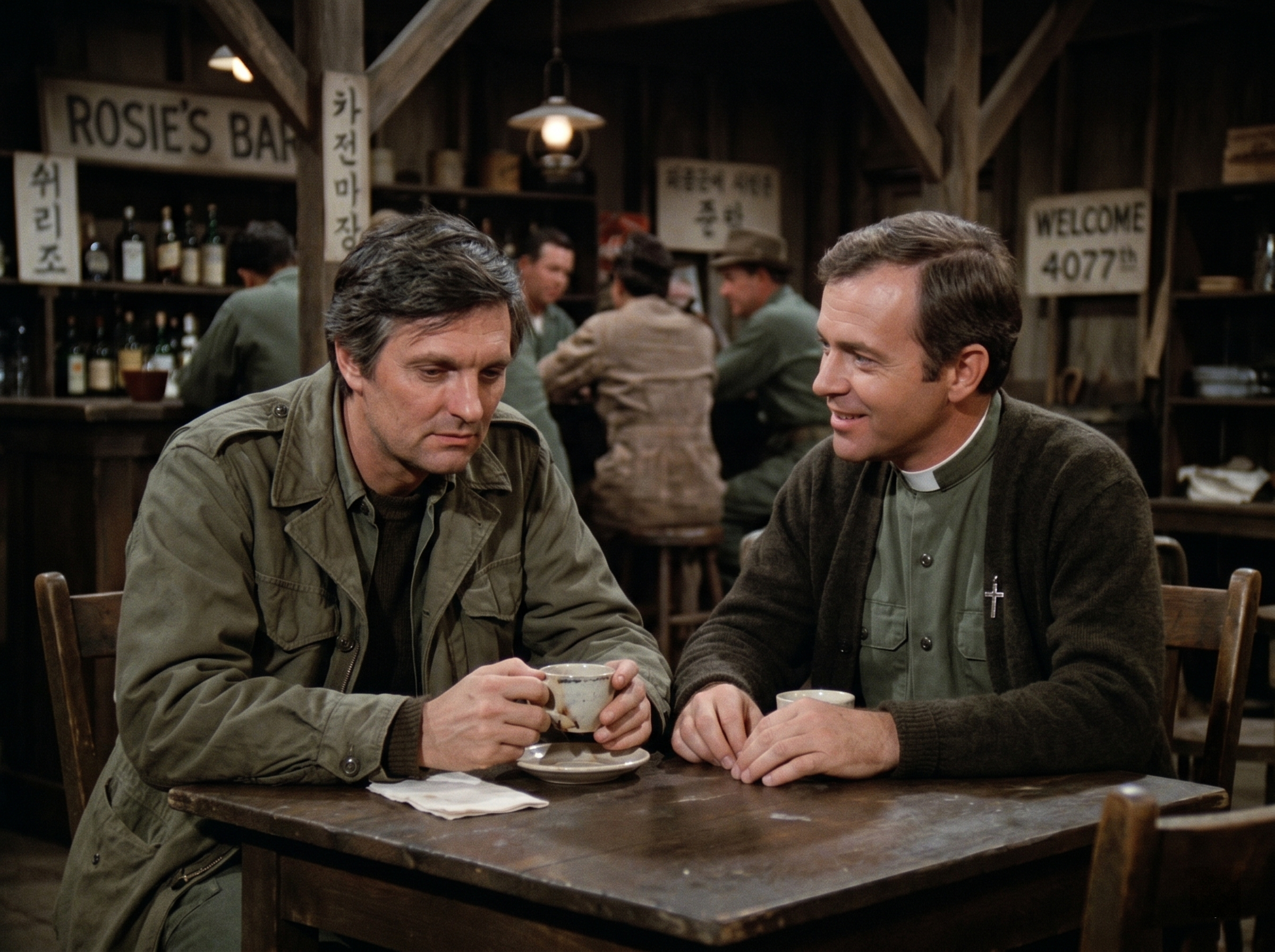
In the dusty, familiar haven of Rosie’s Bar, the air was heavy with the scent of stale beer, damp wool, and exhaustion. The dim, warm practical lighting cast long, soft shadows across the rustic wooden tables and the modest local decor. In the background, faded signs reading “ROSIE’S BAR” and “WELCOME 4077th” hung from the rough wooden beams, a bittersweet reminder of their temporary, absurd home.
At a small table in the corner, Hawkeye Pierce sat completely still.
His signature charisma, the frantic, wisecracking armor he wore so well, was entirely stripped away. Dressed in his worn, olive-drab field jacket and a dark, lived-in sweater, he looked smaller somehow. He leaned his elbows casually, yet heavily, on the scarred wooden table.
In his hands, he cradled a small, chipped ceramic cup. He wasn’t drinking from it; he was just staring thoughtfully downward into the shallow liquid. Beneath his heavy brow, there was a quiet, profound sadness, the look of a man trying desperately to unsee the endless parade of broken bodies.
The wooden floorboards creaked gently, but Hawkeye didn’t look up. He didn’t need to.
Father Francis Mulcahy slipped quietly into the wooden chair across from him. The chaplain wore his thick, brown wool cardigan over his green uniform shirt, the crisp white clerical collar standing out in the dim light. A small silver cross was pinned to his sweater, catching the faint, amber glow of the overhead lamp.
For a long time, neither man spoke. They completely ignored the low murmur of the other patrons blurring into the background.
Mulcahy leaned in compassionately, resting his hands gently on the table just inches from Hawkeye’s. He didn’t offer a booming greeting or a forced joke. Instead, he simply offered a sincere, hopeful smile of moral support, waiting for the surgeon to find his way back to the surface.
“You know, Father,” Hawkeye murmured finally, his voice raspy and stripped of its usual rhythmic bounce. “I used to think I could fix anything in the world, as long as I had enough silk thread and a good light.”
Mulcahy’s smile remained steady, his eyes crinkling with deep, unspoken empathy. He recognized the heavy, dangerous quiet radiating from the camp’s chief surgeon.
“It was that young corporal in pre-op, wasn’t it, Hawkeye?” Mulcahy asked softly, his voice a gentle anchor in the gloomy room.
Hawkeye’s grip tightened around the small cup, his knuckles turning white against the pale ceramic, as the silence between them stretched to a painful, breaking point.
Hawkeye didn’t lift his head. He kept his eyes locked on the dull surface of the table, the faded wood blurring slightly as he fought the sting of absolute fatigue.
“He had a library card in his pocket, Francis,” Hawkeye whispered, a cynical, defensive edge creeping into his voice. “Overdue. Three weeks overdue. I guess the Toledo Public Library is going to have to write off a copy of Treasure Island.”
It was a classic Pierce deflection. It was a weak, desperate attempt to coat the unbearable reality of a lost life in a thin layer of dark, worldly irony. But the joke fell completely flat, evaporating instantly into the stale air of Rosie’s Bar.
Father Mulcahy didn’t offer a hollow platitude. He didn’t quote scripture or tell Hawkeye that it was all part of a grander, mysterious plan. He knew better than to offer simple answers to a man covered in the complex blood of a futile war.
Instead, the priest simply leaned a fraction closer. His presence was a steady, grounding force, a quiet rebellion against the chaos outside the walls. His sincere smile didn’t waver; it just deepened into something profoundly understanding and deeply human.
“I used to love Treasure Island when I was a boy,” Mulcahy offered quietly, his tone conversational, almost impossibly light. “I always fancied myself a bit of a Jim Hawkins. Though I suppose my sister would say I was more suited to being the ship’s cook.”
Hawkeye let out a slow, shaky breath that sounded like half a laugh and half a sigh. The rigid, defensive tension in his shoulders dropped a fraction of an inch.
“You couldn’t be Long John Silver, Father,” Hawkeye said, finally lifting his gaze from the cup to look at the man across from him. “You wouldn’t have the heart to make anyone walk the plank. You’d probably offer them a life jacket and a boxed lunch for the swim.”
The priest’s eyes twinkled with genuine, unforced warmth. “Well, perhaps a nice tuna sandwich. It goes down remarkably well in a maritime crisis.”
The gentle banter hovered between them, a fragile but vital bridge over the dark waters of the day’s agonizing losses. Mulcahy wasn’t trying to erase Hawkeye’s pain or minimize the tragedy of the young corporal. He was simply sitting with him in the dark, ensuring the surgeon didn’t have to carry the weight of the world entirely alone.
“I couldn’t save him, Father,” Hawkeye said, the words slipping out bare, unprotected, and terribly honest. “All that training. All those fancy clamps and retractors. And I couldn’t do a damn thing to stop the clock.”
“You saved six others today, Hawkeye,” Mulcahy replied gently, his hands remaining perfectly still and reassuring on the table. “I know that doesn’t balance the scales in your heart. The arithmetic of war is a terrible, cruel thing to try and calculate.”
Hawkeye closed his eyes for a brief second, letting the chaplain’s words wash over him.
“But you stood at that table for hours, fighting desperately for a boy you didn’t even know,” the chaplain continued, his voice barely above a whisper, yet ringing with absolute conviction. “That is not a failure, Benjamin. That is a testament to the supreme value you place on human life. Even in a place that seems to place absolutely no value on it at all.”
Hawkeye absorbed the words in the dim, quiet space. He looked at the gentle priest across from him—a man armed with nothing but a clerical collar and an infinite, staggering capacity for listening.
Slowly, the frantic, angry buzzing in Hawkeye’s mind began to quiet down. He lifted the small ceramic cup to his lips and finally took a sip of the tepid drink. It tasted bitter and earthy, but it grounded him in the present moment.
The crushing, suffocating weight of the Korean War hadn’t magically lifted from the 4077th. The choppers would inevitably return over the hills, and the bloody, exhausting cycle would start all over again tomorrow.
But in this small, dusty corner of Rosie’s Bar, the darkness retreated just enough to let a little air in. The quiet solidarity of a good friend was a very different kind of medicine, but it was exactly what the chief surgeon needed to survive the night.
“Thanks, Francis,” Hawkeye murmured, the quiet sadness in his eyes finally softening into something resembling peace.
“Anytime, Hawkeye,” Mulcahy smiled, gently tapping the wooden table with his fingertips. “Now, finish your drink before Rosie decides to start charging us for the atmosphere.”
In a place built on mending broken bodies, sometimes it took a quiet word and a friend’s smile to mend a broken spirit.