The Softest Needle in the Swamp
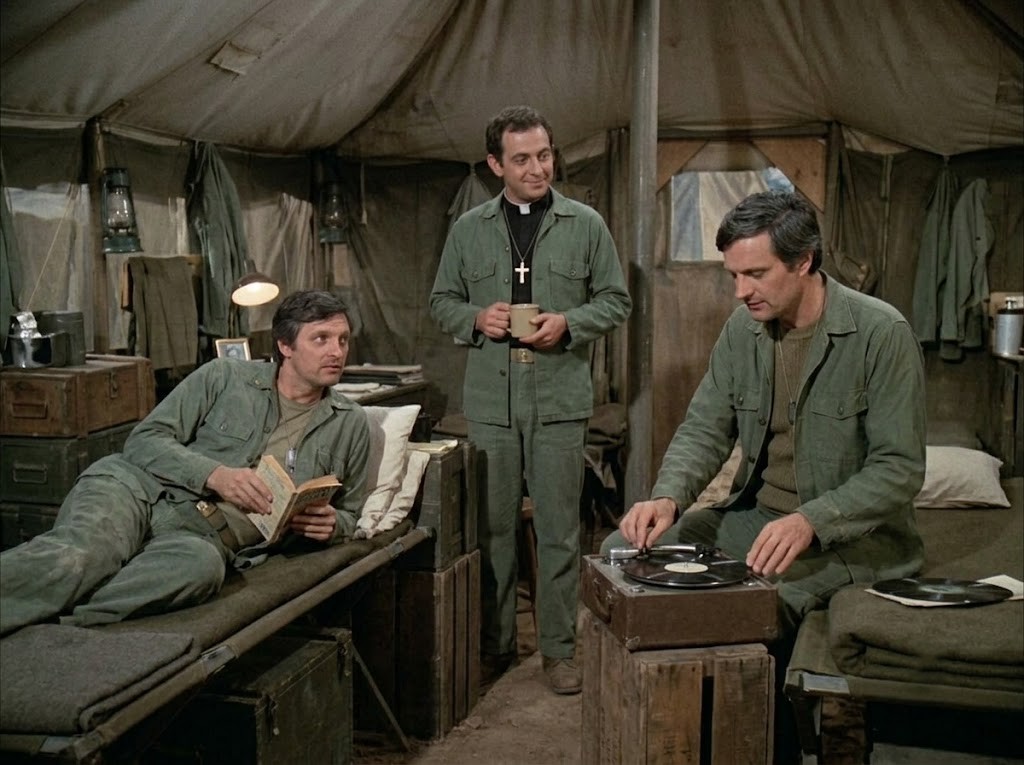
The Mud of Korea had a way of seeping into everything, including a man’s bones, but tonight, the Swamp smelled faintly of old dust, stale coffee, and the scratching hiss of a worn-out needle.
It was one of those rare, fragile evenings where the choppers hadn’t flown in hours.
The silence outside was heavy, almost unnatural, leaving the three men inside the tent to find their own ways back to sanity.
Hawkeye Pierce lay stretched out across his cot, his long frame propped up against a heap of pillows that had seen far better days.
An open book rested in his hands, but his eyes weren’t moving across the page.
Instead, he was looking past the paper, listening to the rhythmic, rhythmic *click-pop* of the record player sitting on a wooden crate across the room.
Beside the record player sat B.J. Hunnicutt, his fingers carefully guiding the arm of the phonograph as if he were performing delicate vascular surgery on a piece of vinyl.
His face was fixed in a look of intense concentration, a slight, weary smile tugging at the corner of his mouth as the first notes of a scratchy, distant big band melody began to float through the canvas walls.
Standing between them, holding a chipped mug of lukewarm tea, was Father Mulcahy.
The gentle priest stood tall, his silver cross catching the dim light of the tent, looking back and forth between the two doctors with an expression of pure, quiet gratitude.
For a long moment, nobody spoke.
The music was a ghost from a home that felt ten thousand miles away, a fragile bridge built out of shellac and wax.
“You know, Hawk,” B.J. muttered, his hand still hovering near the needle, “if we play this loud enough, maybe we can convince ourselves that the mortar fire down the road is just a very aggressive rhythm section.”
Hawkeye didn’t look up from his book, though his lips twitched. “Personally, Beej, I’m holding out for the day the Chinese send over a brass band instead of artillery. It’d do wonders for my insomnia.”
Mulcahy took a slow sip from his mug, his eyes crinkling. “It is a beautiful piece of music, BJ. Truly. It reminds me of the socials back at the parish. Though, I must admit, our record player didn’t require a medical degree to operate.”
“This isn’t just a record player, Father,” Hawkeye said, finally closing the book and letting it rest against his chest. “This is a time machine. One spin of this baby and Hunnicutt here is back in San Francisco dancing with Peg, and I’m back in Maine trying to convince a lovely nurse that jazz is an aphrodisiac.”
B.J. laughed softly, adjusting the volume knob with infinite care. “It works, too. Mostly.”
The music swelled, a sweet, soaring trumpet solo that seemed to push the damp chill out of the tent, replacing it with the warmth of a smoky, half-forgotten ballroom.
But just as the melody reached its peak, the lights in the tent flickered violently.
A low, heavy rumble shook the ground beneath their boots—not the distant thud of artillery they had grown used to, but the deep, unmistakable roar of an incoming convoy of ambulances, their brakes screeching just outside the compound.
The needle skittered harshly across the record, tearing through the melody with a sharp, agonizing screech that made all three men freeze in place.
The sudden silence inside the tent was deafening.
The warmth of the music vanished in an instant, replaced by the cold, familiar adrenaline that always came with the roar of those engines.
Hawkeye’s eyes closed for a brief second, his face instantly hardening from the relaxed, boyish expression of a moment ago into the tired, guarded mask of a surgeon about to face hell.
B.J.’s hand stayed frozen over the record player, his fingers trembling just slightly before he slowly pulled them back.
Father Mulcahy set his mug down on a nearby crate with a quiet, deliberate click, his gentle smile fading into a look of solemn readiness.
Outside, the shouts began—Radar’s voice, sharp and breathless, calling out triage orders, followed by the heavy, commanding bark of Colonel Potter.
“Well,” Hawkeye said, his voice dropping its sarcastic edge, replaced by a quiet, flat tone. “So much for the intermission.”
He swung his legs over the edge of the cot, his boots hitting the dirt floor with a dull thud.
B.J. didn’t move immediately; he just looked down at the silent turntable, where the needle now rested uselessly against the inner groove.
“We were right in the middle of the best part,” B.J. said softly, his voice carrying the immense weight of a man who had been pulled away from home one too many times.
Mulcahy stepped closer, placing a comforting hand on B.J.’s shoulder. “The music will still be here, BJ. It doesn’t forget its place.”
B.J. looked up at the priest, a faint, appreciative smile returning to his face, and then he stood up, reaching for his fatigue jacket.
Hawkeye was already at the tent flap, his hand resting on the canvas, looking back at the two of them.
The humor was gone from his eyes, but the deep, unbreakable bond of the Swamp remained, steady and unyielding.
“Come on, Beej,” Hawkeye said gently, his tone full of a quiet camaraderie that needed no extra words. “Let’s go patch up the audience so we can come back and finish the show.”
B.J. nodded, stepping into the damp night air right behind his friend, while Father Mulcahy followed close behind, already reciting a silent prayer for the hands of the surgeons and the souls of the arriving wounded.
Inside the empty tent, the record player sat still on its wooden crate, holding onto the silence until the music could find its way back to the 4077th.
Behind the jokes and the weariness of the Swamp, the music never really stopped playing.