The Blanket and the Clipboard
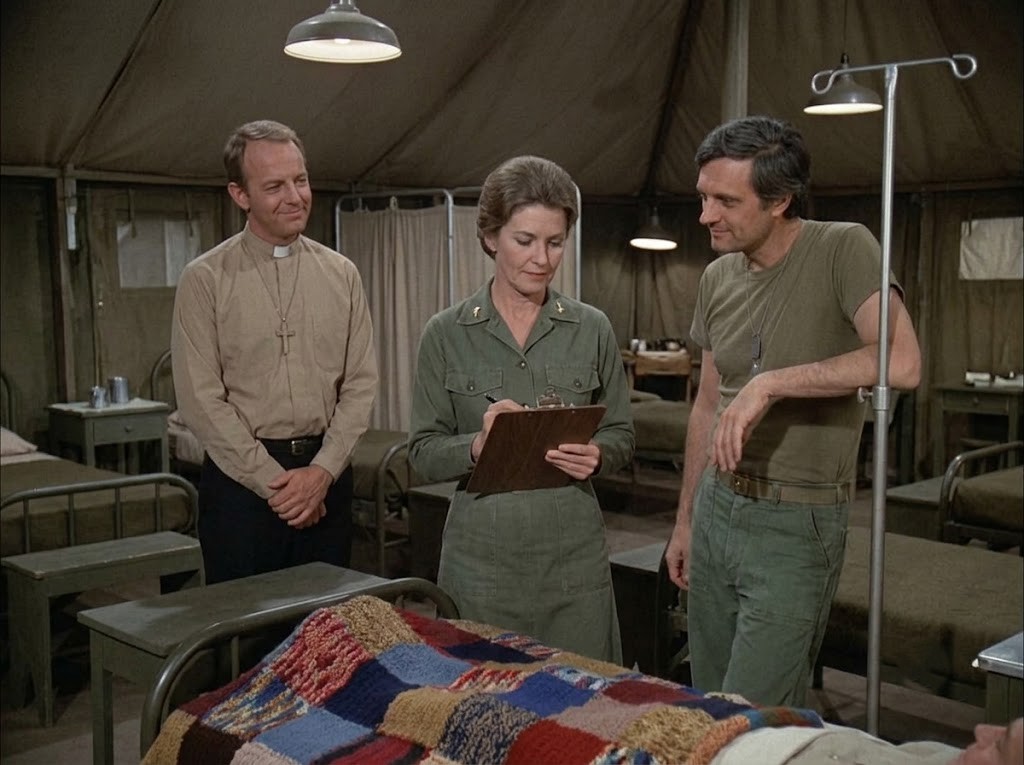
The Swamp was freezing, the O.R. was a meat locker, but the post-op tent always smelled of damp canvas, rubbing alcohol, and the quiet, heavy breathing of men trying to heal.
It was late afternoon, the kind of gray, forgotten hour where the war seemed to pause just long enough for everyone to notice how tired they were.
Hawkeye Pierce leaned against a portable IV stand, his olive-drab tee shirt rumpled, his dog tags resting against his chest like cold coins. He looked at the kid in the bed, then over at Margaret Houlihan, who was staring down at her clipboard with an intensity usually reserved for inspecting the latrines.
Standing just behind her, Father Mulcahy held his hands together, a gentle, worried smile playing on his face, his clean collar a sharp contrast to the olive drab of the tent.
They were looking at Private First Class Jimmy Miller, a nineteen-year-old from Iowa who hadn’t spoken a word since he woke up from anesthesia three days ago.
His physical wounds were healing fine—Hawkeye’s hands had seen to that—but his spirit seemed to have checked out, leaving behind a silent, hollow shell that stared fixedly at the canvas ceiling.
Then, about an hour ago, a mail jeep had rattled into camp, splashing mud against the tents, and delivered a package wrapped in heavy brown paper and thick twine.
Inside was a quilt.
It wasn’t an army-issue blanket; it was a patchwork quilt made of mismatched squares of yarn—deep blues, rich reds, textured browns, and soft creams, knitted together with the kind of tight, loving stitches only a grandmother in the Midwest could manage.
The moment Radar had laid it across Jimmy’s legs, something shifted in the tent.
Margaret had marched over, her pen poised over her medical charts, ready to declare the non-regulation item a sanitation hazard. Hawkeye had drifted in right behind her, a cynical joke ready on his tongue to break the tension of another long shift.
But as Margaret reached out to touch the edge of the knitted squares, her fingers froze.
The silence in the post-op tent grew thick, no longer heavy with sadness, but charged with a sudden, aching memory of home that none of them were prepared for.
“Margaret,” Hawkeye said softly, his usual sarcastic edge completely missing from his voice. “Look at his hand.”
Jimmy’s right hand, which had been clenched into a tight, pale fist for seventy-two hours, had slowly opened. His fingers were lightly brushing the rough, warm yarn of a blue square, his thumb tracing the pattern over and over.
Margaret didn’t answer right away. She kept her eyes fixed on the clipboard, her jaw set firmly in that strict, military line she wore like armor, but her gaze was unusually soft.
“The boy’s temperature has stabilized,” she murmured, her voice steady but lacking its usual brassy authority. “And his chart indicates he’s finally resting comfortably.”
Father Mulcahy smiled, a look of profound relief washing over his face as he looked from the blanket to the young soldier. “It’s remarkable, isn’t it? What a few pieces of yarn can do. It’s as if his family is right here in the tent with him, keeping watch.”
Hawkeye shifted his weight against the IV pole, a slow, bittersweet smile tugging at the corner of his mouth. “Yeah. Leave it to a grandmother from Iowa to outperform the entire U.S. Army medical corps with nothing but two knitting needles and a ball of wool.”
He looked at Margaret, noticing the way she held the clipboard close to her chest, almost like a shield against the sudden wave of homesickness that the colorful quilt had brought into the room.
“You’re not going to cite him for a uniform violation, are you, Major?” Hawkeye teased gently, his voice a warm, familiar comfort in the quiet tent. “I mean, technically, it doesn’t match the curtains.”
Margaret let out a short, quiet breath that might have been a laugh if she weren’t so determined to remain the Chief Nurse. She looked up, her eyes meeting Hawkeye’s with a rare, unspoken understanding.
“The 4077th is out of uniform anyway, Captain Pierce,” she said softly, adjusting her grip on the board. “I’ll just list it as an auxiliary therapeutic device. For medical purposes.”
“An auxiliary therapeutic device,” Hawkeye repeated, nodding solemnly. “Brilliant. I’ll prescribe three hours of it a day, to be taken with a side of actual peace and quiet.”
Father Mulcahy stepped forward, gently tucking a loose corner of the quilt around the boy’s shoulder. “Sometimes, the best medicine doesn’t come from a bottle, Hawkeye.”
They stood there for a few minutes more, three tired people in a muddy valley thousands of miles from home, bound together by a war they didn’t want and a humanity they refused to lose.
The boy in the bed let out a long, peaceful sigh, his eyes closing as he drifted into the first real sleep he’d had in days, his hand still resting against the colorful yarn.
Margaret adjusted her clipboard one last time, turned on her heel, and walked quietly down the row of beds, her starched uniform rustling in the stillness.
Hawkeye watched her go, then looked back at the quilt, the bright colors making the gray canvas around them seem just a little less bleak.
In a place built on olive drab and gray canvas, sometimes it took a few squares of colorful yarn to remind us what we were all fighting to get back to.