The Recipe for a Tuesday Afternoon
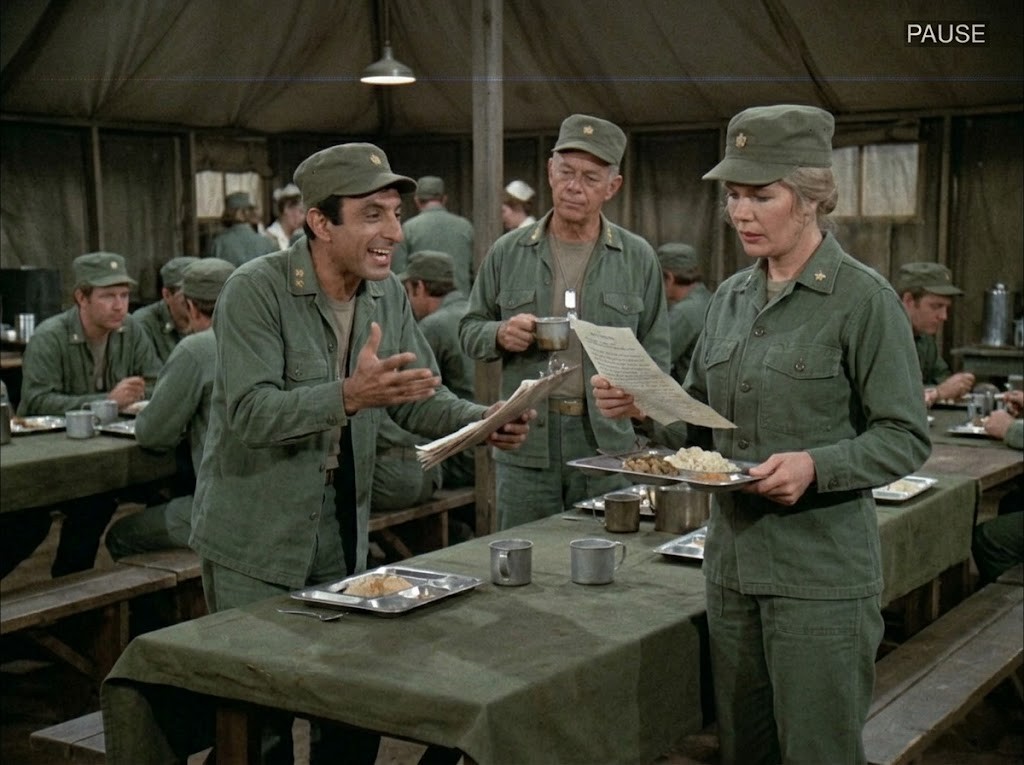
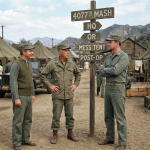
The mud outside the 4077th didn’t care about army regulations, and neither did the visual poetry of the mess tent. It smelled of stale coffee, boiled cabbage, and the damp, heavy exhaustion that only a thirty-six-hour shift in Post-Op could leave behind.
Under the dim overhead bulb, the world slowed down just enough for the reality of Korea to catch up with everyone.
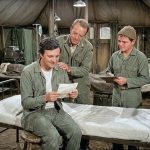
Corporal Maxwell Klinger stood in the middle of the aisle, his hands wildly animating a piece of wrinkled parchment as if it were a declaration of independence. His eyes were wide with the manic, desperate energy of a man who had found a gold mine in a pile of old laundry.
“I’m telling you, Major, it’s not just a letter from my Aunt Albertina,” Klinger pleaded, his voice cutting through the ambient clatter of metal trays. “It’s a blueprint. A culinary map out of this swamp!”
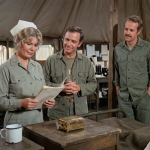
Major Margaret Houlihan stood frozen, her eyes scanning the faded ink on the paper with a mixture of professional skepticism and a sudden, sharp pang of vulnerability. Her metal tray rested heavily in her hands, holding a mound of unidentifiable gray mush that passed for lunch.
Beside her, Colonel Sherman Potter held his tin cup, his sharp eyes darting between Klinger’s expressive face and the paper, his expression a perfect cross between grandfatherly patience and a man who had seen too many bad ideas fail in the mud.
“A recipe, Klinger?” Margaret asked, her voice tight, trying to maintain her usual authoritative posture despite the visible exhaustion under her eyes. “You brought a recipe for Toledo-style meatloaf into a military mess hall during a supply shortage?”
“It’s not just meatloaf, Major! It’s hope! It’s grandma’s kitchen on a Sunday afternoon!” Klinger’s voice cracked slightly, the theatrical veneer slipping for a split second to reveal a profound, aching homesickness.
Colonel Potter took a slow sip of his black coffee, his brow furrowing as he looked closer at the paper. “Klinger, the last time you had an idea from Toledo, it involved a dress made entirely of discarded parachute silk and a pair of fuzzy slippers.”
“This is different, Colonel,” Klinger insisted, taking a step closer, his face turning incredibly earnest. “Look at the ink. Look at the margin. That’s her secret ingredient. If we can get Igor to substitute the powdered eggs with just a dash of the local powdered milk, and use the dried onions from the back supply…”
He stopped talking because Margaret’s hand had begun to tremble slightly against the edge of her tray. She wasn’t looking at the ingredients anymore; her eyes were locked onto a small, handwritten note at the very bottom of the page, written in a shaky, elderly script.
The note at the bottom didn’t say anything about onions or breadcrumbs. It simply read: *’Eat well, Maxie. We are all waiting on the porch for you.’*
The mess tent went unusually quiet, the distant clinking of forks from the surrounding tables fading into the background. Margaret swallowed hard, her rigid military bearing softening into something fragile and deeply human.
“She calls you Maxie,” Margaret said softly, her voice losing its sharp edge entirely.
“Yes, ma’am,” Klinger said, his voice dropping an octave, losing all its theatrical bravado. “Every Tuesday since I was seven. She’d make this, and we’d sit out there until the streetlights came on.”
Colonel Potter stepped in a little closer, his fatherly gaze settling on the paper, then on the tired faces of his staff. He knew the look. It was the same look he saw in the mirror when he thought too long about Mildred and the quiet streets of Hannibal, Missouri.
“The army runs on its stomach, Margaret,” Potter said quietly, his voice a steady anchor in the room. “But a M*A*S*H unit runs on whatever keeps the heart from turning into a block of ice.”
Margaret looked down at her tray of gray food, then back at Klinger’s hopeful, mismatched uniform. For a moment, she wasn’t a Major enforcing discipline in a war zone; she was a woman thousands of miles from home, desperately missing the simple warmth of a family table.
“We don’t have the dried onions, Klinger,” Margaret said, a tiny, almost imperceptible smile touching the corner of her lips. “But I believe Father Mulcahy received a small care package of real garlic salt from his sister last week. If you were to… negotiate a trade.”
Klinger’s face lit up, a brilliant, genuine smile replacing his desperate expression. “Major, for garlic salt, I will personally guarantee you the first slice. The piece with the crispy edge, just the way my uncle likes it.”
“See to it that you do, Corporal,” Potter said with a dry chuckle, clapping Klinger on the shoulder. “And Klinger? Don’t let Igor burn it. If I taste scorched Toledo meatloaf, your next assignment is inventorying the orthopedic socks.”
“Yes, sir! No burning, sir!” Klinger beamed, carefully folding the precious letter and tucking it into his breast pocket like a sacred text.
As Klinger hurried off toward the kitchen, his boots clicking happily against the floorboards, Margaret and Colonel Potter watched him go. The heavy weight of the morning’s triage session seemed just a fraction lighter, the gray walls of the mess tent a little less bleak.
Margaret took a breath, her posture returning to its steady, professional standard, but her eyes remained bright. “He really does try, Colonel.”
“We all do, Margaret,” Potter said gently, raising his tin cup in a silent, affectionate toast to the chaotic, beautiful family they had found in the middle of nowhere. “We all do.”
Because sometimes, the best medicine the 4077th could ever prescribe wasn’t found in the pharmacy, but in a wrinkled piece of paper from home.