A Christmas Gift For Major Winchester, and The 4077th
If there was one person at the 4077th who could turn the act of receiving an incoming shipment into a performance, it was Major Charles Emerson Winchester III.
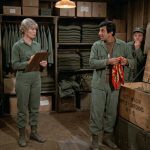
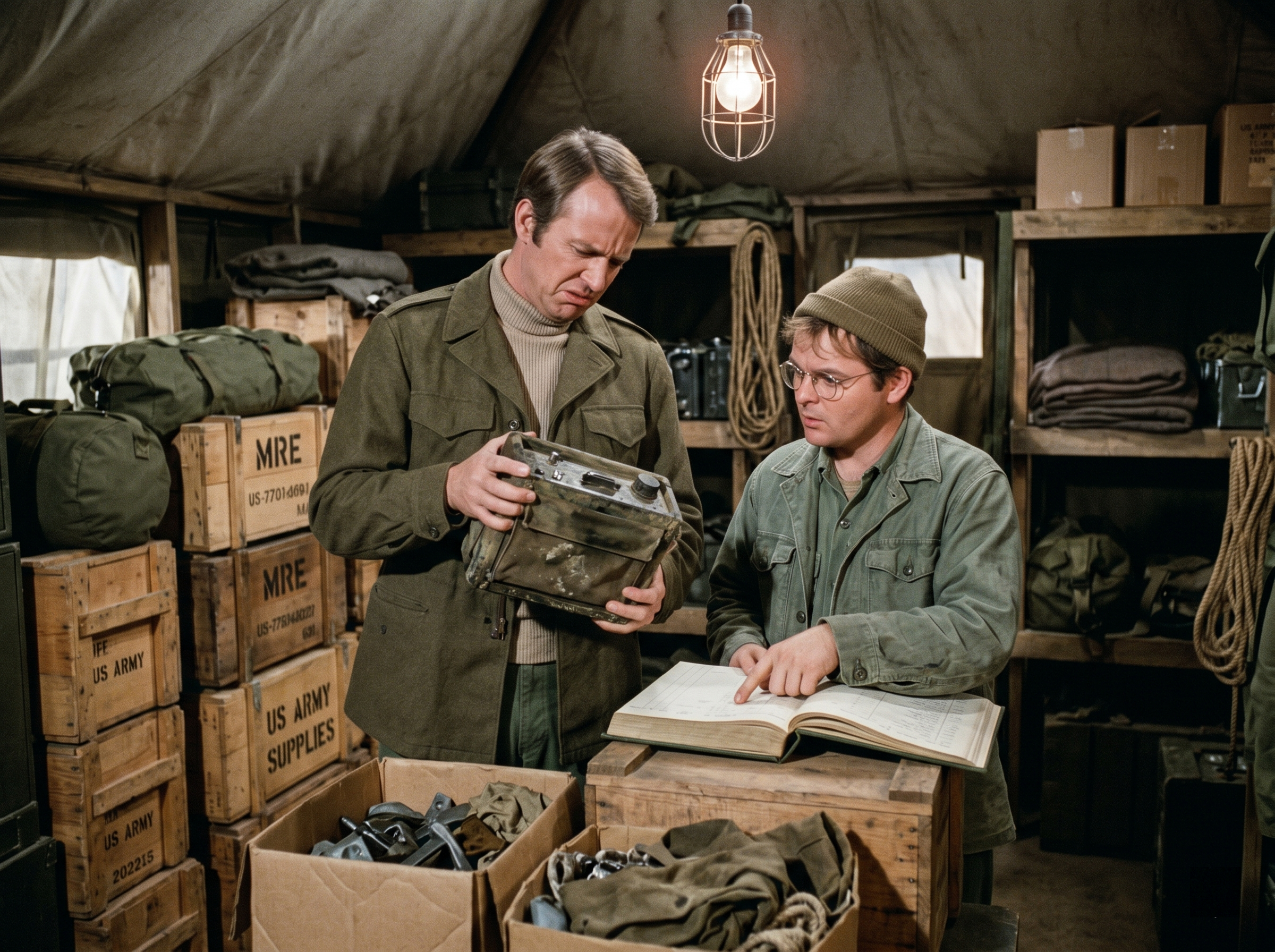
The cold was seeping into Supply. It was always cold in the Supply Tent, it just varied between “bone-chilling” and “my teeth are rattling,” and tonight, it was firmly rooted in “teeth rattling.” The dim, swinging bulb overhead seemed to only emphasize the deep shadows stretching across the endless wooden crates and canvas duffel bags, labeled “US ARMY SUPPLIES” and “MRE” (or worse).
Radar O’Reilly, wearing his trademark beanie and glasses, had his fingers deep in the massive ledger book. It was open on a makeshift desk, a precarious pile of ammunition boxes. He ran a careful index finger down the columns of ink, checking against the physical items being unboxed. His glasses were fogged from the cold, but he didn’t dare wipe them; one smudge on a serial number and the whole system would crumble.
“Alright, Major, next item should be the standard-issue canvas field kit, replacement filters,” Radar muttered, eyes fixed on the line in the book. He heard a rustle of heavy cardboard and a muffled thud. “You find ’em, Major?”
Charles had been grumbling about the temperature, the dust, and the lack of proper labeling for twenty minutes. He was wearing his impeccable brown turtleneck under a heavy field jacket, but his face still held that distinct Winchester grimace—a combination of mild disgust, deep cold, and perpetual offense at the entire Korean experience.
“Radar,” Charles’s voice came, strained and unusually quiet. “I have not found the filters.”
Radar looked up from the ledger. Charles wasn’t holding a canvas bag. He was standing, looking perplexed and deeply disturbed, holding a heavy, rectangular piece of ancient army green field communications equipment.
It was a field radio transmitter, a bulky monstrosity from another war, looking like a green brick covered in switches and knobs, wrapped in cracked canvas.
“What in God’s creation,” Charles asked, his voice dropping to a theatrical hush, “is *this* archaic abomination? It looks like something they dug up at Vicksburg. And more importantly, Radar, it is *not* a replacement filter kit.”
Radar pushed up his glasses. He peered closer at the radio, then back at the ledger. He could already hear the gears of Hawkeye’s brain turning somewhere, imagining the potential pranks this could generate. “Major, that… that’s not on the list. Not even close. It shouldn’t be here.”
“I am acutely aware of what *should not* be here, Radar,” Charles said, his grip tightening on the heavy box. “The list is absolute. This… object is a non-entity. A bureaucratic phantom.”
“Major, we gotta log it,” Radar said, his voice rising in alarm. He knew the paperwork spiral that followed any unlisted arrival. “We gotta find the serial number. It’s not in the book!”
Charles stared at the radio, his expression of confusion turning to profound, almost childish hurt. “Of course, it’s not in the book. And now, thanks to this mechanical reject from a surplus auction, we are delayed further in this arctic tundra you call ‘supply.'”
He held the massive, grimy radio, looking at it like a dead bird he had been forced to hold, his face a complex mask of anger, confusion, and genuine defeat. He let out a slow, frosty breath that crystallized in the light, and his shoulders slumped. For a fleeting second, the Great Charles Emerson Winchester III looked utterly small, standing there under a bare bulb in a cold tent, surrounded by boxes of things nobody wanted, holding a broken piece of junk that didn’t belong anywhere.
It wasn’t funny. It was heartbreaking. Radar watched him, the line in the ledger forgotten. The silence in the tent stretched, broken only by the low hum of the wind outside. And then, Charles spoke, in a voice that was barely a whisper, a voice Radar had never heard before, stripped of all Bostonian baritone.
“Why did they send it here, Radar? Why *this* one, now? Don’t they know we’re full of things that shouldn’t be here?”
Radar held his breath. He saw the shift. This wasn’t about broken logistics. This was Charles, completely unguarded, holding a physical manifestation of his own displacement.
“Maybe…” Radar began, his voice barely audible. “Maybe it just wanted somewhere warm?”
Charles snorted, the flash of vulnerability instantly receding behind his usual defensive wall. “Don’t be sentimental, Radar. It’s a radio. It doesn’t *want* anything. It’s an antiquated piece of equipment that is simply *wasting space* in a space designed to *waste space*.” He shoved the heavy radio toward Radar. “Here. Find its damned serial number before I use it to bash open a box of medical gauze.”
Radar took the cold, heavy radio with both hands. It smelled of mildew and stale oil. He carefully looked at the data plate on the back, squinting through his fogged lenses. He traced the numbers with his finger, his eyes darting back to the ledger, which was now forgotten.
“It’s not in the book, Major,” Radar repeated softly, not looking up.
“Then we shall *make* it be in the book,” Charles said, regaining his stature. He picked up the heavy black fountain pen that Radar had set down. He tapped it on the edge of the ammo box desk. “If this ghost is to haunt this tent, it will have proper documentation. Page 47.”
Radar flipped the pages of the ledger to 47. Charles leaned in, looking at the entry, his eyebrow arching as he scrutinized Radar’s careful handwriting.
“Field Radio Unit,” Charles dictated, his voice regaining its familiar cadence. “Serial Number 88-ALPHA-739. Condition… completely, utterly, and profoundly defunct. Location: The Supply Tent. Permanent Resident.” He then used the pen to elegantly add an asterisks and a note in the margin: *“Has the personality of a particularly depressed badger. Required only for ballast and to provoke existential dread.”*
Radar managed a small smile. He watched as Charles handed the pen back, his gaze lingering on the radio now resting next to the ledger.
“Major,” Radar said, his voice hesitant. “Is it… is it just for ballast?”
Charles looked at him, his face quiet. For a long moment, he said nothing. He looked around the cold Supply Tent, past the rows of crates and canvas bags. Then he looked at the radio again.
“My cousin,” Charles said, his voice devoid of sarcasm. “My cousin Teddy. He… he was a radio operator. First World War. Or perhaps it was… well, that’s not important. Teddy loved radios. He could make them talk, when everyone else just heard static. He said that even a broken radio still held the potential of a voice. It just needed someone patient enough to listen.”
Charles reached out and gently rested his hand on the grimy, cracked canvas covering of the radio. “He would have adored this one, Radar. He would have spent hours coaxing a single, beautiful note from it.”
He didn’t remove his hand. “The world… it moves so fast, Radar. It’s all replacement filters and standard issue gauze, discarding the broken things without a thought. As if memory were just obsolete inventory. And then this arrives, entirely by accident, in the wrong place, at the wrong time, totally useless… and it has nowhere else to go.”
He gave a small, weary sigh and finally removed his hand from the radio. He looked around the tent once more, a different look in his eyes now, perhaps seeing more than just canvas and wood.
“Keep it listed, Radar. For Cousin Teddy. Just in case he’s right about voices in the static.”
He adjusted his field jacket, the Winchester composure once more securely in place. “And for the love of all that is civilized, let us find those filters before I have to requisition my own thermal underwear from the local population.”
Radar closed the heavy ledger book, the sound muffled by the cold air. The entries for filters and gauze felt different now. He picked up the forgotten, ancient radio, the cold canvas still holding the warmth from Charles’s hand. He carefully walked to the back of the Supply Tent and cleared a space on a wooden shelf, right next to the stacks of clean medical sheets. He placed the heavy green box there, its dial pointed straight toward the bare, swinging bulb.
“You have a voice too, Major,” Radar said softly, patting the cold canvas.
He walked back to the front of the tent, picking up his clipboard and the half-empty thermos of coffee that had gone cold hours ago. Outside, the wind howled and the generators pulsed. Inside, under a single light, surrounded by things nobody wanted in a war no one asked for, a ghost radio sat on a shelf, its serial number inked into the margin of a ledger.
It wasn’t funny, and it wasn’t sad. It was just another piece of the 4077th, found exactly where it didn’t belong, reminding everyone that sometimes, even a broken voice was still worth hearing, especially in a place where the static was the only thing you could count on.
In this corner of the world, we learned that sometimes, the items *not* on the list were the ones we really needed.