The Weight of an Unopened Envelope
Some days in the Korean mud, the best thing a man can find is a dry pair of socks. Other days, the only thing keeping the swamp from swallowing you whole is the sight of the mail jeep rolling into camp.
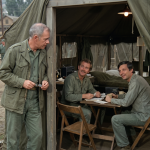
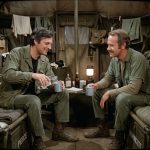
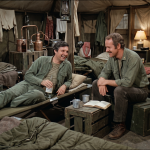
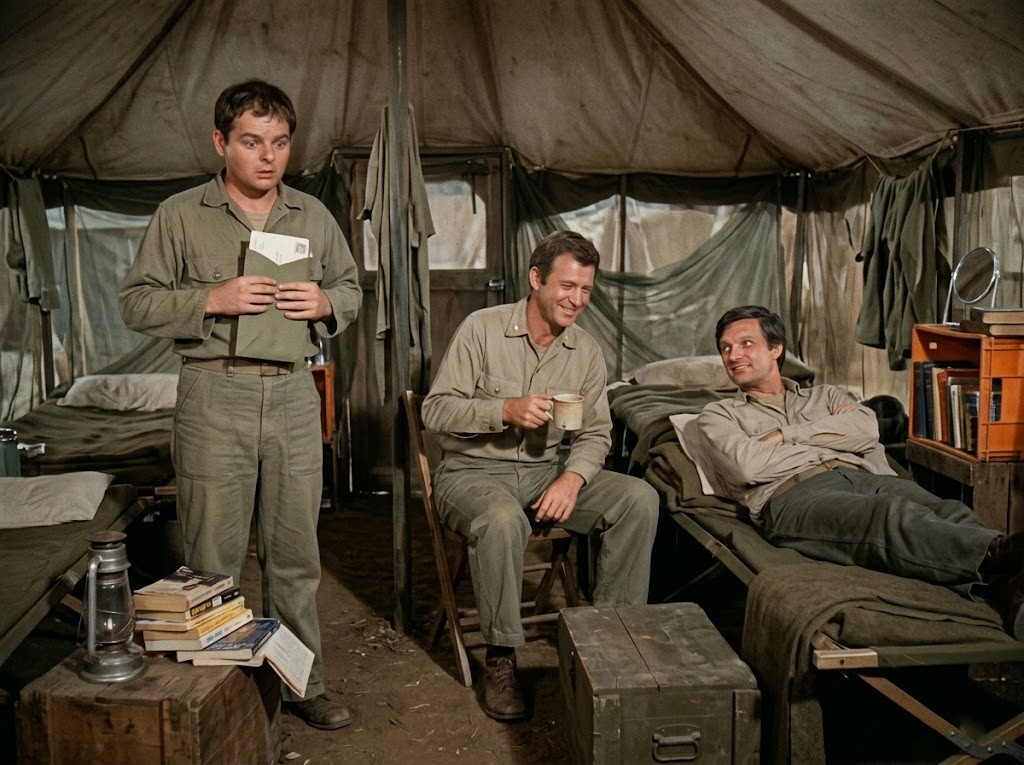
In the Swamp tent, the afternoon heat had settled in like an unwanted houseguest. Hawkeye Pierce was stretched out on his cot, arms crossed, trying to pretend the distant rumble of artillery was just a passing thunderstorm. Across from him, Trapper John McIntyre sat balanced on a folding chair, nursing a mug of something that tasted vaguely like coffee but smelled like old canvas.
The screen door banged open, and Corporal Radar O’Reilly stepped inside.
Usually, Radar burst into the tent like a small, olive-drab tornado, shouting names and throwing packages with the precision of a seasoned quarterback. Today, he stopped dead in his tracks just past the threshold, his boots sinking slightly into the dirt floor.
He held a single, olive-green government envelope in his hands, his fingers gripping the edges so tightly the paper crinkled. His jaw had dropped, his eyes wide behind his thick lenses, staring down at the paper as if it were a live grenade with the pin pulled.
“Hey, look, Hawk,” Trapper said, a slow, easy grin spreading across his face as he took a sip from his mug. “The kid finally got his secret decoder ring from the back of the cereal box.”
Hawkeye didn’t move an inch, but his eyes shifted toward the door, a lazy smile touching the corner of his lips. “Either that, or Iowa just declared war on Illinois, and he’s trying to figure out which side has the better corn.”
Radar didn’t laugh. He didn’t even blink. He just stood there, staring at the white sheet of paper peeking out from the heavy green envelope, his breathing shallow.
“Sirs,” Radar whispered, his voice cracking slightly on the single syllable.
Trapper’s grin softened just a fraction, his thumb tracing the rim of his tin cup. “Come on, Radar. Don’t keep us in suspense. Did Sparky finally send you that autographed picture of the telegraph machine?”
Radar swallowed hard, his eyes darting from the letter to Hawkeye, then over to Trapper. The silence in the tent suddenly felt very heavy, suffocating the lighthearted banter that usually kept the walls from closing in.
“It’s… it’s not for me, Captain,” Radar said, his voice dropping an octave, completely stripped of its usual boyish enthusiasm. “It’s an official dispatch. From the States. It’s about home.”
Hawkeye’s smile vanished instantly, and he sat up slightly on the cot, the casual slouch disappearing from his shoulders as a sudden, cold dread filled the small space between them.
The easy atmosphere of the Swamp dissolved, replaced by the rigid, terrifying reality that always hovered just outside their tent flaps. Trapper set his mug down on the wooden crate beside him, the sharp *clink* sounding like a gavel in the quiet room.
“Radar,” Hawkeye said, his voice entirely devoid of its usual theatrical edge, grounding itself in the quiet authority of a doctor who knew when a joke could no longer heal. “Who is it for?”
Radar took a tentative step forward, past the stacked books and the old kerosene lantern resting on the makeshift nightstand. His hands shook slightly as he lifted the envelope, holding it out like a peace offering or a curse.
“It’s for the Colonel,” Radar murmured. “But it came through my desk first. I had to log the routing numbers. I didn’t mean to read it, Captains, I swear. But the stamp… the red ink at the top…”
Trapper stood up from his chair, the casual, easygoing surgeon replaced by a protective older brother. He crossed the small distance between them and gently placed a hand on Radar’s shoulder, feeling the tension radiating through the young corporal’s frame.
“Take a breath, kid,” Trapper said softly, his voice a warm, steady anchor. “Is it bad news?”
Radar looked up at Trapper, his eyes glassy. “It’s about his son-in-law. The one stationed near Tokyo. There was an accident during a training exercise. They… they don’t know if he’s going to make it through the week.”
The words hung in the humid air of the tent, heavy and bitter. Colonel Potter was the backbone of the 4077th, a man who carried the weight of the entire camp on his seasoned shoulders without ever complaining. He was their father figure, their shelter from the storm, and now a storm was hitting him where he was most vulnerable.
“He’s in the middle of a staff meeting with Margaret,” Hawkeye said quietly, swinging his legs over the side of the cot. He stared at his boots, the reality of their existence sinking in. They spent twenty-four hours a day stitching strangers back together, but when the tragedy hit their own, they were entirely powerless.
“How do we tell him?” Radar asked, looking completely lost. “He’s always the one who knows what to say when we lose a patient. I can’t just hand him this like it’s a supply requisition for more tongue depressors.”
Trapper looked over at Hawkeye, a silent conversation passing between the two roommates. They had shared drinks, jokes, and heartbreaks, but this was a different kind of ache.
“We don’t leave him alone to read it,” Trapper finally said, turning back to Radar with a fierce, quiet loyalty in his eyes. “You go to his office, Radar. You put it on his desk. But Hawk and I, we’re going to be standing right outside that door. And the moment he needs us, we’re walking in.”
Hawkeye stood up, walking over to stand beside Trapper and Radar. He reached out, his long fingers gently tapping the top of the green envelope in Radar’s hand, a small gesture of solidarity.
“He’s a tough old bird, Radar,” Hawkeye said, his voice laced with a deep, reverent tenderness. “But even the toughest birds need a flock when the wind gets too rough. Let’s go look after our Colonel.”
Radar nodded, his shoulders squaring up just a bit as the panic subsided, replaced by the quiet resolve that made him the heart of the 4077th. He tucked the letter under his arm, took a deep breath, and turned toward the door.
As the three of them stepped out into the bright, dusty Korean sunlight, the camp around them was bustling with its usual chaotic energy. But inside the hearts of three men walking toward the administrative tent, there was only a quiet, unwavering promise to hold each other up, no matter how heavy the world became.
Because in a place surrounded by war, the only thing more powerful than the pain of bad news was the family that stood beside you to bear it.