The Measure of a Good Engine (And Better Friends)
Sometimes, the loudest sound in Korea wasn’t the thunder of the incoming choppers or the roar of the artillery over the hills.
It was the complete, stubborn silence of a jeep that refused to start when you needed it most.
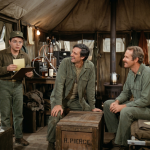
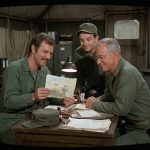
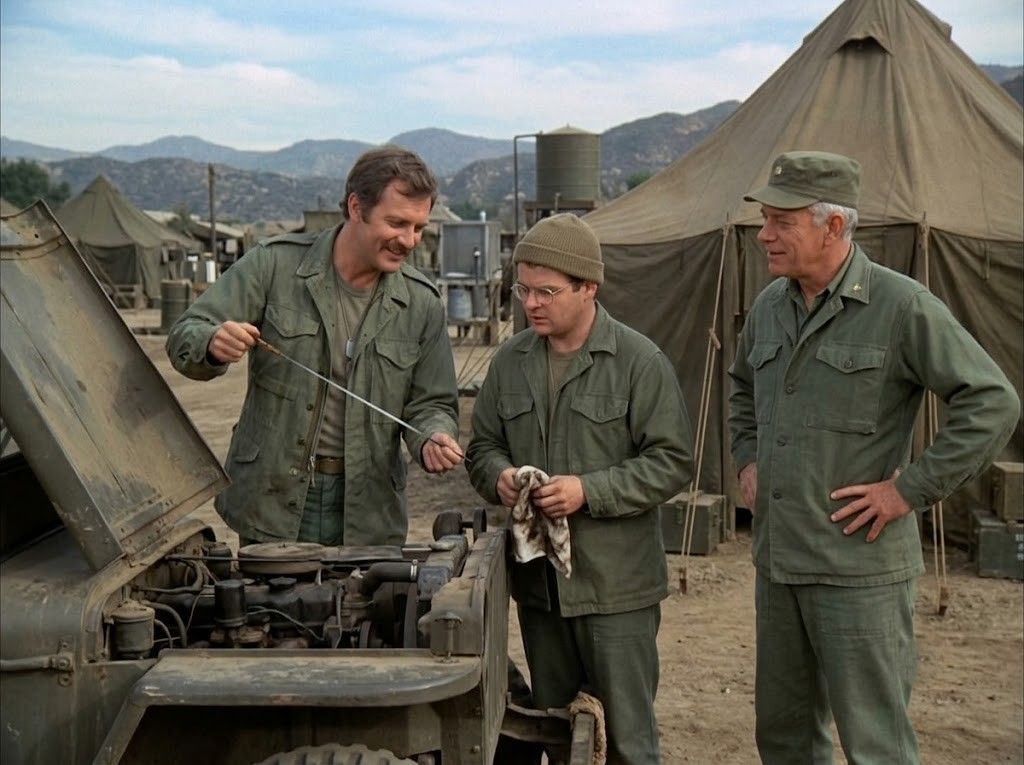
Underneath a pale, washed-out sky that seemed to stretch endlessly over the compound, three men stood gathered around an open hood, locked in a quiet battle with a piece of metal.
The 4077th had been running on fumes for three straight days, fresh out of a grueling forty-eight-hour session in the Operating Room. The surgeons were exhausted, the nurses were sleeping on their feet, and the entire camp smelled heavily of sweat, ether, and damp earth.
BJ Hunnicutt leaned over the exposed engine block, his olive-drab field jacket hung loosely over his tired shoulders. With a faint, characteristically patient smile playing beneath his mustache, he carefully pulled the long, thin metal dipstick out of the engine’s belly.
Beside him stood Radar O’Reilly, the camp’s heartbeat, clutching a greasy, well-worn rag in his hands. Radar’s eyes were wide behind his round spectacles, his knitted brown beanie pulled down tight over his ears as he watched BJ’s hands with the intensity of a man watching a bomb technician.
Colonel Potter stood on the other side, his hands planted firmly on his hips, his posture stiff with the seasoned authority of an old cavalry man. His green fatigue cap was tilted slightly back, his weathered face etched with a mixture of fondness, fatigue, and quiet irritation.
“Well, Beej,” Colonel Potter barked softly, breaking the morning silence with his familiar, gravelly voice. “Give it to me straight. Are we looking at a minor coronary, or is this old mule finally ready for the scrap heap?”
BJ held the dipstick up to the light, turning it slowly between his fingers as a single, dark drop of oil threatened to slide off the tip. “Well, Colonel, the good news is it’s not dead. The bad news is, it’s drier than a temperance lecture in a ghost town.”
Radar bit his lower lip, shifting his weight from one foot to the other as he nervously crumpled the rag in his fingers. “Gee, Captain Hunnicutt… we can’t let her die. That jeep’s the only one we’ve got that doesn’t pull to the left when you hit a pothole. And besides, I promised the guys I’d use it to fetch the mail bag from the crossroads this afternoon.”
“The mail, Radar?” Potter asked, his eyebrows raising slightly as he looked at the young clerk.
“Yes, sir,” Radar whispered, looking down at his boots. “Everyone’s pretty low today. I thought… well, I thought if I could get the letters before sundown, it might help. Especially for Hawkeye. He didn’t say anything, but he looked pretty bad when he crawled into his bunk.”
BJ’s smile faded into a look of quiet understanding, his eyes reflecting the deep, unspoken bond that held the camp together through the worst of times. He wiped the dipstick clean with Radar’s rag, then plunged it back into the dark depths of the engine, waiting for the final verdict.
When he drew it back out, his face fell, the humor draining completely from his expression as he stared at the metal rod.
—
The dipstick was bone dry, reflecting nothing but the cold gray of the Korean sky.
“Nothing,” BJ said quietly, his voice dropping an octave. “Not a drop, Colonel. The oil pan must have cracked on that rocky road near the line yesterday. It’s completely drained.”
Colonel Potter sighed, a heavy, deflating sound that seemed to carry the weight of the entire war. He took off his cap, ran a hand over his silver hair, and looked out across the quiet tents of the compound. “Confound it. No oil means no mail run, and no mail run means thirty very angry, very heartbroken people sitting in the Mess Tent tonight.”
Radar looked as though he had personally let down the entire United States Army. His shoulders slumped, and he stared at the dry dipstick in BJ’s hand as if hoping his sheer willpower could make oil appear. “I should have checked it last night, sir. I’m sorry. I was just so tired after helping in post-op…”
“Hey, come here,” BJ said gently, reaching out to tap Radar’s shoulder with his knuckles. “None of that, Radar. You’ve been working twenty hours a day. Nobody expects you to be a psychic mechanic on top of everything else.”
“Beej is right, son,” Potter added, his voice softening into that warm, fatherly tone he used when the uniform became too heavy for his men. “You can’t fix what the road breaks. Go on inside and get some coffee. We’ll figure something out.”
But Radar didn’t move; he just stood there, looking at the silent jeep that represented their only bridge to the world outside the valley.
Just then, the screen door of the Swamp slammed shut across the compound, and Hawkeye Pierce stumbled out into the dirt, his purple robe flapping around his shins. He looked entirely disheveled, his hair pointing in four different directions, holding a cracked mug of what passed for coffee in the officers’ quarters.
“What’s the convention about?” Hawkeye called out, his voice hoarse but carrying that familiar, cynical edge. “Did the jeep finally decide to enlist in the North Korean army? Or are we just holding a wake for a piece of government property?”
“The oil’s gone, Hawk,” BJ called back, holding up the dipstick like a trophy. “She’s as dry as a martini without the vermouth. No mail run today.”
Hawkeye stopped in his tracks, his sharp wit briefly faltering as the news hit him. He looked at Radar’s crestfallen face, then at Potter’s tired expression, and finally at BJ, who was still standing by the open hood. The humor left Hawkeye’s eyes, replaced by that deep, raw empathy that made him the finest surgeon in the territory.
“No mail?” Hawkeye repeated softly, walking over to join the circle around the engine. He looked down at the dark, silent machinery, his usual frantic energy settling into a quiet, grounded presence. “Man, that’s rough. I think Klinger’s been waiting on a dress from Toledo that’s supposed to make him look like Lana Turner.”
“It’s not just Klinger, Captain,” Radar mumbled, his eyes still fixed on his boots. “I know everyone needed a lift today.”
BJ put the dipstick back into its slot, closing the hood with a heavy, metallic thud that echoed through the quiet camp. He leaned against the rusted fender, crossing his arms. “Well, we aren’t going to let a little thing like a dry engine stop us, are we, Colonel?”
Potter looked at BJ, a small, knowing spark lighting up in his old eyes. “What are you thinking, Hunnicutt?”
“I’m thinking that I happen to know Sparky over at Supply has a couple of cases of motor oil tucked away behind his desk,” BJ said, a slow, mischievous grin returning to his face. “And I also happen to know he’s been dying to get his hands on that bottle of Scotch you keep hidden in your bottom drawer, Colonel.”
Potter scoffed, though the corners of his mouth twitched upward. “That Scotch is for medical emergencies only, Pierce! And for when I have to look at paperwork from Tokyo!”
“Sir, with all due respect,” Radar said, his ears practically perking up at the mention of a deal, “the morale of this camp is definitely a medical emergency.”
Hawkeye took a sip of his coffee, pointing a finger at Radar. “The kid is right, Colonel. If we don’t get that mail, I might have to actually talk to Charles tonight, and that constitutes a cruel and unusual punishment under the Geneva Convention.”
Potter looked around at the three of them—his doctors, his clerk, his family away from home. He saw the deep fatigue lines under their eyes, but he also saw the unyielding warmth and stubborn loyalty that kept them all sane in the middle of a wasteland.
With a mock groan, the Colonel threw his hands up in defeat. “Alright, alright! Radar, get Sparky on the horn. Tell him I’m trading the good stuff, but he’d better have that oil delivered by jeep within the hour or I’ll personally have him transferred to the infantry.”
“Yes, sir!” Radar beamed, his entire face lighting up as he turned and sprinted toward the office, his fatigue instantly forgotten.
Hawkeye watched him go, a soft, genuinely warm smile breaking through his tired features. He clapped BJ on the back, leaning against the jeep’s hood beside his best friend. “You know, Beej, for a guy from California, you’ve got a surprisingly decent brain in that head of yours.”
“Thanks, Hawk,” BJ laughed softly, wiping a smudge of grease from his thumb onto his trousers. “I do what I can to keep us moving.”
The three men stood together for a quiet moment by the old, battered vehicle, looking out toward the dusty hills as the morning sun finally broke through the clouds, casting a warm, golden glow over the tents of the 4077th.
In a place where everything seemed broken, it was always the smallest repairs that kept the heart alive.