The Toledo Illusion and the Patience of Command
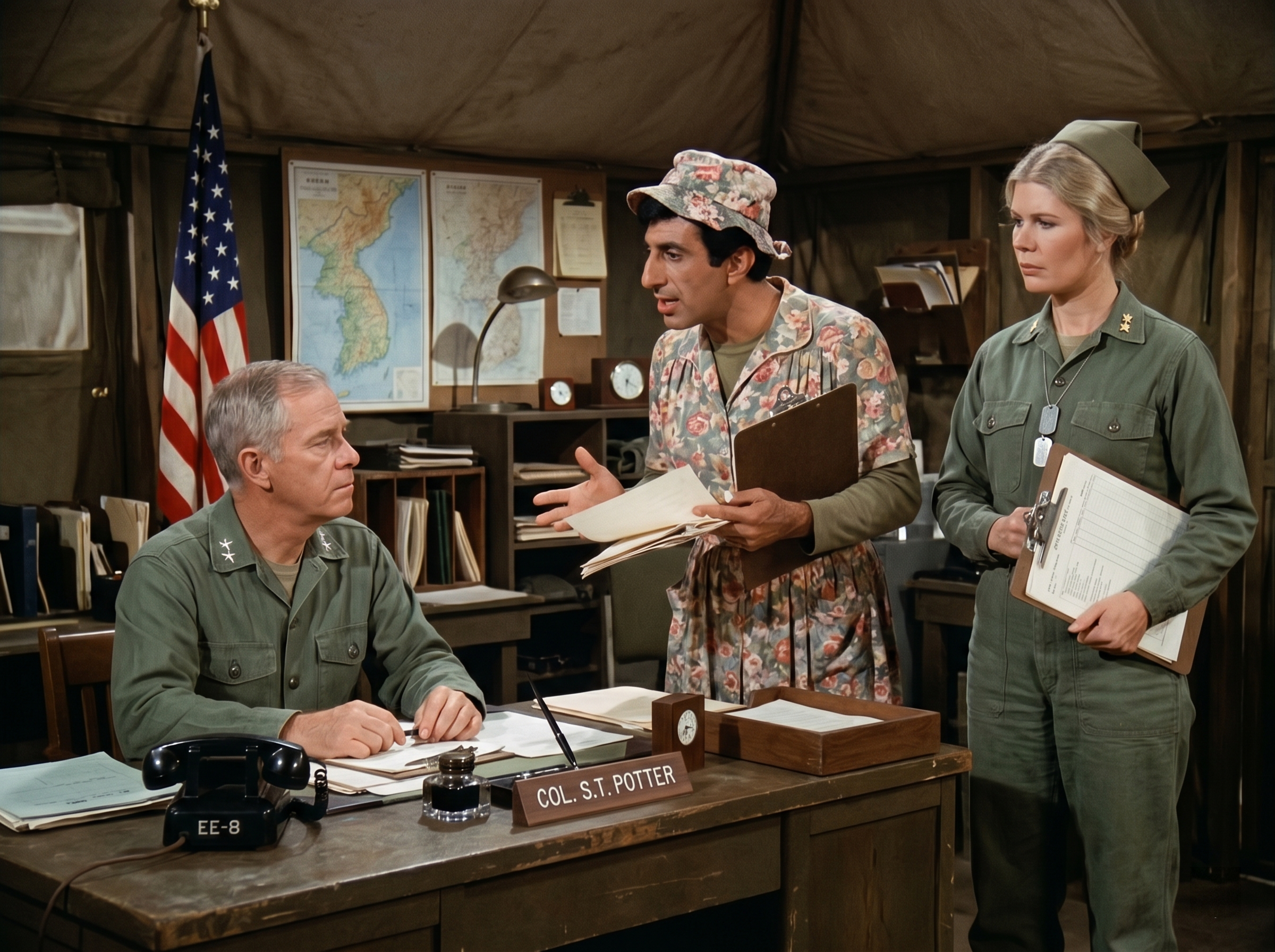
It was 0800 hours at the 4077th Mobile Army Surgical Hospital, and the Korean War was already losing its morning battle against the sheer, stubborn theater of Corporal Maxwell Q. Klinger.
The morning sun was just beginning to bake the faded canvas of the commanding officer’s tent, filling the space with the familiar, stifling scent of dust, canvas, and strong, stale coffee.
Seated behind his heavy wooden military desk, Colonel Sherman T. Potter was an island of cavalry-trained stability in a sea of olive-drab madness.
He sat with compact, perfectly steady posture. His hands rested quietly near the black EE-8 field phone and his glass inkwell.
Just inches from his folded hands, the wooden nameplate reading “COL. S.T. POTTER” stood as a silent reminder of military order—an order that was currently being tested.
Potter’s face held an expression of profound, fatherly exasperation. It was a look that only a man who had survived two world wars and a lifetime of army red tape could truly perfect.
Standing directly before the desk, completely shattering the illusion of military discipline, was Corporal Klinger.
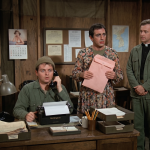
Today’s uniform of rebellion was a modest, floral-patterned house dress with a matching, floppy bucket hat.
Beneath the delicate collar of the dress, the standard-issue olive-drab undershirt of a tired army regular was clearly visible, a harsh contrast to the domestic disguise.
Klinger held a thick stack of faded paperwork in one hand, his other hand splayed open in a gesture of dramatic, theatrical pleading.
He was not just a soldier trying to get a Section 8 discharge; he was a man performing a Shakespearean tragedy in the middle of a war zone.
“It is all right here in black and white, Colonel,” Klinger declared, his voice trembling with manufactured wounded dignity.
“A legally binding, medically irrefutable affidavit from the finest minds in Toledo, Ohio. I am officially suffering from ‘Spontaneous Canvas Rejection Syndrome.'”
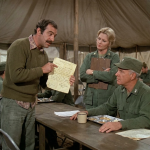
To Klinger’s left, Major Margaret Houlihan stood like a sentinel of reality.
She had come in to deliver the morning duty roster, dressed in crisp, practical fatigues, her silver oak leaves catching the soft, practical office lighting.
Margaret held her clipboard tight against her chest, her arms slightly folded in a defensive, closed posture.
She did not interrupt Klinger’s performance, but her face spoke volumes.
Her expression was one of composed, sharp skepticism. Her eyes were narrowed just slightly, taking in the absurdity of the floral hat and the frantic hand gestures with practiced disdain.
“Canvas Rejection, Corporal?” Potter asked, his voice a low, gravelly rumble that barely disturbed the quiet of the office.
“Yes, sir!” Klinger stepped closer, leaning over the paperwork. “It’s a tragedy, really. If I am exposed to military-grade canvas for more than an hour, my spirit breaks out in hives. The doctors say if I don’t breathe the smog of Lake Erie within forty-eight hours, I could lose my mind entirely.”
“Some might argue we crossed that bridge three years ago, Corporal,” Margaret noted dryly, her voice cool and measured.
Klinger shot her a look of deep, offended betrayal before turning his pleading eyes back to the Colonel.
With a flourish of his wrist, Klinger dramatically separated the top document from his stack and laid it gently, almost reverently, on the center of Potter’s desk.
“The smoking gun, Colonel,” Klinger whispered, stepping back as if the paper itself were radioactive. “Signed, sealed, and ready to be stamped ‘Approved.’ So, what time is the jeep taking me to Seoul?”
Potter did not blink. He slowly lowered his gaze to the paper, the weight of the entire camp suddenly resting on this single, ridiculous moment.
The silence in the office stretched out, heavy and thick.
Outside, the distant rumble of an incoming chopper faintly rattled the canvas walls, a harsh reminder of the real world waiting just beyond the door flaps.
Potter kept his eyes on the paper. He didn’t reach for his glasses. He didn’t need to.
“Klinger,” Potter said softly, his tone completely devoid of anger.
“Yes, Colonel, sir?” Klinger bounced slightly on his heels, hope warring with desperation in his dark eyes.
“This is a grease-stained napkin from Tony Packo’s Cafe.”
Margaret shifted her weight, a tiny, almost imperceptible smirk breaking through her strict, military composure.
“Not just any napkin, sir!” Klinger rallied instantly, waving his hands to regain control of the narrative. “That is a sworn medical testimony written by my Uncle Abdul, who is a renowned specialist in… in textiles and human suffering!”
“It says, ‘Max, owe you two hot dogs. Love, Abdul,'” Potter read aloud, his voice steady, his eyes finally rising to meet the Corporal’s.
Klinger froze, his dramatic hand gestures faltering mid-air. The theatrical energy began to drain from his posture, the floral dress suddenly looking less like a clever disguise and more like a desperate, tired uniform.
“He… he uses a very complex medical cipher, Colonel,” Klinger tried, but the usual spark was missing from his voice. “You have to read between the mustard stains.”
Margaret let out a quiet sigh. It wasn’t a sigh of annoyance, but rather the tired exhalation of a woman who had seen too much war and too many broken men.
She looked at Klinger, her sharp skepticism softening into a fleeting look of quiet, hidden tenderness.
Underneath the dress, underneath the gag, Margaret knew Klinger was just a terrified kid from Ohio who missed his family so much it physically hurt.
She tightened her grip on her clipboard, maintaining her professional boundary, but she offered no further sharp remarks.
Potter leaned back in his wooden chair, the springs creaking in protest.
He looked at Klinger—really looked at him. He saw the dark circles under the boy’s eyes. He saw the genuine, bone-deep fatigue that no floral pattern could hide.
Potter knew that this wasn’t really about a Section 8 anymore. It was about survival.
Every time Klinger put on a dress and plotted an escape, he was reminding himself that there was a world outside of Korea. He was keeping his humanity alive through sheer, stubborn absurdity.
“Corporal,” Potter said, his voice dropping to a gentle, fatherly register. “It’s a fine affidavit. Truly. One of Abdul’s best works.”
Klinger blinked, caught off guard by the unexpected softness in the Colonel’s tone. “It is?”
“It is,” Potter nodded slowly. “But I’m afraid the army doesn’t recognize mustard-based ciphers. You’re going to have to write him back and ask for a translation in pen. Until then, your request is denied.”
Klinger stood silently for a long moment. He looked at the napkin on the desk, then at Margaret, and finally at Potter.
He didn’t argue. He didn’t throw a tantrum. The dignity beneath his comedy rose to the surface.
“I understand, Colonel,” Klinger said quietly, his shoulders slumping just a fraction. “I’ll cable him immediately. Though the time difference is going to be murder.”
“Dismissed, son,” Potter said gently.
Klinger turned with a slow, sweeping motion of his skirt, clutching his remaining papers to his chest. He walked out of the office, stepping back into the harsh Korean sunlight, leaving behind a profound stillness.
Potter picked up his pen and tapped it thoughtfully against the glass inkwell.
Margaret took a step forward, finally breaking her rigid stance.
“He gets more creative every week, Colonel,” she observed, her voice low and remarkably gentle.
“It keeps him going, Major,” Potter replied, looking toward the empty doorway. “It keeps us all going.”
Margaret nodded slowly, looking down at her own tedious duty roster.
They were thousands of miles from home, surrounded by mud, blood, and fear, but in this small canvas room, they had found a strange, enduring family.
Potter dipped his pen into the ink, the scratch of the metal nib echoing in the quiet tent.
“Now,” Potter said, his dry humor returning as he looked back at Margaret. “Let’s see who is scheduled to save lives today.”
In a place where nothing made sense, the gentle madness of the 4077th was the only sanity they had left.