The Loophole in Regulation 402
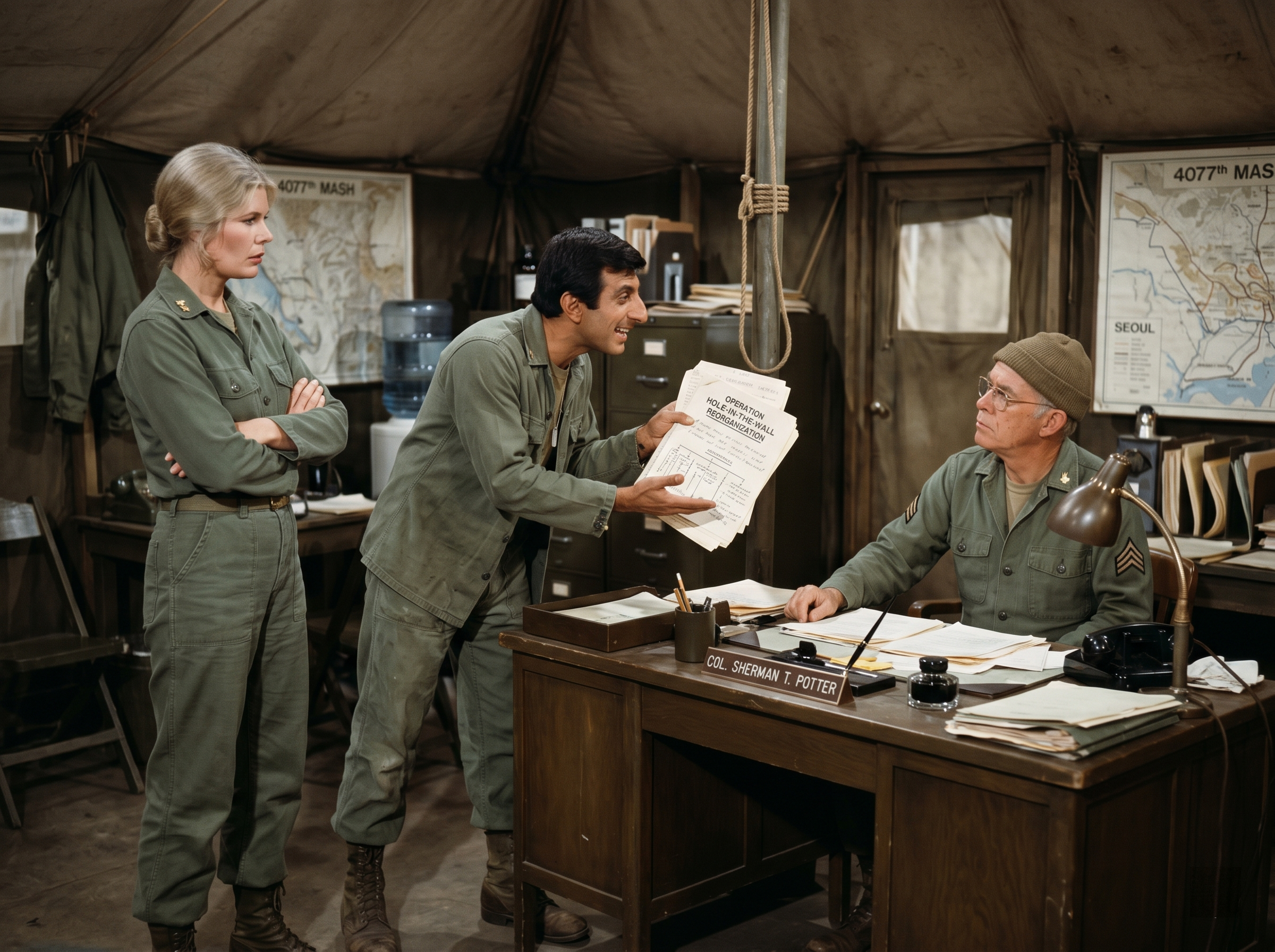
It was a quiet Tuesday afternoon, which at the 4077th meant the surgical ward was mercifully empty, the coffee was exceptionally stale, and the paperwork was actively trying to multiply.
Inside the commanding officer’s tent, the air was thick with the familiar, comforting smells of canvas, floor wax, and inevitable exhaustion.
The low hum of the camp buzzed just outside the thin walls—a distant jeep engine, the clanking of mess tents, the hollow voice of the PA system—but inside, a different kind of battle was taking place.
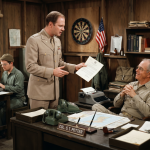
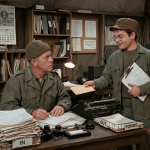
Colonel Sherman T. Potter sat securely behind his heavy wooden desk, a bastion of grounded authority in a sea of olive-drab insanity.
He leaned slightly forward into the soft, warm light of his desk lamp, his face capturing the weary wisdom and fatherly exasperation of a man who had seen it all twice over.
He peered over the rim of his glasses, trying to maintain a shred of military decorum while staring down the latest disaster.
Corporal Maxwell Klinger was not wearing a dress today.
Instead, he stood in standard-issue fatigues, dog tags hanging loosely over his undershirt, looking every bit the practical, worn-in soldier.
But his body language was entirely theatrical.
He leaned aggressively over the edge of Potter’s desk, vibrating with the manic, comic energy of a man who had just discovered the secret to alchemy.
In his hands, he held a tangled, hand-drawn bureaucratic flowchart, thrusting it proudly toward the Colonel’s face.
“It’s foolproof, Colonel!” Klinger announced, his voice practically singing with triumphant pride. “A masterpiece of military administration!”
Standing just a few feet away, Major Margaret Houlihan looked as though she was trying to set Klinger’s paperwork on fire with her mind.
Her arms were locked tightly across her chest in a gesture of absolute, composed frustration.
Her posture was stiff, her uniform impeccable, her blonde hair neatly tied back.
She stood there, radiating sharp, controlled anger, representing every ounce of military discipline that Klinger was currently ignoring.
“It is a masterpiece of lunacy, Corporal,” Margaret snapped, her voice sharp enough to slice through a combat boot. “It’s a deliberate, malicious waste of the commanding officer’s valuable time.”
Klinger didn’t even blink, keeping his eager eyes locked entirely on Potter.
“With all due respect, Major, you just don’t possess the administrative vision to appreciate the genius of the system. According to this chart, if a corporal serving in a medical unit in a foreign theater is concurrently registered as a civilian inspector of agricultural imports in Toledo…”
Potter sighed deeply, the sound carrying thirty years of Army memories.
He looked at the paper Klinger was holding.
It was a dizzying, ridiculous web of boxes, arrows, made-up acronyms, and cited regulations that didn’t exist.
“Klinger,” Potter rumbled, his voice low and steady, tinged with a dry, affectionate exhaustion. “What in the name of Marco Polo’s travel agent am I looking at?”
“My ticket home, sir,” Klinger beamed, tapping a specific, heavily circled box on the diagram. “A perfectly legal, airtight loophole. Paragraph 4, Subsection B. Conflict of interest.”
Klinger puffed out his chest, leaning in even closer.
“The Army has to discharge me immediately, Colonel. Otherwise, the United States government risks violating an obscure, binding trade treaty regarding the export of premium Ohio tomatoes!”
Margaret took a sharp step forward, her eyes narrowing into slits.
“Colonel, if you don’t throw him in the stockade this instant, I will personally court-martial him for impersonating a functioning brain. He is disrupting the entire camp with this nonsense.”
Potter raised a single, calloused hand, instantly stopping the Major’s impending explosion.
He didn’t yell. He didn’t bang his fist on the desk.
He just looked closer at the paper, and then, very slowly, he looked back up at Klinger’s face.
Beneath the theatrical grin, beneath the desperate, loud pitch for freedom, Potter noticed something else.
Klinger’s hands were shaking.
Just a little bit, trembling against the edges of the faded paper.
His eyes, usually wide with comedic mischief and defiance, held a tight, brittle kind of panic that had absolutely nothing to do with Toledo, agriculture, or military regulations.
Potter leaned forward into the lamplight, the fatherly exasperation shifting instantly into sudden, quiet alertness.
He recognized that look. He had seen it on boys in France, in Germany, and now here in Korea.
“Max,” Potter said softly, dropping the rank and using the boy’s first name. “Cut the bull. What’s really going on?”
The question hung heavily in the quiet tent, freezing the manic energy right out of Klinger’s body.
For a brief, painful second, the Corporal tried to maintain the act.
He opened his mouth, ready to spout more loud nonsense about international treaties and agricultural loopholes, but the words withered and died on his tongue.
The proud, theatrical posture slumped away, deflating like a punctured tire.
His arms lowered, letting the ridiculous clipboard rest gently on the edge of the Colonel’s desk.
Suddenly, standing in the muted light of the office, he didn’t look like a scheming trickster anymore.
He just looked like a tired, frightened kid from Ohio in a uniform that felt a few sizes too heavy.
Margaret, sensing the sudden shift in the room’s gravity, slowly uncrossed her arms.
The sharp, severe frustration melted entirely from her face.
It was replaced instantly by the guarded, tender concern she usually kept hidden beneath her brass, the quiet compassion she saved only for the triage pad.
She took a half-step closer to Klinger, not as a superior officer demanding respect, but as a nurse who knew exactly what a breaking point looked like.
“My uncle,” Klinger said, his voice cracking, dropping barely above a whisper. “Uncle Habib.”
He swallowed hard, staring down at his absurd flowchart as if seeing it for the first time.
“He’s the one who practically raised me when my dad was working three jobs at the factory. He bought me my first suit. Taught me how to hustle.”
Klinger paused, his jaw tightening as he fought to keep his voice steady.
“I got a letter from my mother this morning on the mail chopper. Habib had a massive heart attack. They don’t think…”
He squeezed his eyes shut for a second.
“They don’t think he’s going to make it through the week, Colonel.”
The silence that followed was thick and heavy.
It was the specific kind of quiet that only happens thousands of miles away from home, a silence filled with the weight of oceans and impossible distances.
Potter took off his wire-rimmed glasses and rubbed the bridge of his nose, feeling a deep, aching fatigue settle into his bones.
It was the absolute hardest part of command.
Not the noise of the artillery, not the blood in the OR, but the terrible, crushing helplessness of watching his people ache for a home they couldn’t reach.
“I’m sorry, son,” Potter said gently, his voice carrying a profound, fatherly warmth that filled the modest tent. “I truly am.”
“I just… I thought if I could confuse them,” Klinger stammered, a weak, self-deprecating smile touching his lips as he looked at his useless paperwork.
“I thought if I could just bury them in enough red tape, maybe they’d put me on a transport plane before they figured it out. I just wanted to see him.”
Margaret reached out, her hand resting gently on Klinger’s shoulder for just a brief, comforting second.
“You know they wouldn’t, Max,” she said softly, her voice entirely stripped of its usual military edge.
“I know, Major,” Klinger breathed out, the fight completely gone from him. “But I had to try. I couldn’t just sit here in the dirt and do nothing.”
Potter looked down at the flowchart resting on his desk.
It was absurd, messy, complicated, and entirely desperate—a perfect reflection of the war itself.
He picked up his fountain pen, uncapped it, and carefully, deliberately, drew a large, thick ‘X’ right through the center of Klinger’s elaborate diagram.
Klinger watched, his shoulders dropping in final defeat.
“This piece of paper,” Potter said firmly, looking back up, “is the biggest pile of horse hockey I have ever seen in my entire military career.”
He pushed the paper back across the desk toward the Corporal.
“However,” Potter continued, pulling open a side drawer of his desk, “it has brought to my attention that you are looking incredibly pale, Corporal. A bit fatigued. You look like you’re about to drop.”
Potter pulled out a small, rectangular military pad and began to write, his pen scratching loudly in the quiet room.
“Major Houlihan, wouldn’t you agree that Corporal Klinger is showing severe, undeniable signs of administrative exhaustion?”
Margaret blinked, caught off guard for only a fraction of a second.
Then, a small, deeply understanding smile touched the corners of her lips.
“Absolutely, Colonel,” she replied smoothly, standing a little taller. “He looks terrible. It’s a genuine medical concern. He’s practically a menace to camp morale.”
“My thoughts exactly,” Potter said.
He tore a slip of paper from the pad and held it out across the desk.
Klinger looked at it, confused, and took it with trembling hands.
It wasn’t a Section 8. It wasn’t a magical discharge or a ticket back to Toledo.
It was a forty-eight-hour pass to Seoul, complete with stamped authorization from the commanding officer to use the high-priority military telephone lines at central headquarters.
“You can’t sit by his bed, Max,” Potter said gently, his eyes locking onto Klinger’s. “But you can call home. You can talk to your mother. You can let them know you’re with them in spirit.”
Klinger stared at the small piece of paper, his dark eyes suddenly shining with unshed tears.
The theatrical clown was completely gone, leaving only deep, overwhelming, human gratitude.
“Colonel…” Klinger choked out, his throat tight, entirely unable to find the right words.
“Don’t thank me, son,” Potter muttered, picking his glasses back up and hooking them over his ears. “Just get out of my office before I realize what a soft old fool I’ve become. And tell your mother the 4077th sends its prayers.”
“Yes, sir,” Klinger whispered.
He clutched the pass to his chest like it was made of solid gold.
He took a step back and gave a sharp, perfectly executed military salute—no dresses, no jokes, just pure, unadulterated respect.
He turned on his heel and hurried out of the tent, the canvas flaps fluttering shut behind him.
Margaret watched the door for a moment before turning back to Potter.
Her expression had softened completely into genuine, quiet affection for the man sitting behind the desk.
“That was a good thing you did, Sherman,” she said softly.
Potter sighed, looking at the mountain of real, tedious paperwork still waiting for him in the warm lamplight.
“Just keeping the machinery oiled, Margaret,” he said wearily, picking up his pen again. “Just trying to keep the machinery oiled.”
The war was always waiting right outside the canvas, but inside that tent, they made sure no one ever had to carry it alone.