The Polish and the Prayer
The 4077th M*A*S*H was a place defined by its deafening noises, but it was the quiet moments that actually kept the camp alive.
It was a slow Tuesday afternoon, a rare and fragile lull in the fighting. The relentless roar of the chopper blades was absent, replaced by the distant, rhythmic hum of the mess tent generator and the crunch of boots on the dirt compound.
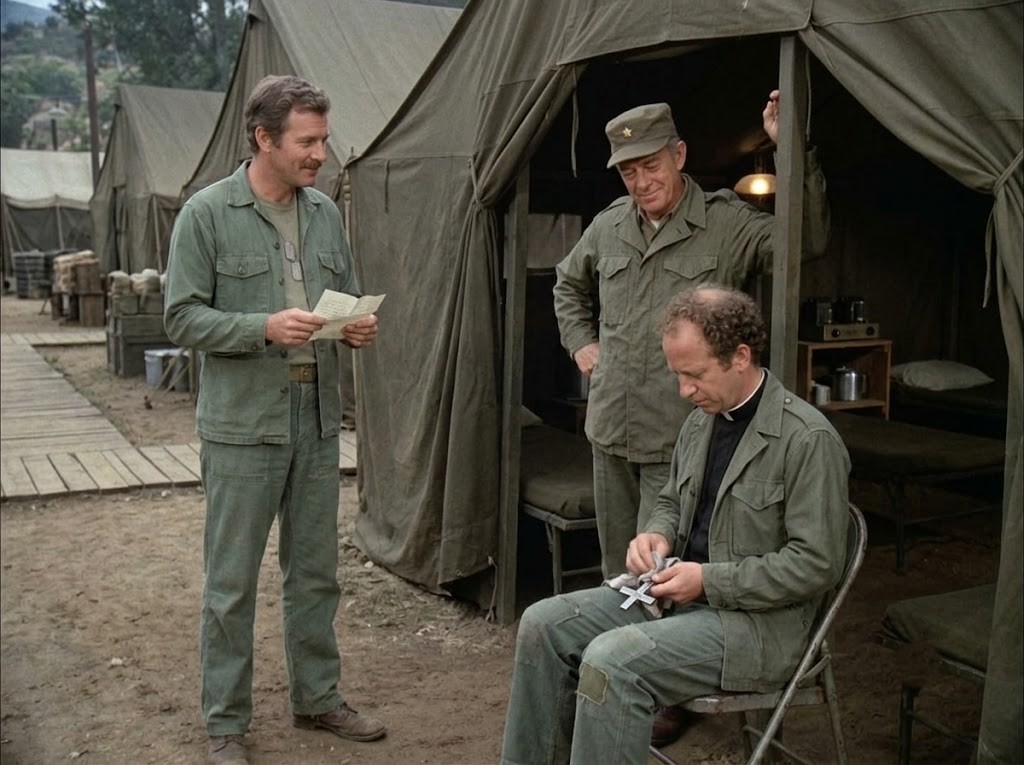
In the center of the camp, standing just outside the canvas flaps of the officers’ quarters, Captain B.J. Hunnicutt looked like a man who had briefly escaped the war.
He stood relaxed in his untucked green fatigues, his shoulders dropped, and the familiar, deep-set exhaustion temporarily erased from his face. In his hands, he held a few crinkled sheets of paper. It was a letter from his wife, Peg, a paper lifeline stretched all the way from Mill Valley, California, right into the dusty heart of South Korea.
Colonel Sherman T. Potter stood comfortably in the doorway of the tent. He leaned his shoulder against the wooden frame, his hands resting easily as he looked out at his people.
Underneath his service cap, Potter wore the fond, fatherly smile of a commanding officer who deeply loved the misfit family he had inherited. He was content just to listen, soaking in the borrowed warmth of Hunnicutt’s home front.
But just below them, the mood was heavier.
Seated on a battered metal folding chair, Father John Patrick Mulcahy seemed completely disconnected from the cheerful atmosphere above him. He wore his black clerical shirt beneath his heavy fatigue jacket, his head bowed in deep, solitary concentration.
In his hands, he held his silver cross and a small, gray rag. With slow, repetitive motions, he was quietly polishing the metal.
He had been sitting there for twenty minutes, rubbing the cross with a quiet intensity. The last session in the operating room had been a grueling marathon of torn youth, and Mulcahy had spent hours standing over boys whose lives were slipping away.
When the surgeons couldn’t fix them, the burden of their final moments fell squarely onto the chaplain’s narrow shoulders. It was a spiritual weight that left him feeling deeply inadequate, and the polishing was a nervous habit—a desperate attempt to scrub away the lingering tarnish of a war he could not stop.
B.J. smiled warmly at the letter, his eyes scanning his wife’s familiar handwriting. “Peg says Erin has finally discovered the magical properties of mud,” he chuckled softly, turning the page. “Apparently, she tried to bring a fistful of it into the living room to feed the dog.”
Potter let out a dry, rumbling laugh from the doorway. “You better write back and tell Peg to lock the doors, Hunnicutt. Once a kid gets a taste for dirt, you’ll be sweeping it out of your bedsheets until they’re in college.”
B.J. smiled, but as his eyes moved down to the second page of the letter, his expression suddenly shifted.
The soft, nostalgic amusement vanished from his face. His posture straightened just a fraction. He stopped reading aloud, his eyes tracking rapidly back and forth across the paper as if he couldn’t quite believe what he was seeing.
The silence in the small circle became thick and noticeable. Potter’s smile faded into a look of quiet, commanding observation. He shifted his weight, his instincts instantly flaring at the sudden change in his surgeon’s demeanor.
Down on his folding chair, Father Mulcahy remained oblivious, his thumb rubbing hard against the silver cross, trapped in the heavy echo of the morning’s casualties.
B.J. lowered the stationary slowly. He looked down at the top of the chaplain’s head, his voice dropping to a gentle, serious register.
“Father,” B.J. said quietly. “You’d better stop polishing for a second. This part of the letter… it’s for you.”
Mulcahy’s hands froze instantly.
The small gray cloth slipped slightly, revealing the brightly polished silver of his cross, gleaming in the dull, overcast light of the Korean afternoon. He lifted his head, his face lined with fatigue and a sudden, fragile apprehension.
Potter straightened up in the doorway, stepping just an inch closer. As the commanding officer, he was always ready to catch one of his people if the mail from home delivered a devastating blow.
“Everything alright, Hunnicutt?” Potter asked, his voice low and steady.
B.J. nodded, though his eyes never left the chaplain. “It’s not bad news, Colonel,” he said softly. He looked back at the paper, taking a careful breath. “Peg says she got a phone call last week. From a woman living over in San Francisco. Her last name is Miller.”
Mulcahy blinked, his brow furrowing as he searched his encyclopedic memory of the wounded. “Miller?” he whispered, his voice slightly hoarse.
“Corporal David Miller,” B.J. clarified, his tone gentle. “We had him in here about a month ago. Nasty chest wound. We operated on him in the middle of that terrible three-day deluge.”
Recognition flashed in Mulcahy’s eyes. He remembered the boy vividly. Miller had been nineteen, terrified, and shivering violently in post-op. He had been convinced that if he closed his eyes, he would never wake up again.
“I remember him,” Mulcahy said quietly, his grip tightening on the cross. “He was so very afraid of the dark. We waited together for the morning evacuation chopper. I… I just sat with him.”
B.J. offered a small, crooked smile, though his eyes were shining with sudden emotion. “Well, Father, he made it home. He’s in a veteran’s hospital in California right now, and he’s going to make a full recovery.”
Mulcahy let out a long, shuddering breath, a profound wave of relief washing over his tired features. “Oh, thank the Lord. That is wonderful news, Captain. Truly wonderful.”
“It gets better,” B.J. said, his voice thick with a sudden, overwhelming warmth. “His mother tracked Peg down through the local operator. She knew the surgeon who fixed her boy was from Mill Valley, and she wanted to make sure my wife knew I had done a good job.”
B.J. paused, swallowing hard, struggling to keep his voice steady as he looked down at the bottom of the page.
“But that’s not the main reason she called, Father,” B.J. continued, reading directly from Peg’s elegant script. “Mrs. Miller asked Peg to pass a message to the Catholic chaplain at the 4077th.”
Mulcahy sat perfectly still, his breath catching in his throat.
B.J. cleared his throat and read the exact words. “‘Please tell the Father that my son is alive today because of him. David said the doctors stitched up his chest, but it was the priest holding his hand in the dark who kept his heart beating. He said he would have given up if the Father hadn’t stayed awake to sing to him.'”
The camp around them seemed to fade away completely. The distant sound of the generator and the jeep engines became nothing more than white noise.
Mulcahy stared at B.J., his mouth slightly open. The gray rag dropped from his fingers, tumbling into the dust beneath his boots. His eyes quickly filled with hot, unshed tears, and he hurriedly wiped at his face with the back of his hand, profoundly embarrassed by his own sudden vulnerability.
For a man who spent every single day wondering if his prayers and his presence made any actual difference in the machinery of war, the words were a stunning, deeply healing grace.
Potter’s face softened into an expression of immense, fatherly pride. He stepped down from the wooden threshold of the tent and walked over to the seated priest.
With a heavy, gentle hand, the Colonel reached out and squeezed Mulcahy’s shoulder. It was a firm, grounding touch, full of unspoken respect.
“Like I’ve always said, Francis,” Potter murmured, his voice rich with affection. “You do a lot more than just pray for us. You shine up the insides of this whole damn camp.”
Mulcahy sniffled softly, offering a trembling, incredibly bright smile. He looked up at Potter, then over to B.J., seeing the deep, brotherly love reflected in both of their faces. They weren’t just colleagues in a medical unit; they were his family, his flock, and his anchor.
B.J. folded the letter carefully and tucked it into his shirt pocket, tapping it once right over his heart. He didn’t need to say anything else. The heavy burden that had been pressing down on the compound all afternoon had been entirely lifted.
Father Mulcahy looked down at his lap. He picked up his silver cross, holding it delicately in his palm.
He didn’t reach for the polishing cloth in the dirt. He realized, in the quiet warmth of the afternoon, that his faith didn’t need any more scrubbing today. It was already shining exactly as bright as it needed to be.
In a place built on mending broken bodies, they always relied on the quietest among them to mend their broken spirits.