A Touch of Yellow in the Mud
The mud in Korea had a way of seeping into everything—your boots, your blankets, and eventually, your soul. It was a relentless, drab gray world that chewed up days and spit out exhaustion. But inside the wood-paneled sanctuary of the Colonel’s office, the battle against the madness was fought with a very different kind of weapon.
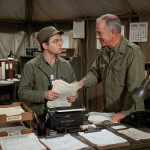
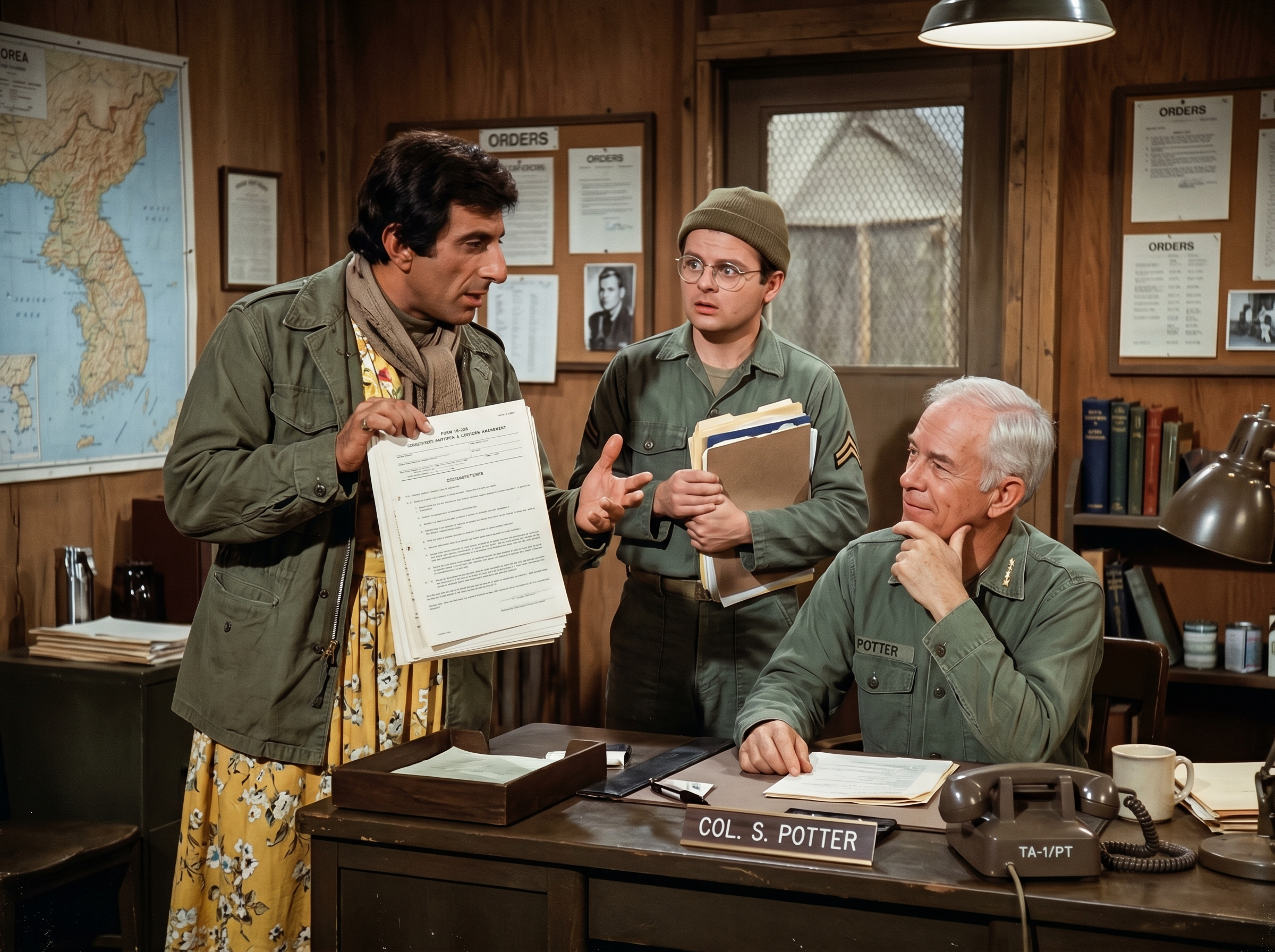
Colonel Sherman T. Potter sat quietly at his desk, his hand resting thoughtfully against his chin as he looked up. The brass nameplate before him read “COL. S. POTTER,” a small island of strict military order in a place that felt entirely lawless. On the wall behind him, the map of the Korean peninsula hung like a reminder of their displacement, flanked by bulletin boards cluttered with endless, fading orders.
Standing directly in front of the desk was Corporal Maxwell Klinger, looking as magnificent and ridiculous as the circumstances allowed. Beneath his standard-issue olive-drab field jacket, he was wearing a vibrant, yellow floral-printed dress that cascaded down past his knees, paired with a heavy brown winter scarf wrapped tightly around his neck.
In his right hand, Klinger proudly brandished a thick, official military document, holding it up like a holy relic while his left hand gestured grandly in the air. His face was a picture of intense, theatrical desperation, his dark eyes wide as he tried to plead his latest case for a ticket out of the war.
Between them stood Corporal Radar O’Reilly, clutching a stack of manila folders to his chest like a shield. Radar’s eyes were wide with a mix of anxiety and innocence, his woolen beanie pulled low over his ears as he nervously shifted his weight, looking back and forth between his commander and the desperate dress-wearer.
“I’m telling you, Colonel, it’s right here in black and white,” Klinger insisted, his voice a dramatic mix of a carnival barker and a dying man making his final request. “Section Four, Paragraph Two of the revised Mediterranean theater code, which by legal precedent carries over to the Pacific and mainland Asia under the Unified Command Act of 1947!”
Colonel Potter didn’t yell; he merely let out a slow, weathered breath and kept his eyes fixed on Klinger, a tiny, amused smile playing at the corner of his mouth. He had seen a hundred of Klinger’s legal loopholes, each one more creative than the last, yet he always gave the man his stage.
Radar cleared his throat nervously, his voice cracking just a bit as he chimed in. “Uh, sir, technically, Klinger made me look it up in the big green binder under the supply cot, and… well, according to the words written on the paper, he might actually have a point this time.”
Klinger slammed his hand against the document, leaning over the desk with an expression of pure, unadulterated hope. “It’s my golden ticket, Colonel! My mother’s cousin’s uncle in Toledo has a certified shortage of tractor mechanics, and under this specific provision, as an essential citizen of Lucas County, I am legally required to be repatriated immediately!”
Potter looked from the yellow flowers on Klinger’s dress to the intense, aching sincerity hidden deep behind the corporal’s eyes. The office grew suddenly quiet, the distant hum of a generator outside the screen door filling the silence as Potter reached out his hand toward the paper.
—
PART 2:
Colonel Potter took the document from Klinger’s hand, the paper crisp against the humid, stale air of the office. He pulled his glasses down from his forehead, adjusting them on his nose as he carefully scanned the typed lines.
Klinger held his breath, his hands freezing mid-gesture, while Radar seemed to stop breathing altogether, his knuckles turning white against his manila folders. For a fleeting second, the silly yellow dress didn’t look like a joke anymore; it looked like a man’s desperate, colorful prayer to go home to the streets he loved.
Potter read the paragraph once, then twice, his thumb tracing the official army seal at the bottom of the page. He let out a soft hum, the kind he usually reserved for a good glass of scotch or a particularly well-behaved horse.
“Well, Corporal,” Potter said slowly, looking up over the rims of his glasses. “This is a remarkably fine piece of legal engineering. You and Radar must have burned a whole gallon of midnight oil finding this hidden away in the archives.”
“Two gallons, sir! And a box of Fig Newtons!” Klinger blurted out, a massive, triumphant grin spreading across his face. “Does this mean… Toledo? The Toledo Mud Hens? A real hot dog from Tony Packo’s instead of mystery meat in a tin can?”
Potter sighed, his expression softening into that fatherly, wise gaze that had anchored the 4077th through its darkest nights. He carefully laid the document down on top of his desk blotter, smoothing it out with the palm of his hand.
“It means, Klinger, that you have a wonderful imagination and a heart that loves Ohio more than anyone I’ve ever met,” Potter said gently. “But if you look at the very top of page two, you’ll see this particular directive was rescinded by the Department of the Army exactly three months before we crossed the parallel.”
Klinger’s grin froze, then slowly melted away, his shoulders slumping beneath the heavy olive-drab jacket. The dramatic energy drained out of him all at once, leaving just a tired kid from Toledo standing in a wet tent in the middle of a war zone.
“Rescinded, sir?” Klinger asked, his voice suddenly dropping its theatrical pitch, sounding small and genuinely heartbroken.
“Rescinded, son,” Potter confirmed quietly. He stood up from his chair, walking around the desk until he was standing right in front of Klinger, looking past the makeup and the floral pattern straight into the soldier. “I’m sorry, Klinger. I truly am.”
Radar looked down at his boots, feeling the heavy disappointment in the room like a physical weight. He knew how much Klinger missed home, just like he missed Iowa, and just like the Colonel missed Missouri.
Klinger stared at the floor for a long moment, clutching his scarf. “I just… I thought this was the one, Colonel. I really thought I found the way out this time. The mud is just getting so heavy.”
Potter reached out and placed a firm, steady hand on Klinger’s shoulder, the gesture full of a quiet, unshakeable loyalty. “We all want to go home, Max. Every blessed one of us. But until that day comes, we need you here. Who else is going to bring a little color to this dreary place?”
Klinger looked up, seeing the genuine warmth and respect in his commander’s eyes, and a faint, modest smile returned to his lips. He wiped a stray tear from his cheek, adjusting the collar of his jacket over his floral dress with a sudden return of his natural dignity.
“Well,” Klinger muttered, clearing his throat and trying to find his usual bravado. “I suppose a dress this beautiful shouldn’t be wasted on a troop ship anyway. The fellas in the post-op haven’t seen this yellow one yet. It cheers ’em up.”
“That it does, Corporal,” Potter said with a nod, stepping back behind his desk. “Now, both of you get back to work before I find a real regulation to put you on latrine duty.”
“Yes, sir,” Radar whispered, already moving toward the door with his folders.
Klinger gave a crisp, perfectly executed military salute, his yellow skirt swirling slightly as he turned on his heel to follow Radar out into the grey Korean afternoon. Potter watched them go, his heart heavy with the bittersweet reality of their lives, yet deeply grateful for the strange, beautiful family they had built in the mud.
FINAL LINE:
In the heart of the 4077th, home was always a million miles away, but family was as close as the nearest smile.TITLE: A Touch of Yellow in the Mud
PART 1:
The mud in Korea had a way of seeping into everything—your boots, your blankets, and eventually, your soul. It was a relentless, drab gray world that chewed up days and spit out exhaustion. But inside the wood-paneled sanctuary of the Colonel’s office, the battle against the madness was fought with a very different kind of weapon.
Colonel Sherman T. Potter sat quietly at his desk, his hand resting thoughtfully against his chin as he looked up. The brass nameplate before him read “COL. S. POTTER,” a small island of strict military order in a place that felt entirely lawless. On the wall behind him, the map of the Korean peninsula hung like a reminder of their displacement, flanked by bulletin boards cluttered with endless, fading orders.
Standing directly in front of the desk was Corporal Maxwell Klinger, looking as magnificent and ridiculous as the circumstances allowed. Beneath his standard-issue olive-drab field jacket, he was wearing a vibrant, yellow floral-printed dress that cascaded down past his knees, paired with a heavy brown winter scarf wrapped tightly around his neck.
In his right hand, Klinger proudly brandished a thick, official military document, holding it up like a holy relic while his left hand gestured grandly in the air. His face was a picture of intense, theatrical desperation, his dark eyes wide as he tried to plead his latest case for a ticket out of the war.
Between them stood Corporal Radar O’Reilly, clutching a stack of manila folders to his chest like a shield. Radar’s eyes were wide with a mix of anxiety and innocence, his woolen beanie pulled low over his ears as he nervously shifted his weight, looking back and forth between his commander and the desperate dress-wearer.
“I’m telling you, Colonel, it’s right here in black and white,” Klinger insisted, his voice a dramatic mix of a carnival barker and a dying man making his final request. “Section Four, Paragraph Two of the revised Mediterranean theater code, which by legal precedent carries over to the Pacific and mainland Asia under the Unified Command Act of 1947!”
Colonel Potter didn’t yell; he merely let out a slow, weathered breath and kept his eyes fixed on Klinger, a tiny, amused smile playing at the corner of his mouth. He had seen a hundred of Klinger’s legal loopholes, each one more creative than the last, yet he always gave the man his stage.
Radar cleared his throat nervously, his voice cracking just a bit as he chimed in. “Uh, sir, technically, Klinger made me look it up in the big green binder under the supply cot, and… well, according to the words written on the paper, he might actually have a point this time.”
Klinger slammed his hand against the document, leaning over the desk with an expression of pure, unadulterated hope. “It’s my golden ticket, Colonel! My mother’s cousin’s uncle in Toledo has a certified shortage of tractor mechanics, and under this specific provision, as an essential citizen of Lucas County, I am legally required to be repatriated immediately!”
Potter looked from the yellow flowers on Klinger’s dress to the intense, aching sincerity hidden deep behind the corporal’s eyes. The office grew suddenly quiet, the distant hum of a generator outside the screen door filling the silence as Potter reached out his hand toward the paper.
Colonel Potter took the document from Klinger’s hand, the paper crisp against the humid, stale air of the office. He pulled his glasses down from his forehead, adjusting them on his nose as he carefully scanned the typed lines.
Klinger held his breath, his hands freezing mid-gesture, while Radar seemed to stop breathing altogether, his knuckles turning white against his manila folders. For a fleeting second, the silly yellow dress didn’t look like a joke anymore; it looked like a man’s desperate, colorful prayer to go home to the streets he loved.
Potter read the paragraph once, then twice, his thumb tracing the official army seal at the bottom of the page. He let out a soft hum, the kind he usually reserved for a good glass of scotch or a particularly well-behaved horse.
“Well, Corporal,” Potter said slowly, looking up over the rims of his glasses. “This is a remarkably fine piece of legal engineering. You and Radar must have burned a whole gallon of midnight oil finding this hidden away in the archives.”
“Two gallons, sir! And a box of Fig Newtons!” Klinger blurted out, a massive, triumphant grin spreading across his face. “Does this mean… Toledo? The Toledo Mud Hens? A real hot dog from Tony Packo’s instead of mystery meat in a tin can?”
Potter sighed, his expression softening into that fatherly, wise gaze that had anchored the 4077th through its darkest nights. He carefully laid the document down on top of his desk blotter, smoothing it out with the palm of his hand.
“It means, Klinger, that you have a wonderful imagination and a heart that loves Ohio more than anyone I’ve ever met,” Potter said gently. “But if you look at the very top of page two, you’ll see this particular directive was rescinded by the Department of the Army exactly three months before we crossed the parallel.”
Klinger’s grin froze, then slowly melted away, his shoulders slumping beneath the heavy olive-drab jacket. The dramatic energy drained out of him all at once, leaving just a tired kid from Toledo standing in a wet tent in the middle of a war zone.
“Rescinded, sir?” Klinger asked, his voice suddenly dropping its theatrical pitch, sounding small and genuinely heartbroken.
“Rescinded, son,” Potter confirmed quietly. He stood up from his chair, walking around the desk until he was standing right in front of Klinger, looking past the makeup and the floral pattern straight into the soldier. “I’m sorry, Klinger. I truly am.”
Radar looked down at his boots, feeling the heavy disappointment in the room like a physical weight. He knew how much Klinger missed home, just like he missed Iowa, and just like the Colonel missed Missouri.
Klinger stared at the floor for a long moment, clutching his scarf. “I just… I thought this was the one, Colonel. I really thought I found the way out this time. The mud is just getting so heavy.”
Potter reached out and placed a firm, steady hand on Klinger’s shoulder, the gesture full of a quiet, unshakeable loyalty. “We all want to go home, Max. Every blessed one of us. But until that day comes, we need you here. Who else is going to bring a little color to this dreary place?”
Klinger looked up, seeing the genuine warmth and respect in his commander’s eyes, and a faint, modest smile returned to his lips. He wiped a stray tear from his cheek, adjusting the collar of his jacket over his floral dress with a sudden return of his natural dignity.
“Well,” Klinger muttered, clearing his throat and trying to find his usual bravado. “I suppose a dress this beautiful shouldn’t be wasted on a troop ship anyway. The fellas in the post-op haven’t seen this yellow one yet. It cheers ’em up.”
“That it does, Corporal,” Potter said with a nod, stepping back behind his desk. “Now, both of you get back to work before I find a real regulation to put you on latrine duty.”
“Yes, sir,” Radar whispered, already moving toward the door with his folders.
Klinger gave a crisp, perfectly executed military salute, his yellow skirt swirling slightly as he turned on his heel to follow Radar out into the grey Korean afternoon. Potter watched them go, his heart heavy with the bittersweet reality of their lives, yet deeply grateful for the strange, beautiful family they had built in the mud.
In the heart of the 4077th, home was always a million miles away, but family was as close as the nearest smile.