The Quiet Comfort of the Mess Tent
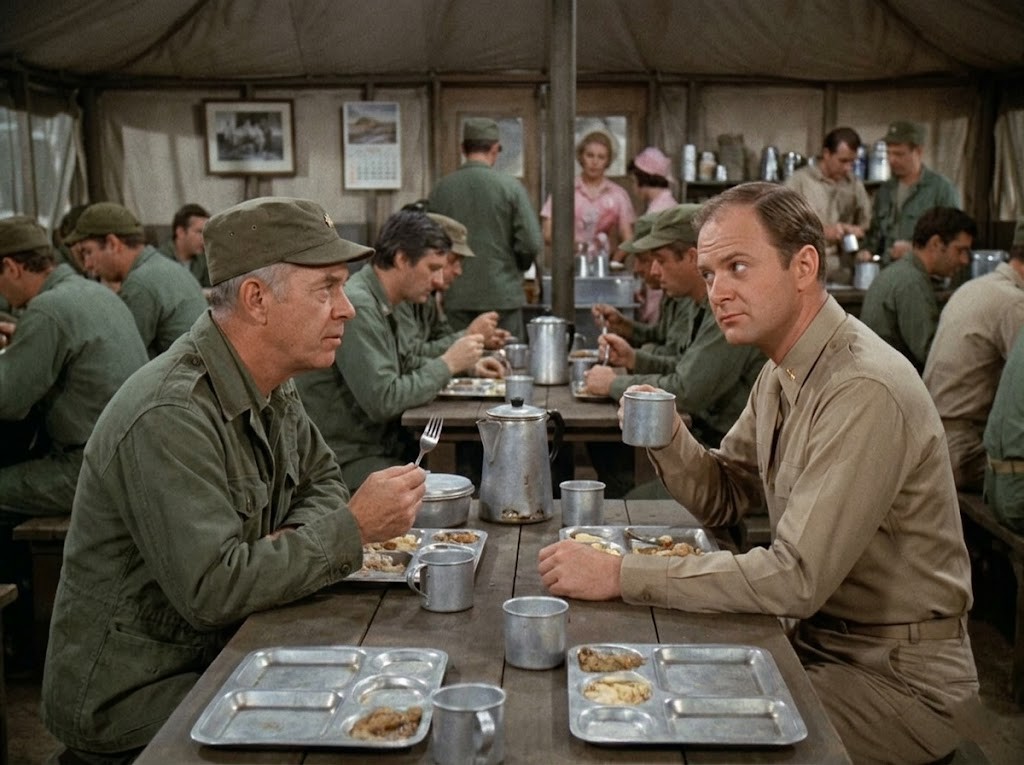
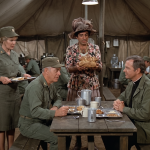
The tin trays always smelled vaguely of industrial soap and the ghosts of a thousand boiled potatoes. In the 4077th, the mess tent wasn’t just a place to fuel a tired body; it was a sanctuary where the war was temporarily barged out by the clatter of aluminum forks. Tonight, the air was thick with the usual humid heavy heat, the distant thud of artillery acting as a low bassline to the chatter of weary personnel.
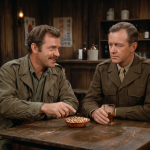
Colonel Potter sat across from Charles Emerson Winchester III, his fork poised mid-air, a look of weathered skepticism etched deep into his forehead. Between them lay a sea of lukewarm gravy and mystery meat that defied any known biological classification. Charles, looking impeccably composed despite the olive-drab surroundings, held his metal cup with a delicate precision that belonged in a Boston parlor, not a canvas tent in Korea.
“Winchester,” Potter said, his voice a dry, gravelly rumble that could stop a charging jeep. “You’ve been staring at that piece of gristle for five minutes like it’s about to recite Shakespeare. Eat it or bury it, but stop giving it the eye.”
Charles sighed, a sound soaked in Brahmin superiority and profound exhaustion. “Colonel, I am merely contemplating the absolute tragedy of human culinary degradation. Back in Boston, a piece of meat is treated with reverence, marinated in fine wine, and served by a man who knows how to pronounce ‘hors d’oeuvre.’ Here, it appears to have been tenderized by a convoy of heavy trucks.”
A few benches down, Hawkeye Pierce let out a sharp, barking laugh, his eyes twinkling behind the mask of twenty hours in OR. “Come on, Charles! That gristle is local royalty. I think it’s the same piece of beef Igor used to patch a hole in the swamp’s roof last Tuesday. It’s got structural integrity.”
“It has the texture of an old boot heel, Pierce,” Charles shot back, though his posture softened just a fraction. He took a slow sip of the lukewarm water from his tin cup, his eyes drifting toward the canvas door where the sound of an incoming chopper suddenly broke the rhythm of the mess hall.
The tent went momentarily still, the collective breath of fifty people holding in their chests. It was the unspoken rule of the 4077th: the meat might be terrible, the coffee might taste like battery acid, but the moment the choppers wailed, the world stopped. Potter dropped his fork, his fatherly gaze instantly shifting from Charles’s plate to the horizon beyond the tent flaps, his eyes mapping out the long night of surgery that was undoubtedly about to begin.
The chopper sound faded into the distance—a passing transport, not an inbound casualty run. A collective, silent exhale rippled through the mess tent, and the clatter of tin forks resumed.
Potter picked his fork back up, looking at Charles with a gentleness that he usually reserved for his horse, Sophie, or a letter home to Mildred. “We’re all tired, Charles. I know Boston feels like a different planet right now. Heck, Missouri feels like a fairy tale I read forty years ago.”
Charles looked down at his metal tray, the sarcastic armor slipping away for just a fraction of a second. Underneath the snobbery was a man who had spent the last three days stitching young men back together, his hands steady while his soul grew heavier. He took his fork and finally pushed the mystery meat aside, choosing instead a small mound of mashed potatoes that looked remarkably like library paste.
“It isn’t just the food, Colonel,” Charles murmured, his voice dropping to a register that Hawkeye and B.J. couldn’t hear over their own bantering. “It is the… the relentless uniformity of it all. The green tents, the green clothes, the green trucks. Sometimes, I worry that when I return, I will no longer recognize a color that isn’t olive drab.”
Potter smiled, a small, knowing crease at the corner of his mouth. He reached out and tapped the rim of Charles’s tin cup with his own fork, a sharp, ringing sound that cut through the low drone of the room.
“You see that sheen on the tin, Charles?” Potter asked quietly. “That’s not olive drab. That’s the silver lining. Look around this room. You’ve got Pierce making jokes that would get him court-martialed in a regular army unit. You’ve got Hunnicutt missing his kid so bad it hurts, but still sharing his last stick of gum. And you’ve got me, an old cavalryman who somehow found himself commanding the finest bunch of doctors on God’s green earth.”
Charles looked up, his pale eyes meeting the Colonel’s steady, fatherly gaze. He looked around the crowded tent—at the nurses laughing over bad coffee, at Radar rushing in with a stack of forms, at the absolute mess of humanity crammed under a canvas roof in the middle of a forgotten valley.
“I suppose,” Charles said, adjusting his collar with a return of his usual dignity, “that if one must be marooned in a wasteland, the company could be marginally worse.”
Hawkeye leaned over from the next table, throwing a stale biscuit into Charles’s tray with a perfect arc. “Careful, Winchester. If you start liking us, we’ll have to report you to the Boston Medical Board for a complete loss of standards.”
Charles didn’t throw the biscuit back. Instead, he picked it up, inspected it for microscopic life, and took a small, fastidious bite. The dry humor, the shared fatigue, and the quiet, unbreakable bond of the 4077th settled over the table like a warm blanket, keeping the cold Korean night at bay for just a little longer.
In a place where everything felt temporary, the family they built was the only thing that stayed real.