The Canvas Confessional
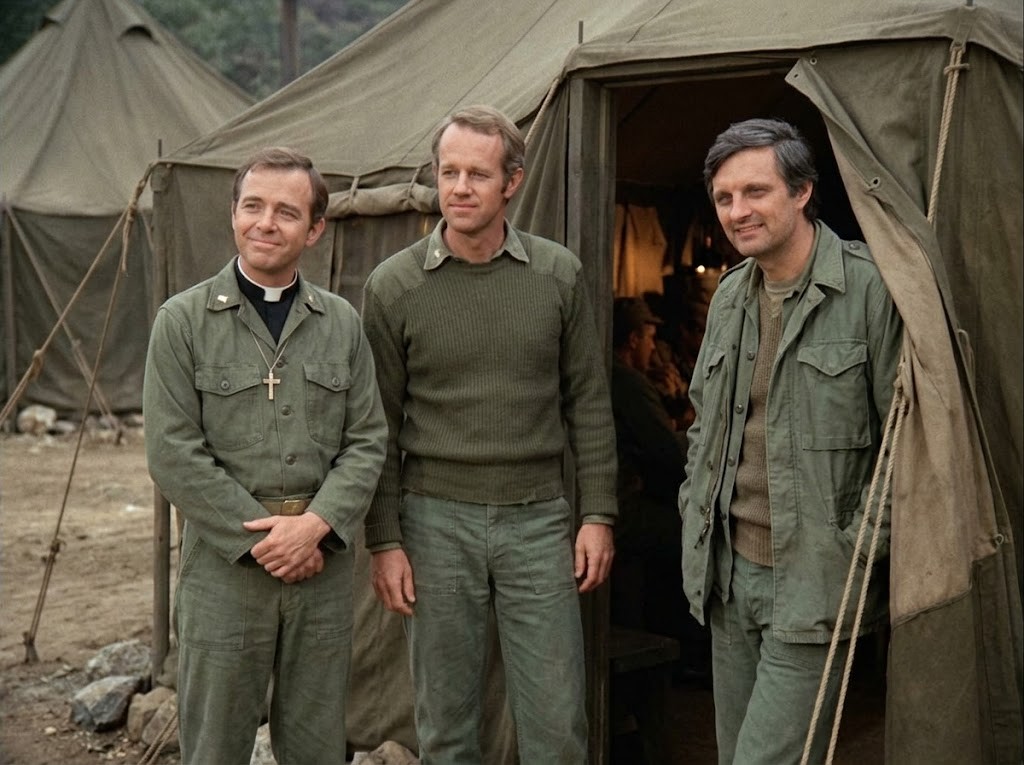
The mud in Korea has a memory. It remembers every boot that ever sank into it, every heavy-hearted trudge toward the O.R., and every brief, breathless moment of laughter that managed to crack through the gray morning chill.
On this particular afternoon, the 4077th was wrapped in a rare, heavy silence. The chopper blades had finally stopped spinning an hour ago, leaving behind the usual ringing in everyone’s ears and a exhaustion so deep it felt carved into the bone.
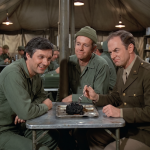
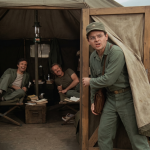
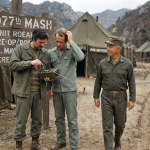
Outside the Swamp, three figures stood in the pale light, looking out over the compound. Father Mulcahy stood to the left, his hands clasped tightly before him, his silver cross catching the dim sun, wearing a faint, tentative smile that always seemed to ask permission to be hopeful. Beside him was B.J. Hunnicutt, looking solid and grounded in his heavy olive sweater, his eyes fixed on something distant, his expression a mixture of quiet resilience and a father’s faraway longing. On the right, Hawkeye Pierce leaned against the tent framework, his hands shoved deep into his jacket pockets, a crooked, tired grin splitting his face—the kind of look he used to mask the raw edges of a soul that had seen too much.
They were waiting. Not for a fresh influx of wounded, thank heaven, but for Radar.
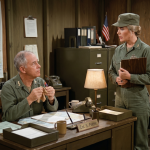
The company clerk had been unusually quiet all morning, going about his duties with his head down, refusing to look anyone in the eye. A few minutes ago, Colonel Potter had called the young corporal into his office, and the heavy canvas flap of the administrative tent had dropped shut behind them like a iron curtain.
“He looked pale, didn’t he?” Mulcahy asked softly, his voice barely carrying over the distant hum of the generator. “When he walked in there. Like a lad facing the firing squad.”
B.J. shifted his weight, his boots crunching on the gravel. “Potter’s not going to skin him, Father. But Radar’s got that look he gets when he thinks he’s let the whole world down. It’s a heavy load for a kid from Iowa to carry.”
Hawkeye let out a short, dry chuckle, though his eyes remained soft. “If Radar did something wrong, it probably involves accidentally ordering ten thousand left-handed tongue depressors or giving Sparky at Seoul-com a piece of his mind. The kid’s conscience has its own zip code.”
Just then, the door to the office tent creaked open slightly. Through the gap, they could see the silhouette of Colonel Potter, his posture stiff, holding a crumpled piece of paper in his hand. Radar was standing in front of him, his shoulders slumped so low his chin nearly touched his oversized dog tags.
The three men outside froze, their banter evaporating into the cold air. They saw Potter raise his hand, the paper trembling slightly in his grip, his voice muffled but undeniably stern.
Radar’s shoulders hitched. The boy who kept the entire camp running, the boy who could hear the choppers before they even cleared the mountains, looked suddenly small, fragile, and completely broken.
Hawkeye took his hands out of his pockets, the sarcastic grin vanishing instantly from his face. “Alright, that’s enough. If the Old Man is tearing into him, I’m going in there. I’ll tell him Radar was acting under my orders. I’ll invent a medical emergency. I’ll tell him we needed those left-handed tongue depressors for a rare condition called Iowa-itis.”
“Hold on, Hawk,” B.J. said, putting a steadying hand on Hawkeye’s arm. “Look closer.”
Inside the tent, Colonel Potter wasn’t shouting. He slowly lowered the paper, his stern expression softening into something deeply, profoundly tired. He reached out and placed a heavy, fatherly hand on Radar’s shoulder.
Outside, Mulcahy, B.J., and Hawkeye watched as the tension broke. They couldn’t hear the words, but they saw the exact moment the boy’s shoulders stopped shaking. They saw Radar look up, his round glasses reflecting the dim oil lamp inside, a look of immense, tearful relief washing over his face.
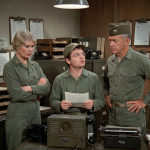
The office door opened fully, and Radar stepped out into the compound, holding a small, battered cardboard box. He stopped when he saw the trio waiting for him. He looked sheepish, his cheeks flushed pink.
“What’s in the box, Radar? Contraband?” Hawkeye asked, his voice returning to its familiar, comforting drawl as he stepped forward, trying to ease the boy’s embarrassment. “Please tell me it’s real beef. Or at least a pair of clean socks.”
Radar looked down at the box, then up at the three men who had become his surrogate family. “It’s… well, it’s a bunch of letters, sirs. From home. My mom sent them, but they got mixed up with the official casualty reports from Tokyo. I thought… I thought I lost them. I spent three hours searching the filing cabinets instead of logging the morning requisitions. Colonel Potter found me doing it.”
“And the Colonel?” Father Mulcahy asked gently, stepping closer, his smile widening with genuine warmth.
“He told me that a man who doesn’t look after his mother’s letters isn’t much of a man at all,” Radar whispered, a small, genuine smile finally breaking across his face. “Then he gave me two hours off to read them. He said if I didn’t finish them by dinner, he’d make me eat the chipped beef.”
A collective sigh of relief passed through the group. B.J. let out a soft laugh, his eyes crinkling at the corners as he thought of his own daughter’s drawings waiting for him across the ocean. “The Old Man’s tougher than a boot, but he’s got a soft spot for Iowa.”
Hawkeye leaned back against the tent pole, the warmth returning to his posture, his tired eyes shining with a quiet affection for the kid, the camp, and the strange, beautiful community they had built in the middle of a wasteland. “See? What did I tell you? The 4077th operates on a strict policy of absolute chaos, balanced out by an occasional outbreak of human decency.”
They stood there together for a long moment, just four men in olive drab, bathed in the fading afternoon light, watching the smoke rise from the mess tent. The war was still out there, just beyond the hills, waiting for tomorrow. But right here, next to a canvas tent in the mud, there was a little bit of home.
In a place where tomorrow was never promised, they held onto each other, finding pieces of home in the middle of nowhere.