The Broken Lense
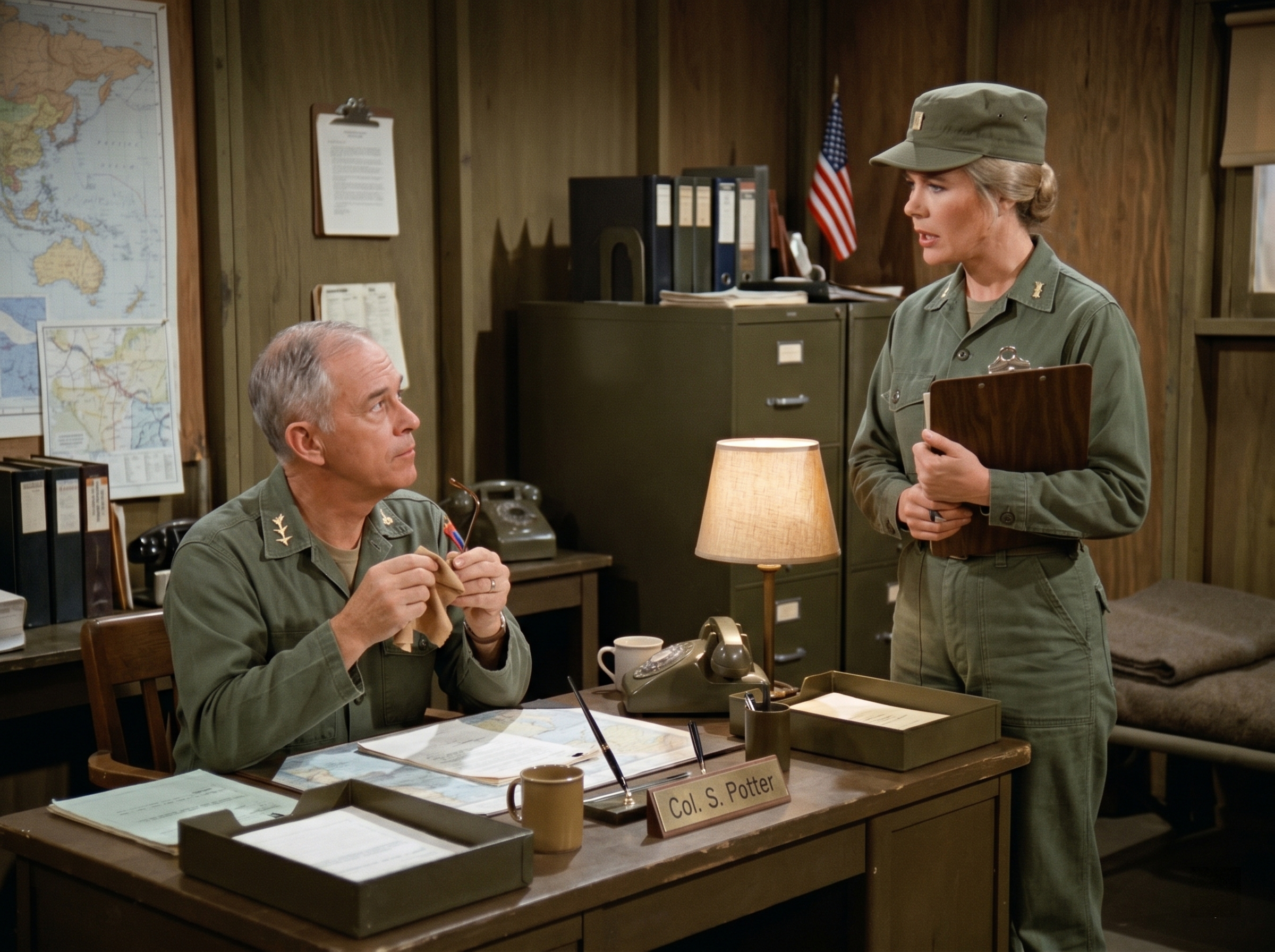
Colonel Potter sat behind his desk, the weight of the war etched into his forehead. His glasses, usually a tool of clarity, were currently in tatters. They lay in his large hands, a fractured testament to a momentary lapse in concentration. The specific memory was fleeting – a loose button, a fumbled grab, a sickening crunch. All that remained was the evidence.
His index finger traced the jagged edge of the lens, a rhythmic, almost comforting gesture. Behind him, the wood-paneled walls of his office felt closer than usual. Maps of a divided country, a telephone, the mundane clutter of a military post – they were all there, but they seemed diminished. Even the American flag, usually a symbol of stoic purpose, felt a little limper.
Major Houlihan stood across from him, her clipboard a shield against the mounting tension. She was briefing him on the latest supply chain issues – the missing tongue depressors, the delayed shipment of morphine. Her words were efficient, precise, yet they seemed to bounce off the silence gathering in the room.
“And finally, Colonel,” she continued, her voice gaining a slight tremor, “the expected consignment of… well, reading glasses…”
Colonel Potter paused his rhythmic tracing. His gaze, usually so sharp, was now obscured by a thin film of regret. Major Houlihan stopped. The air grew thick, the only sound the faint, distant hum of the generator.
Her fingers tightened around the clipboard. A bead of sweat formed on her upper lip. Colonel Potter raised his eyes, and Major Houlihan felt the weight of his uncharacteristic silence. The broken glass, now glistening in the lamp light, felt like a fracture between them. She knew the consequences of a delay. She knew the impact on moral. She just wasn’t sure how to bridge this new, fragile gap.
She saw the raw vulnerability in his eyes. The general, the leader, reduced to this singular moment of clumsy humanity. It was more than a supply issue. It was a cracking of his armor, a reminder of the fragility they all carried. She stopped speaking, her breath catching in her throat, the words dissolving into the silence.
A long, slow exhale escaped Colonel Potter’s lips. It was a quiet sound, yet in that small, wooden office, it resonated like a cannon shot. He placed the broken glasses on the blotter, the fractured pieces clicking against the wood.
Major Houlihan felt a wave of relief wash over her. The tension broke, replaced by a sudden, intense awareness of the man sitting before her. This wasn’t the formidable commander who weathered storms and commanded respect. This was a man who occasionally made mistakes. A human being who, like everyone else, felt the pressure.
“The irony is palpable, isn’t it, Major?” he said, his voice a gravelly whisper. A wry, almost playful smile ghosted across his face.
Major Houlihan managed a small, tentative laugh. “Yes, Colonel. Quite palpable.”
The simple shared moment, the acknowledgement of absurdity, was a powerful antidote. The clipboard became less of a shield and more of a prop, as she relaxed her stance.
“I suppose we’ll have to make due,” he continued, picking up the frames. He peered through the remaining lens, a comical expression of concentration. “Looks like my view of the world will be a bit… fragmented… for the time being.”
Major Houlihan smiled, this time with genuine warmth. “Well, Colonel, sometimes the fragmented view is the most honest one.”
He looked at her, and in that gaze, there was a deeper understanding. They were a team. They were in this together, facing not just the war, but the quiet, everyday battles of their own humanity.
He nodded slowly. “You may be right, Major. You may be right.”
He carefully tucked the broken frames into his breast pocket. The action felt symbolic, an embrace of imperfection, a quiet acceptance. Major Houlihan watched him, a sense of deep respect for the man filling her heart.
The generator continued its rhythmic hum, but the silence now was different. It wasn’t heavy with tension; it was light, hopeful. It was the quiet space where human connection blossomed. In the midst of chaos and division, a simple, broken lens had provided a glimpse into something profound: the undeniable truth that even in the toughest of times, our shared vulnerabilities are what connect us.
And sometimes, it’s the broken pieces that allow us to see things clearly.