A Little Piece of Softness in a Olive-Drab World
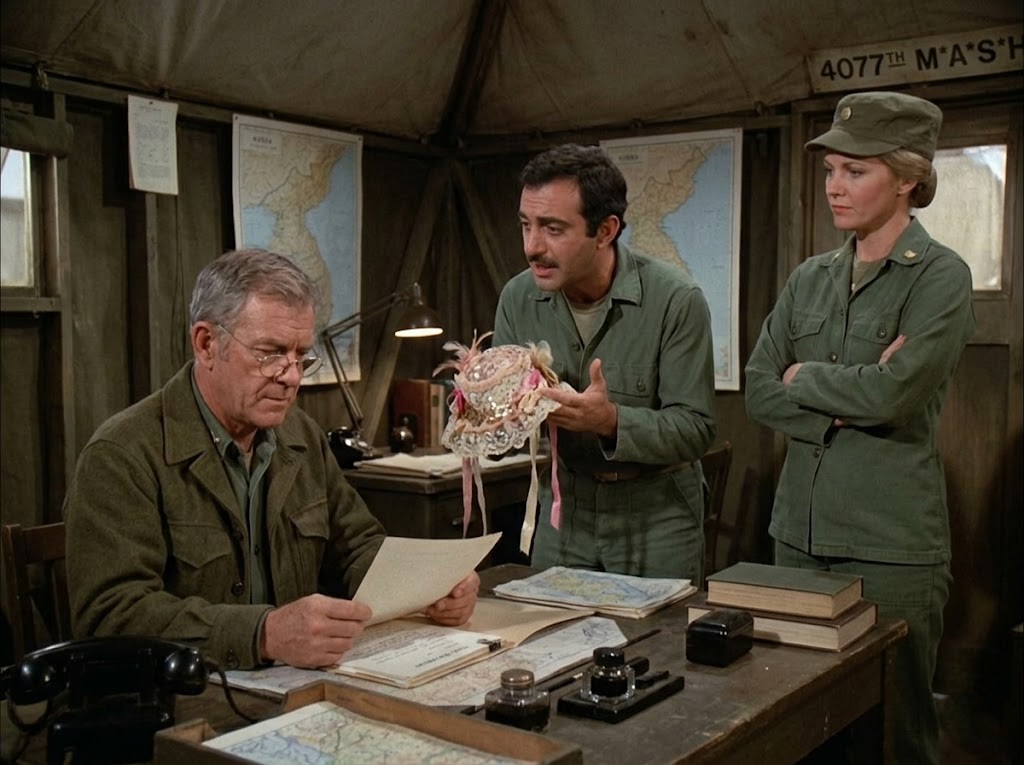
Some days in the Uijeongbu valley don’t belong to the artillery, or the incoming choppers, or the endless smell of rubbing alcohol.
Some days belong entirely to the quiet, heavy fatigue that creeps into the canvas walls of the 4077th when the guns go silent.
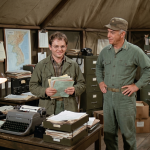
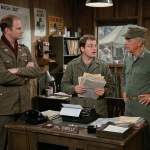
It was exactly that kind of Tuesday afternoon when the three of them gathered in the administrative tent, under a sagging roof that still smelled faintly of last night’s monsoon rain.
Colonel Potter sat behind his heavy wooden desk, his spectacles perched precariously on the bridge of his nose as he stared down at a stack of official transfer requisitions.
His face was a roadmap of a long career, etched with the deep lines of a man who had seen too many young boys arrive whole and leave broken.
To his right stood Margaret, her arms crossed tightly over her starched olive-drab fatigue jacket, her posture as rigid as a parade-ground flagpole.
Yet, if you looked closely at the corners of her eyes, the fierce Major Houlihan mask was slipping, replaced by the crushing weight of a seventy-two-hour shift in the operating room.
And then there was Klinger.
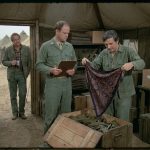
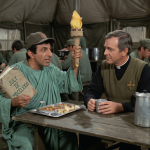
He didn’t wear one of his famous chiffon gowns or a feathered boa today; instead, he stood in standard-issue green, his dark eyes wide and pleading as he held out a tiny, absurdly delicate object.
It was a miniature Victorian bonnet, an explosion of pink lace, faux pearls, and shimmering sequins, dangling from his calloused fingers by two pale pink silk ribbons.
“I’m telling you, Colonel, it came straight from Toledo,” Klinger pleaded, his voice a mix of desperate theatricality and genuine, raw anxiety. “My Aunt Tanya made it with her own hands, sent it third-class mail because she thought it would bring good luck to the camp.”
Potter didn’t look up from his papers, his thumb tracing the edge of a supply report, though his eyebrows twitched with an old cavalryman’s impatience. “Klinger, we are currently short on penicillin, three types of surgical suture, and edible meat. I don’t think a doll’s hat is going to balance the ledger.”
“It’s not a doll’s hat, sir! It’s a symbol!” Klinger took a step closer, thrusting the sequined creation forward as if it could shield them all from the reality outside the tent. “It’s a reminder that somewhere across the ocean, people still make things that have absolutely no military purpose whatsoever.”
Margaret let out a sharp, impatient breath, her arms tightening against her ribs. “Corporal, the Colonel is trying to process emergency personnel files. Take your haberdashery and get back to the supply tent before I have you written up for insubordination.”
“But Major, look at the stitching!” Klinger’s voice cracked slightly, losing its usual grifter rhythm and exposing something much softer underneath. “Just look at it. It doesn’t smell like grease, or mud, or blood. It smells like cedar chests and Sunday mornings.”
Potter finally paused, his pen hovering a mere inch above the paper.
The tent grew suddenly, profoundly quiet, save for the distant, rhythmic thud of a generator somewhere near the motor pool.
The contrast was almost painful: the rugged, mud-splattered maps of the Korean peninsula pinned to the canvas walls behind them, and this fragile, glittering piece of home held out like a peace offering.
Margaret opened her mouth to snap another order, but her gaze caught the way the light hit the small pink sequins, reflecting tiny, bright dots onto Klinger’s tired face.
Potter slowly lifted his head, his sharp blue eyes looking past the bonnet, straight into the eyes of the young man from Ohio who spent every waking hour trying to escape the war.
“Klinger,” Potter said softly, his voice dropping the commanding edge and adopting the tone of a father who knew exactly what ailed his children. “Why did you really bring this in here?”
Klinger’s chest hitched, his fingers tightening on the delicate silk ribbons until they threatened to tear, the comedy completely draining from his face as a solitary tear tracked through the dust on his cheek.
The silence stretched, thick and heavy with the kind of unspoken truth that everyone in the 4077th carried but rarely put into words.
Klinger looked down at the bonnet, his shoulders dropping under the weight of his standard-issue shirt.
“My cousin Maurice,” Klinger whispered, his voice barely carrying over the hum of the camp. “The mail clerk just brought the casualty list from the 2nd Division. He’s on it, Colonel. He was twenty-one.”
Margaret’s arms slowly uncrossed, her hands dropping to her sides as her stern posture dissolved into a profound, aching stillness.
“He loved Aunt Tanya’s sewing,” Klinger continued, his thumb gently smoothing a stray piece of lace on the tiny hat. “When we were kids, he’d steal her scraps to make parachutes for his toy soldiers. When this arrived in the mail ten minutes ago… I just couldn’t stay in my tent alone with it. I needed to see someone who could tell me the world hadn’t completely gone crazy.”
Potter looked at the paper in front of him, then slowly slid it into a drawer, closing it with a quiet, decisive click.
He took off his spectacles, placing them on top of the desk next to the inkwell, and rubbed the bridge of his nose where the plastic had dug into his skin.
“Wars don’t make sense, son,” Potter said, his voice carrying the gentle, worn-down wisdom of three different conflicts. “They take the best things we have and try to grind them into the dirt. Your aunt didn’t know about Maurice when she stitched this. She just sent a piece of her heart across the Pacific.”
Margaret stepped forward, her boots clicking softly against the floorboards.
She stopped just inches from Klinger, her hand reaching out automatically, hesitating for a fraction of a second before she gently touched the edge of the pink silk ribbon.
“The stitching really is beautiful, Walter,” she said, using his real name with a quiet tenderness that she reserved only for the moments when the uniform became too heavy to bear. “My grandmother used to make lace just like this in Indiana. It takes an incredible amount of patience.”
Klinger looked up, blinking back tears, surprised by the sudden warmth in her voice. “She uses a double-knot on the trim, Major. Said it keeps the wind from fraying the edges.”
“A good strategy,” Potter murmured, standing up from his chair and walking around the desk. He stood beside them, a short, steady anchor in the middle of the olive-drab room. “In the cavalry, we used to say that a man needs two things to survive a winter campaign: a reliable mount, and a memory of what he’s fighting to get back to.”
He reached out and patted Klinger firmly on the shoulder, his hand lingering there with a warm, grounding pressure.
“You keep that hat right on your desk in the supply tent, Corporal. And if anyone asks you what a pink Victorian bonnet is doing in a combat zone, you tell them it’s a high-priority piece of psychological camouflage.”
A small, watery smile broke through Klinger’s mustache, his dark eyes shining with gratitude. “Thank you, Colonel. Thank you, Major.”
“Now, get out of here,” Potter said, though his eyes were completely crinkled at the corners with affection. “Before I have the Major inspect your boots, which look like they’ve been through a swamp.”
“Yes, sir. Right away, sir,” Klinger said, carefully cradling the bonnet against his chest as if it were made of spun glass, turning and slipping out through the tent flaps into the bright Korean sunshine.
Margaret watched the canvas door settle back into place, her shoulders still relaxed, a rare, soft expression lingering on her face.
“He’s a good kid, Sherman,” she said quietly, addressing the Colonel by his first name now that they were alone.
“They’re all good kids, Margaret,” Potter sighed, walking back to his desk and picking up his spectacles. “That’s the damn tragedy of it.”
He sat down, pulled the transfer files back out of the drawer, and dipped his pen into the inkwell, the familiar rhythm of camp life resuming its steady, mechanical pace.
But for a few brief moments, the smell of gunpowder and old canvas had been entirely replaced by the faint, sweet scent of cedar chests and an aunt’s love from Toledo.
Beneath the mud and the khaki of the 4077th, the human heart always found a way to keep from fraying at the edges.