A Supply Tent Miracle in O.D. Green
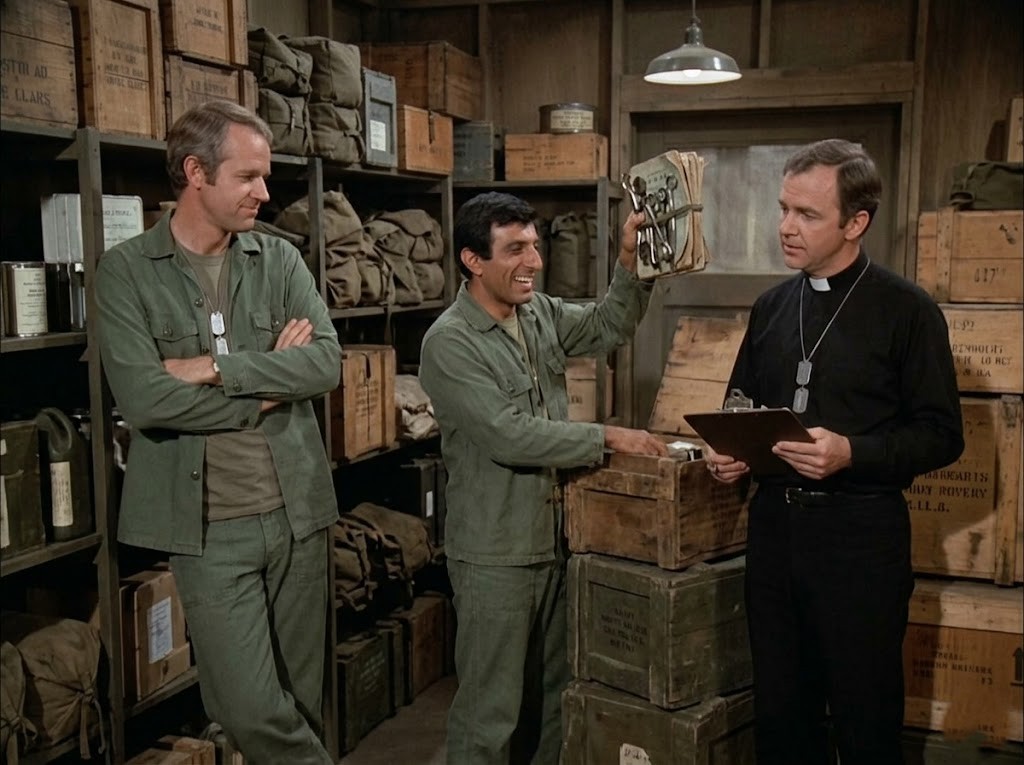
The smell of the 4077th supply shed was a unique cocktail of dry canvas, oiled pine crates, and the permanent, lingering dust of a country that refused to stay on the ground.
It was a quiet afternoon, a rare pause in the relentless, thumping rhythm of the incoming choppers. Captain B.J. Hunnicutt had retreated into the dusty storage tent just to hear himself think.
He leaned casually against a towering stack of wooden medical crates, his arms crossed comfortably over his chest. His green fatigue shirt hung open over a faded olive t-shirt, his silver dog tags resting quietly against his collarbone. B.J. wore the tired, contented smile of a man who had finally scrubbed the harsh smell of the operating room from his hands, at least for a passing hour.
Across from him stood Father Mulcahy, the camp’s gentle shepherd. The priest was dressed in his black clerical shirt and white collar, his own dog tags glinting in the dim light of the single bulb hanging from the wooden rafters.
Mulcahy held a battered clipboard, his eyes scanning the endless, frustrating columns of inventory sheets. Keeping the camp’s moral compass straight was always easy compared to keeping track of General MacArthur’s gauze pads.
Then, the heavy canvas flap of the tent was pushed aside, and in walked Corporal Maxwell Q. Klinger.
Today, Klinger wasn’t wearing chiffon, taffeta, or a velvet pillbox hat. He was dressed in standard-issue O.D. green fatigues. But what he lacked in high fashion, he more than made up for in pure, unadulterated triumph.
Klinger marched into the center of the room, grinning like a Toledo mud hen who had just swallowed a very fat, very expensive worm. In his raised left hand, he proudly displayed a bizarre, makeshift bundle. It was a stiff piece of cardboard, heavily wrapped with rough twine, securing a dozen gleaming metal instruments.
“Gentlemen,” Klinger announced, his voice echoing off the wooden crates. “I present to you the Holy Grail of the 4077th. Or, as I like to call it, the ‘Klinger Miracle of Tuesday Afternoon’.”
B.J. chuckled, shifting his weight against the shelves. “I didn’t know miracles came tied with butcher’s string, Max. What have you got there?”
“Only a complete, pristine set of stainless-steel orthopedic bone clamps,” Klinger declared, giving the bundle a little shake so the metal clinked against the cardboard. “The exact ones Captain Pierce has been crying about all week.”
Father Mulcahy lowered his clipboard, his gentle brow furrowing in confusion. He stepped closer, adjusting his grip on his pen.
“Bone clamps?” Mulcahy asked, squinting at the heavy bundle. “But Corporal, we haven’t had a medical supply truck from Seoul in over ten days. I certainly don’t recall seeing any official requisitions for these.”
“That, Father, is because official requisitions are for people without imagination,” Klinger said smoothly, his chest puffed out with pride. “This was a private negotiation. A delicate, high-level dance of diplomacy.”
Mulcahy’s gentle confusion slowly shifted into a quiet, rising panic. He knew Klinger’s ‘diplomacy’ all too well, and he knew that nothing in this war was ever truly free.
The priest looked down at his clipboard, desperately scanning the manifests for the camp and the local orphanage. He looked back up at the grinning corporal, the color draining slightly from his face.
“Max,” Mulcahy said, his voice dropping to a serious, fearful whisper. “The winter blankets for the children at the mission just arrived this morning. Tell me you didn’t trade the children’s warmth for surgical steel. Please tell me.”
The triumphant grin vanished from Klinger’s face in an instant. The silence in the dusty supply shed suddenly felt heavy and suffocating.
Even B.J. dropped his arms, the relaxed amusement fading from his eyes as he stood up a little straighter, waiting for the corporal’s answer.
“Father!” Klinger gasped, genuinely offended. He clutched the bundle of clamps to his chest as if the priest had slapped him. “You wound me! You really think I’d freeze a bunch of orphans for some shiny pliers?”
Mulcahy let out a long, trembling breath he didn’t know he was holding. His tense shoulders dropped in a wave of profound relief.
“I’m sorry, Max,” Mulcahy said softly, offering a sheepish, apologetic smile. “It’s just… one can never be too sure how the Lord’s work gets funded in this camp.”
“The Lord’s work is completely safe, Father,” Klinger muttered, still looking a bit stung. He straightened his fatigue jacket with his free hand, restoring his dignity.
B.J. leaned back against the crates, his warm, steady smile returning to his face. “So, if it wasn’t the blankets, Max, who did you fleece? And more importantly, what did it cost you?”
Klinger’s proud, sly grin slowly crept back onto his face. He held the bundle of clamps back up into the warm light of the hanging bulb.
“Let’s just say there’s a certain supply sergeant down in Inchon who fancies himself a theatrical genius,” Klinger explained, his dark eyes twinkling with mischief. “He’s putting on a grand production of *The Mikado* for the brass next week.”
Mulcahy raised a curious eyebrow. “And?”
“And,” Klinger continued, his voice dropping to a conspiratorial whisper, “he was desperately short on authentic, imported silk kimonos. The kind with real gold thread embroidery on the sleeves.”
B.J. let out a low, impressed whistle. “Max… not the Tokyo Rose special. You’ve been saving that kimono for your next Section 8 hearing with General Clayton.”
Klinger shrugged, looking down at the heavy metal tools in his hand. The theatrical bravado faded for just a moment, revealing the exhausted, deeply human soldier underneath the con-man exterior.
“Yeah, well,” Klinger said quietly, staring at the clamps. “Clayton never buys the crazy act anyway. And I was getting really tired of watching you and Hawkeye try to piece guys back together with rusty pliers from the motor pool.”
The words hung in the air, simple and unadorned.
There was no sweeping orchestral music, no dramatic salute. Just the quiet reality of a man who had traded his most prized possession—his imaginary ticket out of this war—to make the nightmare a little easier for his friends to manage.
Father Mulcahy looked at Klinger, his eyes shining with a sudden, overwhelming warmth. The priest didn’t see a scheming corporal or a man desperate to wear a dress. He saw a deeply good man, doing his absolute best in a terrible place.
Mulcahy lifted his pen and made a careful, deliberate checkmark on his tattered clipboard.
“How shall I log this, Father?” Klinger asked, quickly trying to steer the moment back to a joke before things got too emotional. “Miscellaneous hardware? Donations to the blind?”
“No, Corporal,” Mulcahy said gently, his voice full of quiet reverence. “I think I will simply log it under ‘Provisions of Grace’.”
B.J. pushed off the shelves, walking over to Klinger. He reached out and clapped the corporal firmly on the shoulder, giving it a heavy, meaningful squeeze. The touch was thick with gratitude, an unspoken acknowledgment between brothers.
“Good work, Max,” B.J. said softly. “Hawkeye is going to kiss you when he sees these. Right on the mouth.”
Klinger visibly shuddered, his Toledo street-smarts snapping right back into place.
“In that case, Captain,” Klinger said, turning sharply toward the tent flap. “Tell him I left them on his cot. I’m going to go hide in the mess tent until the terrible urge to show affection passes.”
B.J. and Mulcahy watched him go. The heavy canvas flap fell shut behind him, leaving the two men alone once again in the dusty, quiet shed.
B.J. looked over at the priest, a tired, affectionate smile lingering on his face. Mulcahy simply smiled back, tapping his pen rhythmically against his clipboard.
In the middle of a war that took everything it could, it was a beautiful thing to remember that sometimes, humanity still found a quiet way to deliver.
Not all angels wear white; some wear olive drab and hail from Toledo.