A Thousand Miles from Anywhere
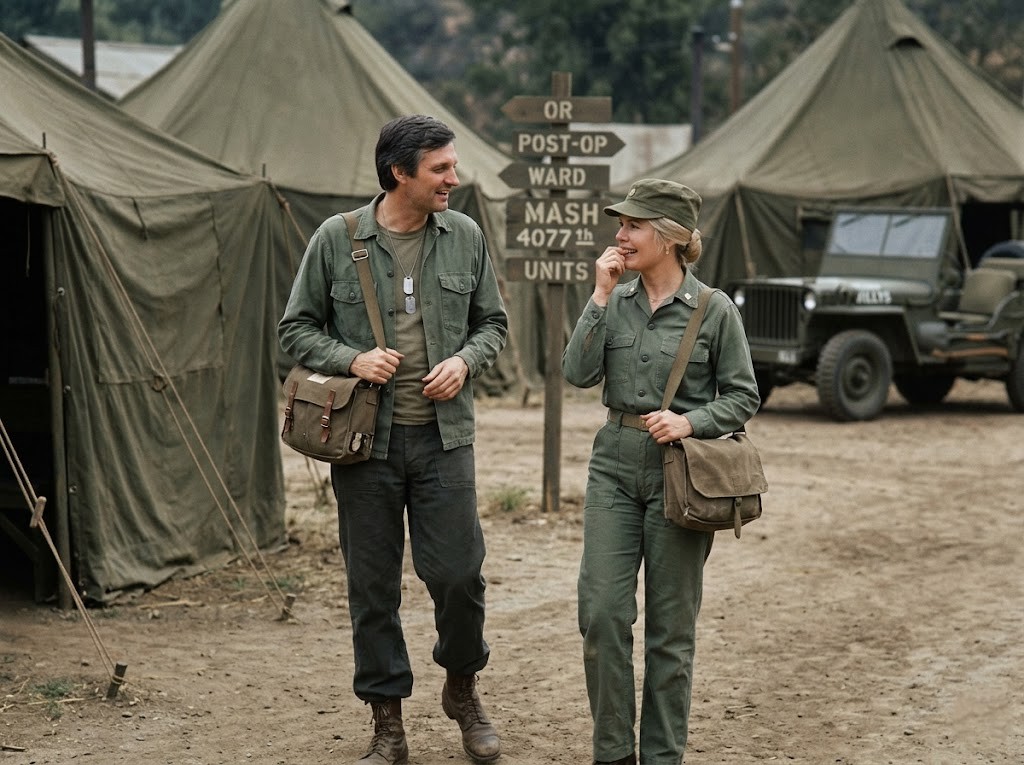
The war stopped for exactly three minutes on a Tuesday morning, and all it took was a worn canvas bag and a perfectly timed dose of absurdity.
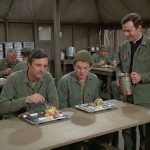
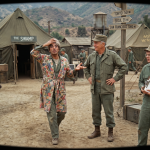
The 4077th was slowly waking up around them, shedding the heavy frost of the Korean night. The camp was a familiar sea of olive drab tents, damp dirt, and the lingering scent of stale coffee from the mess tent.
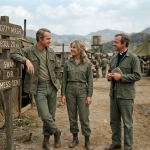
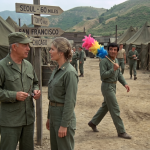
Hawkeye Pierce and Margaret Houlihan walked side by side through the center of the compound, the iconic wooden signpost looming behind them. They had just survived another brutal marathon in the OR. Thirty-two hours of endless noise, bright lights, and desperate prayers whispered under surgical masks.
Now, the choppers were finally quiet. The only sounds were the crunch of their heavy boots on the hard-packed earth and the distant, sputtering engine of a motor pool Jeep.
Hawkeye looked exactly like a man who had slept for three hours in the past three days. His green fatigue shirt was unbuttoned, hanging loose over his olive undershirt. His silver dog tags clinked faintly against his chest with every step.
He didn’t care about uniform regulations right now. He barely cared about staying upright.
Margaret, true to form, was putting up a much better fight against the exhaustion. Her fatigue cap was pinned perfectly in place, and her uniform was remarkably squared away for someone who had just spent two nights pulling shrapnel out of kids.
But the “Major Houlihan” armor was cracking, just a little. Her shoulders were slightly relaxed, and the rigid, professional mask she wore for the nurses had softened into something undeniably human.
They were both carrying heavy canvas messenger bags slung over their shoulders. Radar had ambushed them on their way out of the post-op ward, pressing the bags into their hands with a frantic, bleary-eyed salute. The mail had finally arrived, delayed by three weeks of bad weather and logistical nightmares.
Usually, Hawkeye would have torn into his mail the second it touched his hands. But the sheer weight of the shift had left him numb. He just walked, staring blankly ahead, his hand resting absently on the strap of the bag.
“You know, Margaret,” Hawkeye muttered, his voice gravelly and low. “I’ve been doing the math. If I eat one more plate of powdered eggs, my blood type is going to officially change from O-negative to Grade-A Fluff.”
Margaret didn’t snap at him. She didn’t remind him of military decorum. Instead, a tiny, betraying snort escaped her lips.
She quickly raised a hand near her mouth, trying to politely cover the smile that was breaking across her face. “You are absolutely impossible, Pierce. Even when you can barely stand, you never stop talking.”
“It’s a medical condition,” he replied, finally turning his head to look at her. A genuine, tired smile crinkled the corners of his eyes. “If I stop talking, the silence gets too loud. It’s a very tragic affliction. I’m hoping for a Section Eight, but Klinger already has the market cornered on tragic afflictions.”
Margaret laughed again, a soft, warm sound that felt entirely out of place in the middle of a war zone. She looked over at him, her eyes bright, appreciating the brief moment of levity. For a few seconds, they weren’t a head surgeon and a head nurse carrying the weight of a hundred broken boys. They were just Benjamin and Margaret, two friends sharing a quiet joke in the cold morning air.
Hawkeye reached into his canvas bag, intending to pull out a copy of the Stars and Stripes to swat at a passing fly. Instead, his fingers brushed against something stiff and unfamiliar.
He paused. He pulled the object out slowly. It wasn’t a letter. It was a small, crudely wrapped package tied with heavy brown twine.
The smile instantly faded from Hawkeye’s face. He stopped dead in his tracks, his boots kicking up a small cloud of dust.
Margaret took two more steps before she realized he wasn’t beside her anymore. She turned back, the laughter dying in her throat.
Hawkeye was staring at the brown package in his hands. His knuckles were white. The return address was handwritten in a shaky, frantic script he didn’t immediately recognize, but the name on the corner made his breath catch in his chest.
“Hawkeye?” Margaret asked, her voice instantly dropping into that soft, concerned tone she usually reserved for the worst cases in post-op. She took a step toward him, her own canvas bag swinging against her hip. “Hawkeye, what is it? What’s wrong?”
Hawkeye didn’t answer. He just kept staring at the little brown box, the silence in the camp suddenly feeling very, very heavy.
“Hawkeye,” Margaret repeated, her voice firmer now, anchoring him. She closed the distance between them, ignoring the cold wind that swept past the signpost. “Talk to me. Is it your father?”
Hawkeye blinked, the spell breaking. He shook his head slowly, still staring at the package. “No. No, it’s not Dad. It’s… it’s from Mrs. Higgins.”
Margaret furrowed her brow. “Who is Mrs. Higgins?”
“She runs the bakery down the street from my house in Crabapple Cove,” Hawkeye said, his voice quiet. “She’s seventy-two. She makes a blueberry pie that could broker world peace. I haven’t heard from her since I got drafted.”
He carefully slipped a pocket knife from his trousers and sliced the heavy twine. Margaret stood silently beside him, instinctively shielding him from the view of the compound. If bad news had found him here, she was going to make sure he had the dignity of privacy to receive it.
He peeled back the brown paper. Inside was a sturdy, dented metal tin. Taped to the lid was a single, folded sheet of lined paper.
Hawkeye unfolded the note. He read it once. Then he read it again.
Margaret watched his face closely. She saw the tension in his jaw, the heavy bags under his eyes, the way his dark hair fell messily over his forehead. She braced herself to offer comfort. She knew how these moments went. A telegram, a letter, a sudden shattering of the fragile world they left back home.
But then, an incredibly strange sound came from Hawkeye’s throat. It was a cross between a choke and a gasp.
He lowered the paper. He looked at Margaret. And then, he burst out laughing.
It wasn’t his usual loud, performative bark. It was a deep, chest-shaking, exhausted laugh. The kind of laugh that only comes when you are running on empty and reality decides to turn upside down.
“Benjamin, what on earth?” Margaret demanded, though a relieved smile was already tugging at the corners of her mouth.
“She sent cookies,” Hawkeye wheezed, tapping the dented metal tin. “She sent three dozen of her famous oatmeal raisin cookies.”
“That’s very sweet,” Margaret said, entirely bewildered. “Why is that funny?”
Hawkeye held up the piece of lined paper, his shoulders shaking. “Because she wrote a three-page letter complaining about my father. Apparently, Dad has been aggressively pruning the oak tree that hangs over her property line. She wanted to officially inform me, as an officer of the United States Army, that my father is a ‘botanical menace’ and she demands I court-martial him immediately.”
Margaret stared at him for a second. The absolute absurdity of it hung in the air between them. They were standing in a dirt field in Korea, smelling like iodine and fatigue, three thousand miles from home, and Hawkeye was being asked to court-martial a doctor in Maine over tree branches.
Margaret tried to hold it in. She bit her lip. She adjusted her cap. She looked at the wooden signpost pointing to Seoul and Coney Island.
But she couldn’t do it.
Margaret let out a sudden, bright laugh. She brought her hand up to her mouth again, her eyes crinkling with genuine, unfiltered delight. It was the laugh captured perfectly in the morning light—soft, genuine, and beautifully unbothered by military protocol.
Hawkeye looked at her, his own laughter settling into a warm, comfortable smile. He loved it when she laughed like this. When the ‘Major’ melted away and just left Margaret. It was a rare, precious thing in a place that dealt so heavily in tragedy.
“A botanical menace,” Margaret repeated, shaking her head, her smile still wide. “Well, you clearly inherited his blatant disregard for boundaries.”
“It’s a family tradition,” Hawkeye agreed smoothly, sliding the letter and the tin back into his canvas bag. “I’m going to write her back and tell her to lay siege to his porch with daylilies. That’ll teach him.”
They began walking again, falling effortlessly back into step. The heavy weight that had been pressing down on their shoulders just moments before seemed miraculously lighter. The dirt was still dirt. The war was still the war. The OR would inevitably fill up again.
But right now, the morning felt a little warmer.
“You know, Margaret,” Hawkeye said quietly, his tone losing the sharp edge of his usual sarcasm. “I think I might actually share these cookies with you. Assuming they haven’t turned into shrapnel during the trip.”
Margaret looked over at him, her expression softening with an unspoken gratitude. She knew exactly what he was doing. He was sharing a piece of his home. He was letting her into the quiet, sane part of his world.
“I would be honored, Captain Pierce,” she said softly. “But if you try to give me powdered eggs instead, I’ll court-martial you myself.”
Hawkeye grinned, his dog tags softly clinking as they walked past the jeeps and the mess tent, heading toward the quiet refuge of their quarters.
“Deal,” he said softly.
They walked the rest of the way in a comfortable, companionable silence, two tired soldiers finding a brief, beautiful moment of peace in the middle of madness.
In a place built on the heartbreak of mending broken things, sometimes all it took to heal a soul was an old canvas bag, a shared laugh, and the comforting reminder that somewhere, a world without a war still existed.