Tuesdays, Stew, and the 4077th’s Own Food Critic
You knew it was Tuesday before you even walked into the Mess Tent. A heavy, indistinct smell settled over the compound like a humid blanket. It was the olfactory signature of Tuesday’s “Beef Stew Supreme,” a dish whose ‘supreme’ qualities remained an unsolved medical mystery.
The three of them had made it. The OR was quiet for the first time in thirty hours, leaving them drained and running on little but adrenaline and caffeine. Now, they were running on desperation.
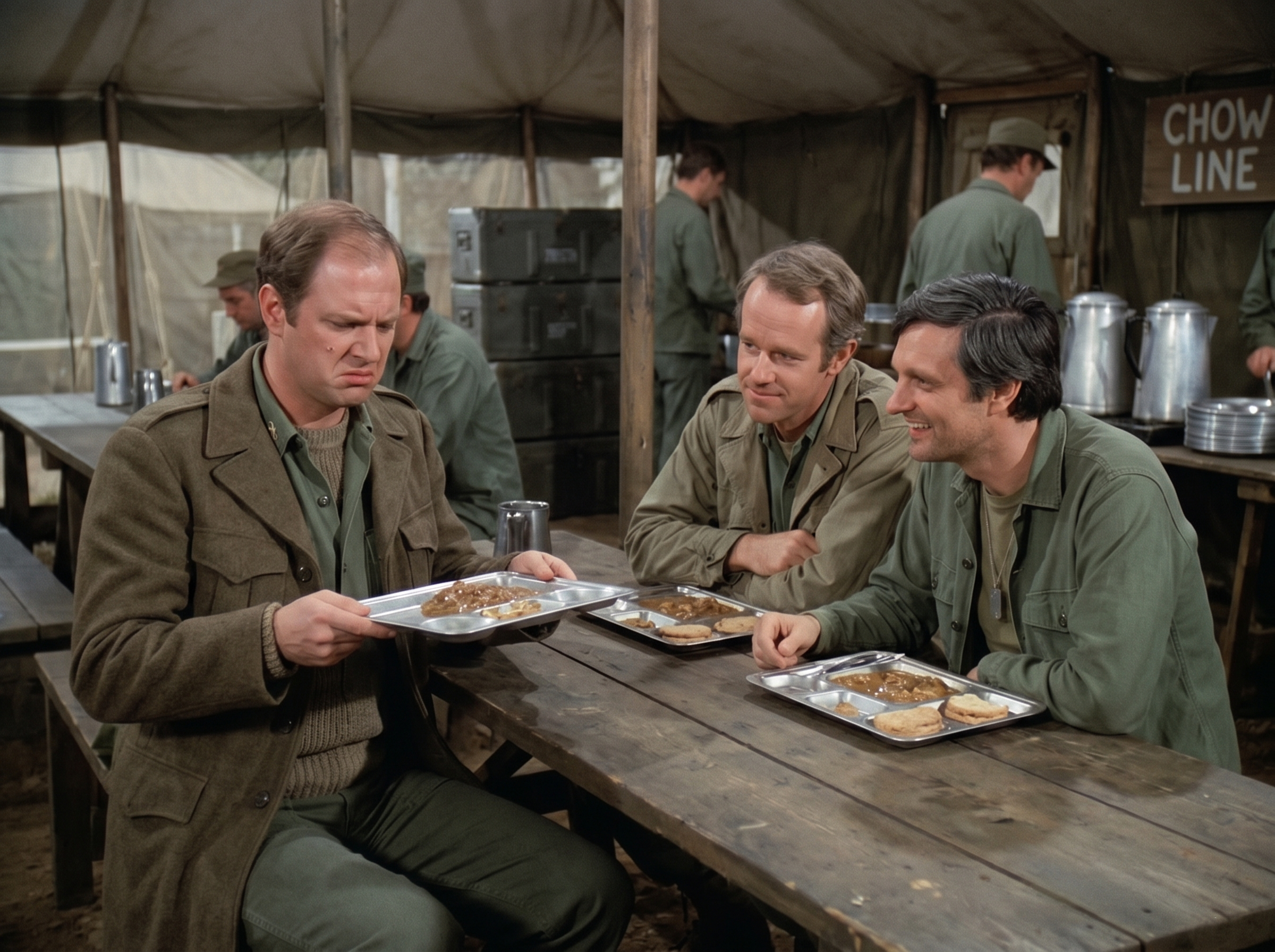
Winchester was the first one through the line. He accepted his tray with an invisible pair of tongs, carrying it like it contained radioactive material rather than sustenance. His posture was impeccable, a stark contrast to the slightly hunched, green-clad figures moving around him.
He was wearing his heavy wool overcoat, collar turned up. It was either an attempt at insulation from the drafty tent, or a refined sartorial shield against the visual assault of the food.
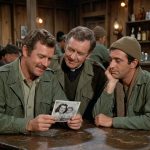
Winchester stopped by the end of the long wooden table. He held his metal tray out, presenting it to the universe. His face was a masterpiece of distress.
He wasn’t eating it. He was analyzing it. He wasn’t just disapproving; he was genuinely and deeply affronted. His brows were furrowed, his mouth twisted into a perfect, eloquent grimace of disgust.
“Gentlemen,” Winchester declared, his voice a low, cultured vibrate that nevertheless carried. “I believe I have discovered a new state of matter on my tray. It’s too rubbery to be solid, too viscous to be liquid.”
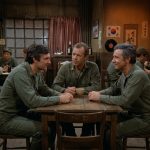
B.J. Hunnicutt, sitting opposite Hawkeye Pierce, simply smiled. It was the smile of a man who had seen too much to be surprised and loved too much to be unkind. He was just glad to be sitting, his tired mind temporarily disengaged.
Hawkeye, sitting next to B.J., let out a short, tired laugh. He had been staring blankly at his own tray, which featured a similar pale-brown substance and two round, flat pucks masquerading as biscuits.
For forty minutes, Hawkeye hadn’t said a word. The weight of the world, and especially of young men he couldn’t save, had left him mute. B.J. had just sat with him, respecting the silence.
They hadn’t spoken a single word since they left the OR. Then, Winchester arrived, held up his tray, and produced that perfect, operatic expression of despair.
Hawkeye looked up. The silent fog that had wrapped around him all morning seemed to lift, even if just a little. He saw B.J.’s gentle, amused eyes, and then he looked directly at Winchester’s miserable, judgmental face.
“What is it, Charles?” B.J. asked quietly, a small spark finally reaching his tired expression.
“B.J.,” Winchester stated, still holding his tray aloft, “I believe it’s an interpretive dance. It’s meant to convey ‘sadness.’ ”
Hawkeye’s smile widened, becoming genuine. He looked across the table at B.J., and B.J. looked back at him. The sheer absurdity of Winchester in his fine coat, treating this grey-brown sludge with intellectual dignity, was a lifeboat.
The tension of thirty non-stop hours was there, still present, but Winchester’s performance was the first crack in it. The whole tent, filled with other exhausted medics in green fatigues, seemed to draw a small, collective breath.
Everyone was watching. Winchester looked at his tray, then at Hawkeye. He didn’t just see Hawkeye. He saw *his* Hawkeye, a man with too many jokes and too much pain. And Winchester knew. He absolutely knew.
Winchester didn’t say another word about the interpretive dance. He met Hawkeye’s gaze, held it, and in that moment, the sarcasm and superiority evaporated.
In its place was a quiet, almost invisible communication. Charles wasn’t just performing. He was trying. He was trying to offer something, *anything*, other than medical statistics and fatigue.
It was a small, almost undetectable shift in his tone. He shifted his tray slightly, presenting it now with a dramatic flourish.
“Moreover,” Charles declared, “I have deducted that this particular piece of, uh, *beef*…” He poked the unidentifiable brown lump with his finger. “…is, in fact, an escapee from a low-grade tennis tournament.”
B.J. let out a short, genuine chuckle. Hawkeye, however, actually laughed. It wasn’t the cynical, tired bark that often passed for humor lately; it was a full, warm, easy laugh that seemed to echo in the canvas walls.
It was the sound of a man remembering how.
Charles didn’t smile, but a softness touched his eyes. He lowered the tray and took his seat, the rustle of his heavy wool overcoat the only sound. He looked across at Hawkeye. “Did that help, Captain?”
Hawkeye picked up his fork and nudged his own ‘Beef Stew Supreme.’ He looked at Winchester, then B.J. “You know, Charles, you’re a snob, a pompous ass, and a musical elitist.”
Winchester stiffened. B.J. raised a hand, unsure which way this was going.
Hawkeye paused, a genuine softness in his voice. “But that tennis ball analogy was spot on. Thanks for breaking the silence.”
B.J.’s smile widened. He looked at Charles, then Hawkeye, and felt a profound sense of warmth. These were his people. A refined Boston snob, a sarcastic surgeon from Maine, and himself, the quiet family man.
They came from different worlds, and yet they sat together in this canvas world, sharing bad stew and a hard-won laugh.
The tension in the tent had diffused. Conversations resumed, quieter now, but with more human connection. Radar could be seen glancing over, a relieved look on his face as he realized the silence had been broken by humor, not an argument.
Winchester looked around at the green-clad figures. He’d never say it out loud, but he wasn’t just a snob; he was a snob who loved his snobbery because it protected him. But today, he had used it to heal.
“I will,” Charles declared, picking up his fork with immense reluctance, “eat this tennis ball under protest. But only because I am famished and have an appointment with a stack of records and a very expensive cigar.”
“Can I have the fuzz off the top?” Hawkeye asked, already digging into his stew. “I think that’s the nutritional part.”
Winchester didn’t answer. He just took his first bite, his face immediately collapsing back into its original look of profound distress. It was the face of a man who was suffering, and he was suffering because he was here, and he was here because they needed him.
The three of them finished their meals. They talked of small things—a new patient, a favorite song, the hope of mail from home. The grand despair of the morning had been contained, shrunk down to a manageable size by a metal tray and a moment of understanding.
As they left the Mess Tent and walked back into the compound, the heavy smell of the stew followed them. They didn’t mind so much now. It was just the smell of Tuesday.
And Tuesday was almost over. They had made it. They had made it together, as a family they had chosen and, somehow, had chosen them.
It was just one Tuesday, but in that small moment, a terrible stew and a shared laugh were all it took to make a bad world a little more human.