The Long Distance to Toledo
If the war taught us anything, it was that home is a fragile memory wrapped in distance. It’s the faint smell of fresh paint on a Saturday afternoon. The sound of a favorite song on a staticky radio. And sometimes, it’s just the desperate need to hear a familiar voice.
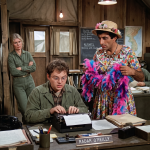
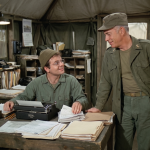
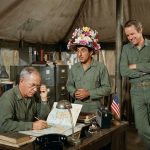
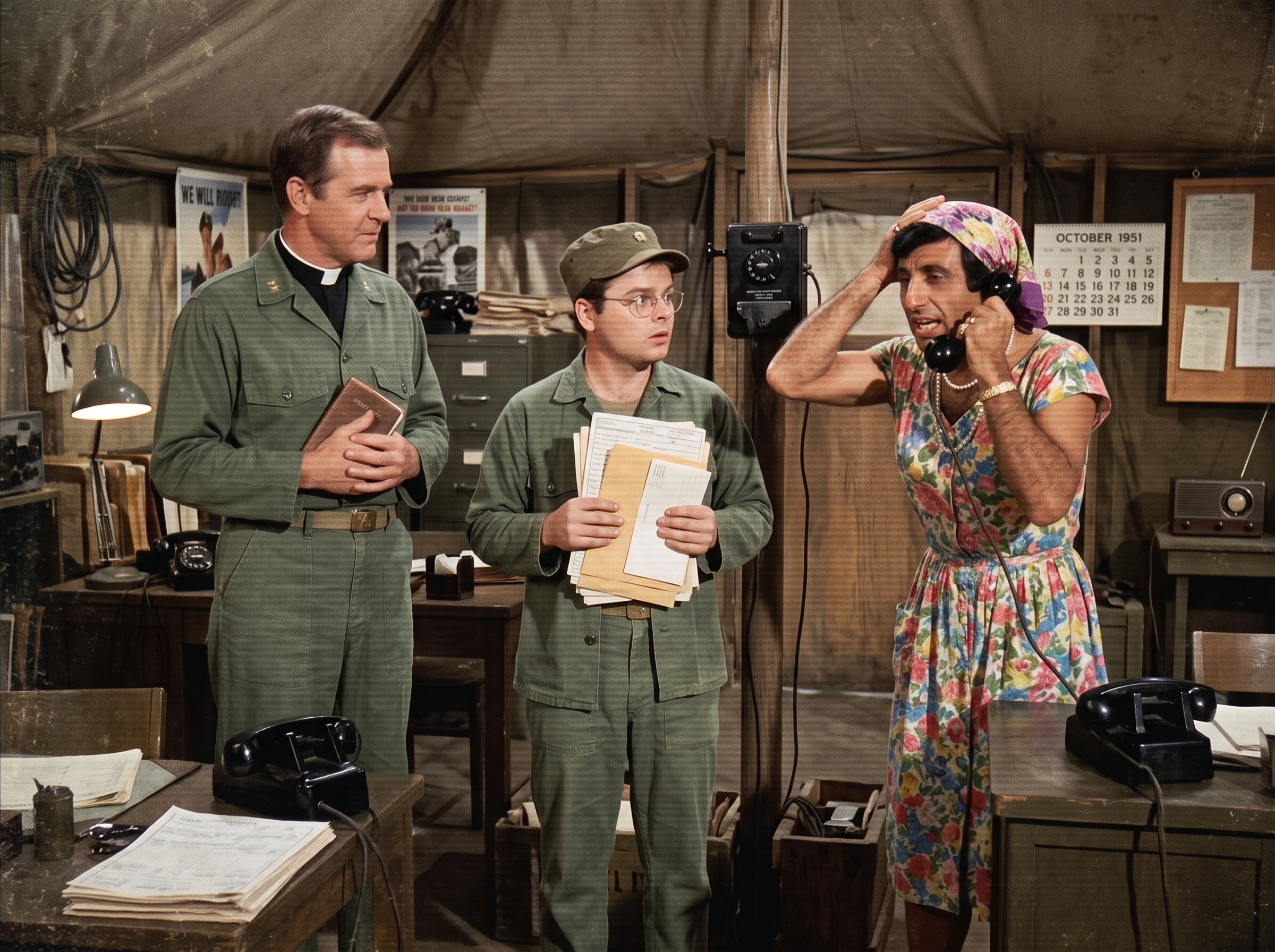
The visual memory attached to that feeling is a familiar sight in Radar O’Reilly’s tiny, frantic office. It’s a humble clearing in the bureaucratic jungle of the 4077th. Desks groan under the weight of paperwork, field phones, and communications gear. Small details fill the space: filing trays, worn pencils, and a calendar that seems perpetually stuck in October 1951.
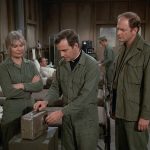
Here, a delicate balance is always on the verge of collapsing into absolute chaos. Radar stands nervously, his expression a familiar cocktail of wide-eyed concern and innocent confusion. He clutches a stack of forms to his chest like a life preserver. Envelopes and official papers threaten to spill out as he watches Klinger.
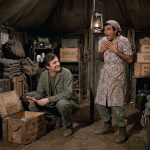
Klinger is, as always, a whirlwind of energy. He’s dressed in a bright, colorful floral housedress and matching headscarf, looking more like an overly animated suburban aunt than a soldier. His dramatic flair is dialed to maximum as he stands over the desk. He gestures wildly with his free hand, pouring his heart into the heavy black field phone handset pressed to his ear.
Klinger is mid-plea, trying to talk his way into an unauthorized call home to Toledo. The field lines are down, the operator is uncooperative, and Klinger is growing increasingly frantic. Radar is desperate to move on to the actual work at hand but can’t bring himself to stop the raw, theatrical performance unfolding.
Father Mulcahy stands slightly to the side, observing the scene. He holds a small prayer book, a quiet contrast to the administrative storm. His face is a study in gentle, innocent misunderstanding and hopeful warmth. He understands the human cost of the bureaucratic obstacles, even if he can’t always navigate them.
The tension grows with every crackle of static on the line. Radar knows the mail is delayed, and families at home are waiting. Klinger’s voice is rising, a mix of comedic desperation and genuine heart. “Just one connection! My mother in Toledo! I need to tell her…“
Suddenly, a voice finally cuts through the static on Klinger’s end. It’s not the operator. It’s a distant, thin voice. Klinger freezes. His eyes go wide in his dramatic dress. Everything, for a heartbeat, stops. The chaos holds its breath.
Klinger doesn’t move. He stands holding the handset like a sacred relic. The voice on the other end is real. A faint, shaky connection to Toledo.
Father Mulcahy subtly steps closer, his quiet presence like a benediction. “Maxwell?” he says softly, his voice cutting through the silent office. Radar takes a step back, the forms clutched even tighter. The official duty battles with the human heart.
Klinger drops the performance. He doesn’t yell. He doesn’t gesture wildly anymore. He leans into the receiver, his voice dropping to a vulnerable, almost childlike register. “Mom?” he whispers. “Is that you, Mom?“
The office is completely silent except for the faint voice. The floral dress, the headscarf, the dramatic gestures—all of it fades away. There is only a homesick son trying to bridge an ocean of distance. A man whose theatrical resilient exterior is just a thin shell for immense vulnerability.
Klinger begins to speak, and the words spill out. “I’m okay, Mom. We’re all okay here. Are you taking care of yourself? Is Uncle Benny still bothering the paperboy? How is the chili dog stand on Monroe Street? I… I miss it.“
His eyes are moist, and the light in the office catches the slight tremble in his lower lip. Radar watches, a profound empathy softening his face. He sets the stack of forms down gently on his desk. He knows those papers are important, but not in this moment.
The connection is tenuous. Static threatens to take the conversation away. “I just needed to hear you, Mom,” Klinger says quickly. “The lines are bad. I have to go soon. I love you.” He is rushing, trying to save every precious second before the distance claims the link.
The connection abruptly cuts to a drone of staticky silence. Klinger holds the phone to his ear for a long moment. He slowly lowers it, letting it rest on the desk cradle. He doesn’t put it down right away.
He stands there, a solitary figure in a floral housedress. The silence in the office is profound, heavy with shared fatigue and tender care. Found-family feeling hangs thick in the air, a bond forged in the crucible of war. It is a moment that balances lighthearted camp misunderstanding with deep tenderness.
Father Mulcahy offers a comforting hand, a silent prayer. Radar says nothing. He simply steps over and puts a reassuring hand on Klinger’s shoulder. The humor, the camp, the absurdity—it’s all there, but it yields to the raw human truth. Klinger is resilient, but right now, he’s just a man who misses home.
Radar finally gathers the forms from his desk. “I have mail to process, Klinger,” he says quietly, his voice a little softer than usual. “We all have families waiting to hear from us.” He starts back to work, the small administrative details resuming.
Klinger sit down, dejected but somehow lighter. The floral pattern of his dress seems brighter, and the headscarf is just a headscarf. A shared moment of bureaucratic chaos and deep connection. A simple, poignant reminder of what they were fighting for, and what they missed, every single day.
The longest distance wasn’t the thousands of miles between Korea and Toledo, but the single moment a voice cut through the static, reminding us all of home.