The Weight of an Inch
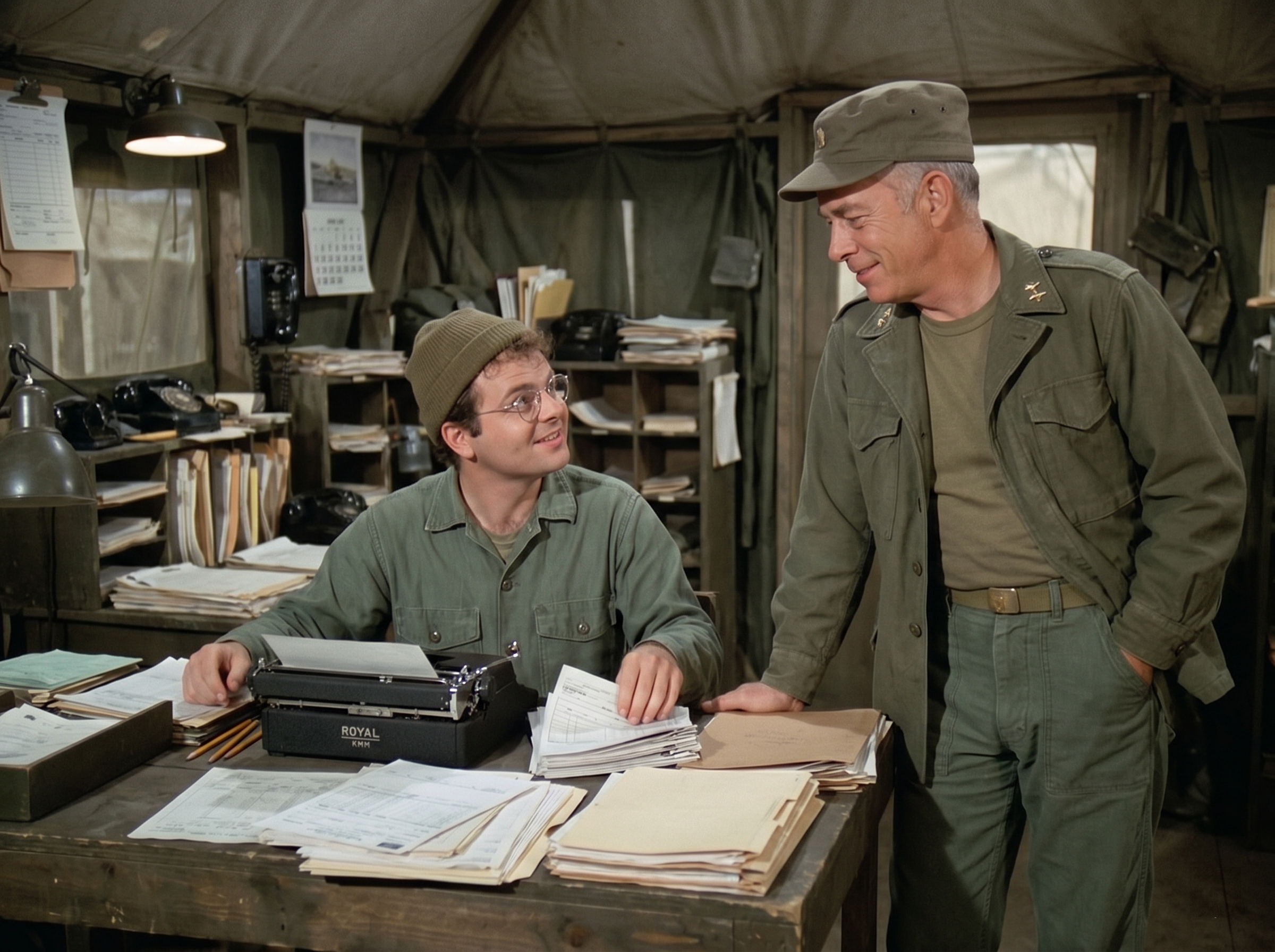
The air in the office was thick, and not just with the perpetual dust of Korea. It was heavy with the silence that follows a 72-hour operating session. It was the quiet that feels fragile, as if one wrong sound could shatter the rest everyone desperately needed.
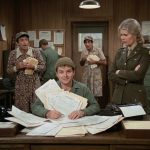
For Radar, sitting at his desk, that sound was the insistent, metal *clack-clack-clack* of his own typewriter. He stared down at the half-filled forms, his glasses slipping slightly down his nose, his brow furrowed with a focus that was both intense and weary.
The form—a requisition for medical gauze—seemed impossibly complex tonight. Every line was a test, every word an exercise in memory. He felt a phantom chill, a familiar prickling down his spine, but for once, it wasn’t warning him of Incoming. It was warning him of something different.
He didn’t even need to look up to know who was standing over him. He felt the broad, solid presence, smelled the comforting, old-world scent of Pipe Tobacco and leather.
Colonel Potter stood just behind Radar’s right shoulder. One hand was draped naturally in his pocket, a posture of relaxed, fatherly authority. His eyes, usually so sharp and appraising, were warm as he looked down at the young corporal.
They weren’t looking at the medical supply forms. They were looking at something much more important. They were looking at a small, unassuming form, tucked away beneath a stack of other papers, titled “APPLICATION FOR SPECIAL DISPENSATION – COMPASSIONATE LEAVE.”
Radar finally looked up. He didn’t say anything, but his eyes were wide, and they held an impossible question. He looked younger than usual, the wool beanie and large glasses emphasizing the vulnerability he tried so hard to hide.
The Colonel’s smile was small, barely a lift of his lips, but it was there, and it was entirely for Radar. He seemed to be weighing something carefully.
“Got all your ducks in a row for this requisition, Walter?” Colonel Potter asked, his voice a low, soothing drawl.
Radar gulped. His small hands tightened around the edge of a fresh stack of papers. “Yes, sir. Gauze, four-by-four, sterile. Thirty units. Plus two cases of antiseptic and… and one, uh, requisition for, uh… this.” He lightly tapped the top of the Compassionate Leave form.
Potter didn’t move his hand from his pocket. He didn’t touch the paper. He just looked from the form back to Radar’s face, and then to a calendar pinned to the bulletin board behind the desk, its pages marked up with dates that felt both too long ago and not quite soon enough.
For a moment, they just existed in that quiet, loaded space. Outside, a jeep rumbled past. Somewhere, a nurse gave a sharp, exhausted order. In here, time seemed to stretch, thin and taught. Radar’s breath hitched. He needed this form signed. He needed *one signature*. He held it out, just an inch or two across the cluttered desk.
Colonel Potter slowly took his hand out of his pocket.
Colonel Potter didn’t take the form. Instead, he simply extended his index finger and placed it directly on top of the ‘Compassionate Leave’ application, pinning it gently against the desk. He didn’t look at the paper, his gaze remaining steady on Radar.
The silence grew, but it changed. It was no longer a fragile silence, but a profound one.
“Tell me about the family, Walter,” Potter said softly. It wasn’t an interrogation; it was an invitation.
Radar let out a slow, shaky breath. His gaze dropped back to the desk, his thumbs drumming a silent, anxious rhythm on the gauze forms.
“It’s, uh, it’s my Uncle Ed, sir. My Mom’s brother. He’s the one who runs the small engine repair shop. He, uh… they think it might be the heart. He’s been really bad.”
Radar looked back up at the Colonel, his large glasses amplifying the moisture building in his eyes. “He’s the one who taught me how to adjust the spark plugs on the tractor, sir. Every Tuesday night was engine night.”
Colonel Potter’s smile softened further. He nodded slowly, a deep understanding of Midwestern life—and the weight of those simple, steady routines—passing between them.
“My Uncle, the one who first let me handle a colt’s halter… he had a bad heart, too,” Potter murmured, more to himself than Radar. He looked past Radar for a moment, seeing a whole different set of ghosts and family. “Sometimes, the heart just gets too tired.”
Radar’s lip trembled. He wanted to look away, but he couldn’t. He saw the genuine sorrow in the old soldier’s eyes. It was a mirror of his own.
The tension in the room wasn’t dramatic. It was human. It was the simple, heartbreaking act of realizing how much we are made of the people we leave behind, and how much it costs to be away when they need us.
Potter’s finger remained on the form. He knew the regulations. Compassionate leave was a tightrope walk. It took more than just a sick uncle. He had to be sure this was the right decision. Not just for Radar, but for the 4077th, which was currently one bad surgical shift away from collapsing.
“Are you certain this is the only way, Walter?” Potter asked, his voice steady but layered with the heaviness of his command.
Radar looked at the Colonel’s hand, so close and yet so far from signing. He looked at the family photos on the shelf behind the desk—a whole alternate life that seemed more real than the war.
“My Mom…” Radar started, then cleared his throat. “My Mom can’t manage the shop, and Uncle Ed has… there’s a big order for the farm tractors before harvest. If he’s gone… I’m the only one who knows where the inventory log is, and how to… how to mix the fuel for the vintage models. The whole harvest, it’s only a few weeks away.”
Radar’s voice was barely a whisper. He wasn’t pleading; he was stating the brutal, practical truth of a life he might lose forever. He was a farm boy first, and a soldier second. He knew how one missing part could stop a whole machine.
Colonel Potter finally removed his hand from the paper. He didn’t pick up a pen. He just stood up straight, letting his other hand drop out of his pocket.
The high point wasn’t over. It had just shifted. The suspense now was in the decision itself, which Radar, in that moment, realized had already been made.
Colonel Potter reached down. He didn’t pick up the Compassionate Leave form. He picked up the stack of Gauze requisitions.
“I’m signing the gauze, Walter,” Potter said, his voice returning to its normal, brisk authority. He walked around the desk and slapped the stack down in front of a startled, confused Radar.
Potter then picked up the Compassionate Leave form and crumpled it slowly into a ball.
Radar’s face fell. The light went out behind his glasses. He stared down at the crumpled ball. It felt like a physical blow.
Colonel Potter looked at him, his face stern. “I’m signing the gauze because this unit needs surgical supplies. We can’t operate without gauze.”
He picked up the crumpled ball of paper. “I am *not* signing this because we are currently in a state of operational crisis. Your request is denied. I cannot afford to lose my best supply clerk for a week. Not right now.”
Radar didn’t say a word. He just stared at the desk.
Potter tossed the crumpled ball into the trash can. “Now, I’m going to go get some coffee. When I come back, I expect to see that requisition form filled out correctly.” He turned and walked toward the exit.
Just as he reached the door, he stopped. He didn’t look back.
“Oh, and Walter?”
Radar flinched. “Sir?”
“When I come back, I also expect to see a *brand new*, *properly written* application for a full, 30-day extended emergency furlough on my desk. And it better be filled out *perfectly*, or I might not get around to signing it for… oh, say, five minutes. Get to work.”
Colonel Potter pushed open the door and stepped out into the night, the sound of his boots marching away, leaving Radar alone with the slow, dawning realization of what had just happened.
The clack of the typewriter started up again, and this time, the sound was different. It was fast. It was eager. It was the sound of a kid who knew that no matter how tired he was, no matter how heavy the weight, someone was carrying it with him. The heart might get tired, but the simple, steady hand that had been on that form—it was stronger than anyone knew.
It’s amazing how much weight one small hand can hold, especially when a stronger one helps you lift it.