The Quiet After the Storm
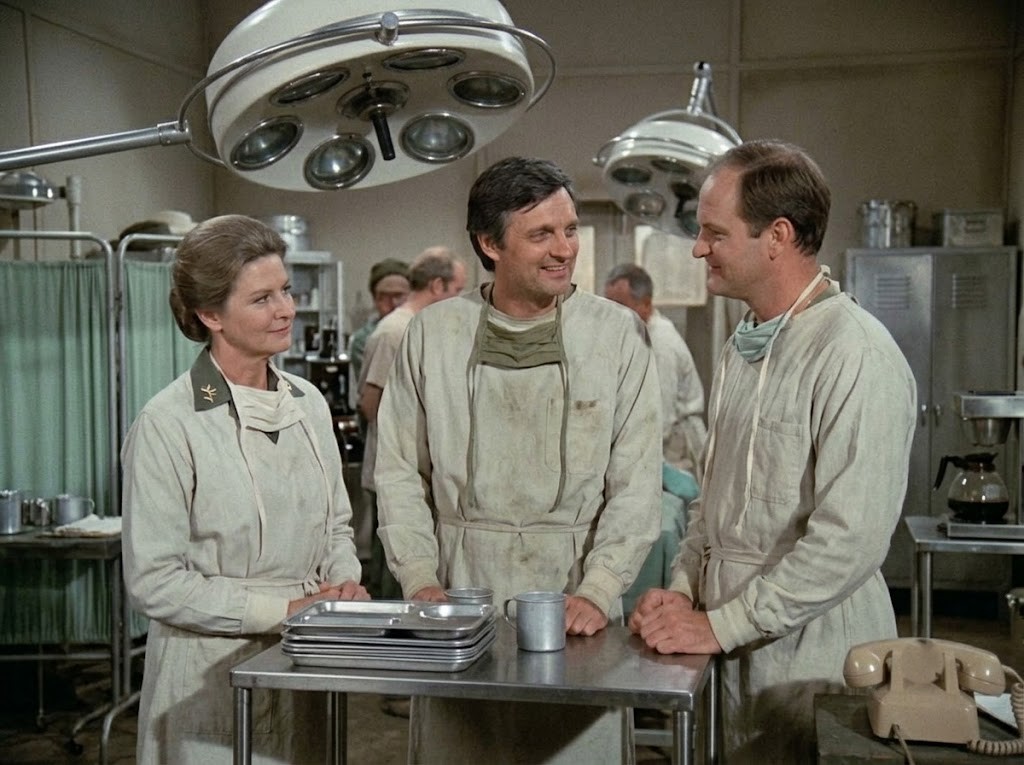
The overhead surgical lamps were still ticking as they cooled down, emitting a low, rhythmic hum that was often the only sign of life left in the Operating Room when the chaos subsided. For fourteen straight hours, the 4077th had been a whirlwind of flying gauze, snapping hemostats, and the desperate, synchronized dance of survival. Now, the meat-wagon sirens had finally fallen silent, leaving behind an empty room thick with the smell of rubbing alcohol, stale coffee, and heavy, collective exhaustion.
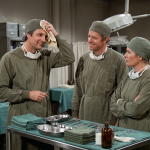
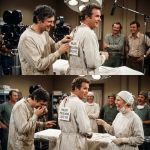
Hawkeye Pierce leaned against the cold edge of a stainless-steel prep table, his fingers loosely curled around a battered tin cup. His surgical gown was mapped with the faint, telltale smudges of a long night’s labor, and his mask hung limply around his neck like a discarded collar. Beside him stood B.J. Hunnicutt, his tall frame slightly slouched from the sheer weight of fatigue, his hands resting heavily on the table. Margaret Houlihan stood on the other side, her blonde hair neatly pinned back, her posture still retaining a trace of military discipline despite the dark circles under her eyes.
They weren’t talking about the war, or the kids they had just patched up, or even how much they desperately wanted to sleep for a week. Instead, they were caught in a rare, fragile pocket of peace, looking at each other with the kind of unspoken understanding that only grows in the mud of Korea.
“You know,” Hawkeye said, his voice a low, gravelly rasp that broke the silence like a soft footstep, “if we stay completely still, Colonel Potter might mistake us for actual medical equipment and order us a coat of paint.”
B.J. let out a soft, breathy chuckle, his eyes crinkling at the corners. “I don’t know, Hawk. I think the army would complain about the quality of the vintage. We’re looking a little worse for wear.”
Margaret didn’t reprimand them for the cynicism. Instead, a gentle, surprisingly tender smile softened her sharp features as she looked at the two surgeons. For all their jokes, their rule-breaking, and their constant badgering, she knew exactly what those hands had accomplished over the last fourteen hours. They had pulled miracles out of thin air, using nothing but sheer willpower and dull scalpels.
“You both did an excellent job tonight,” Margaret said quietly, her voice devoid of its usual command-layer stiffness. “Every single boy who came through those doors is breathing right now. You should be proud.”
Hawkeye looked down at the stack of empty metal surgical trays sitting between them, their reflective surfaces catching the harsh light of the remaining lamp. The top tray was completely empty, save for a tiny, crumpled piece of lined notebook paper that had been tucked under the rim by a trembling hand just before the last patient was wheeled out to Post-Op.
Hawkeye reached out, his hand hovering over the paper. The tension in the room suddenly shifted, the lighthearted humor dissolving into something thick, heavy, and deeply emotional as they all stared at the small scrap of paper.
Hawkeye carefully unfolded the piece of paper. His fingers, usually so steady with a scalpel, shook just a fraction. It wasn’t a letter from home, nor was it an official military dispatch. It was a clumsily drawn picture of a stick-figure soldier standing next to a giant, disproportionate crab, with the words *‘Thank you for the legs’* scrawled in shaky, child-like handwriting at the bottom.
Private Danny Miller, nineteen years old from Iowa, had insisted on slipping it to Margaret before the anesthesia took him under, begging her to give it to “the funny doctors.”
“He told me he drew it while he was waiting in the pre-op triage,” Margaret murmured, her eyes glistening slightly as she looked at the drawing. “He said he heard about the two doctors who wore bathrobes and made jokes, and he wanted to make sure you didn’t forget him.”
B.J. stared at the drawing, a slow, bittersweet smile spreading across his face. He thought of his daughter, Erin, back in Pegram, and how she was probably drawing similar stick figures on the kitchen table right now. The distance between the warm kitchen in California and this drafty, blood-stained tent in Korea felt immeasurably vast, yet this tiny piece of paper bridged the gap in a way that words never could.
“A crab, Hawk,” B.J. said, his voice thick with a mixture of amusement and unshed tears. “He thinks you look like a crab. Personally, I think it captures your better side. Especially the claws.”
“Hey, that is a highly accurate, structurally sound rendering of my personality,” Hawkeye shot back, though his voice lacked its usual sharp edge. He looked up from the paper, his blue eyes locking onto B.J.’s, then turning to Margaret. The cynical, sarcastic armor he wore every day cracked completely, leaving behind just a tired man who cared far too much. “He’s going to walk, Beej. He’s actually going to go home and walk on those legs.”
Margaret reached out, her hand resting briefly over Hawkeye’s on the stainless-steel table. It was a gesture of pure, unadulterated solidarity. In this room, stripped of rank, insubordination, and regulations, they were just three human beings holding back the darkness together.
“We all did it,” Margaret said softly, her gaze steady and full of a quiet, fierce pride. “The nurses, the corpsmen, Radar, the Colonel… and you two idiots.”
From the background, near the back door of the O.R., the familiar, comforting clatter of a coffee pot signaled that the rest of the camp was slowly winding down. Through the canvas doorway, they could hear the distant, muffled sound of Klinger arguing with a supply clerk over a shipment of silk stockings, and the faint, reassuring murmur of Father Mulcahy comforting a patient in the next tent. Life at the 4077th was continuing its chaotic, beautiful rhythm, but inside this small circle, time stood entirely still.
Hawkeye picked up his tin cup, raising it a few inches in the air. B.J. mirrored the movement, his own cup clinking gently against Hawkeye’s. Margaret didn’t have a cup, so she simply placed her hand over the stack of metal trays, completing the circle.
“To the 4077th,” Hawkeye offered softly, the wit completely gone, replaced by a profound, aching gratitude for the people standing beside him. “The only place in the world where you can find a family in the middle of a nightmare.”
They stood there for a long moment, smiling at one another as the final surgical lamp was clicked off from the back, bathing the room in the soft, gray light of the incoming Korean dawn.
In the heart of the mud and the madness, they found a warmth that no winter could ever freeze.