The Weight of the War in Manila Folders
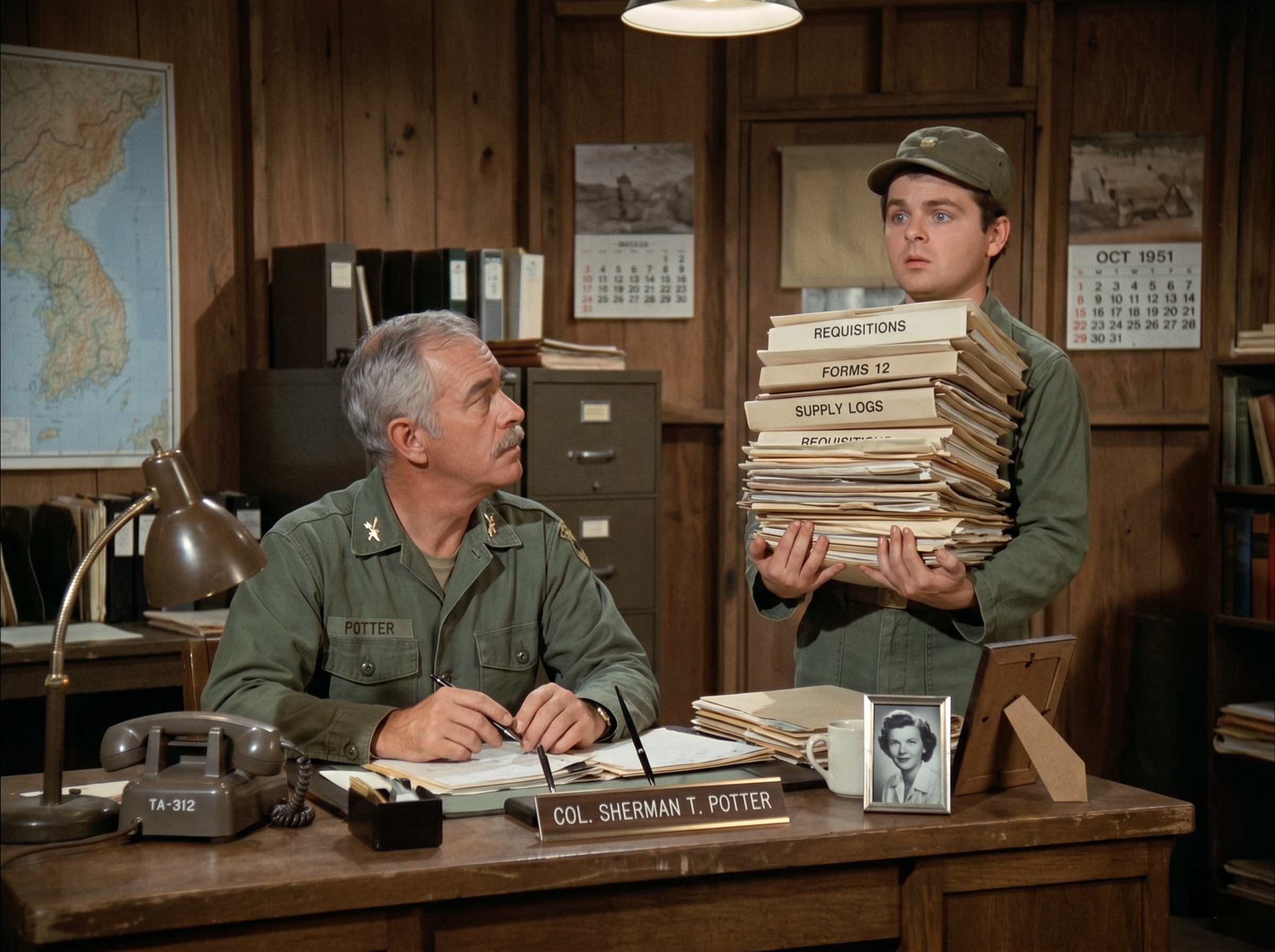
The afternoon sun was baking the 4077th into a dusty, olive-drab oven.
Inside the Commanding Officer’s tent, Colonel Sherman T. Potter was enjoying a rare and beautiful thing: thirty seconds of absolute silence.
The camp was quiet. The OR was empty. The mess tent was between meals.
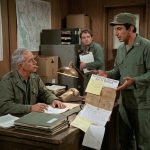
Potter sat behind his modest wooden desk, his posture compact and steady. He adjusted his wire-rimmed glasses, picked up his fountain pen, and looked down at a single, manageable piece of paper.
Beside him sat the heavy black field phone, mercifully quiet. Next to that, a small framed photograph of Mildred smiled back at him, anchoring him to a world that made sense.
It was peaceful. It was calm. It was, inevitably, about to end.
The screen door squeaked open with a timid, familiar whine.
Potter didn’t look up immediately. He just let out a slow, tired sigh through his nose. “What is it, Radar?”
There was no verbal answer, only the heavy, shuffling sound of combat boots struggling under a massive load.
Potter finally raised his eyes, and the sight before him made his weary heart sink into his worn leather boots.
Standing before the desk was Corporal Walter “Radar” O’Reilly. At least, Potter assumed it was Radar.
The boy was entirely hidden behind a comically tall, absurdly thick stack of identical beige manila folders. The column of paperwork stretched from Radar’s belt buckle to just below his olive-drab knit cap.
Radar peeked around the side of the paper mountain, his innocent face etched with a mixture of nervous confusion and intense, earnest focus.
“Excuse me, Colonel, sir,” Radar squeaked, his voice strained.
Potter stared. He had served in two world wars. He had seen cavalry charges, artillery barrages, and generals who thought they were Julius Caesar.
He thought he had seen everything the United States Army could throw at a man. And yet, the sheer, unadulterated absurdity of this paper tower still managed to surprise him.
“Great galloping ghosts, son,” Potter murmured, his face settling into a mask of fatherly exasperation. “Did you bring me the morning report, or did you chop down a whole forest and pulp it yourself?”
“It’s I Corps, sir,” Radar panted, his knees visibly trembling. “They… they sent a courier.”
“With what? The Encyclopedia Britannica translated into military jargon?”
“No, sir. It’s the new directives. For the requisition forms. For the medical supplies.”
Radar shifted his weight. The tower of folders shifted with him.
A dangerous wobble rippled up the stack. Radar’s eyes went wide with panic. He leaned sharply to the left, trying to counter-balance the leaning tower of bureaucracy.
“Steady, son,” Potter warned, dropping his pen.
“They said we’ve been filling out Form 43-A sub-section B all wrong, sir,” Radar rambled, speaking faster as the files began to slide. “So they sent us the corrections. And the cross-references. And the addendums to the cross-references.”
The top half of the stack slid another two inches to the right.
Radar let out a high-pitched gasp, hugging the bottom of the pile desperately. “And sir… they want you to initial every single one!”
The tower reached its critical tipping point. The beige folders fanned out like a deck of cards, hanging suspended in the stifling air, threatening to bury the Colonel’s office in an avalanche of pure, unadulterated red tape.
“Hold it right there!” Potter barked, the sharp command of a seasoned cavalry officer echoing in the small office.
Radar froze. The stack of folders seemed to freeze with him, defying gravity through sheer fear of the Colonel.
Slowly, carefully, Potter stood up. He walked around the wooden desk, keeping his eyes locked on the precarious paper mountain.
“Now, Corporal,” Potter said, his voice dropping to a gentle, steady murmur. “I want you to slide your left hand up. Just an inch. Support the middle.”
Radar swallowed hard, his Adam’s apple bobbing. He slid his hand up. The wobble stopped.
“Good lad,” Potter said softly. “Now, step forward. Nice and easy. Pretend you’re carrying a crate of nitroglycerin across a minefield.”
Taking tiny, shuffling steps, Radar closed the distance to the desk.
“Lower them,” Potter instructed.
With a heavy, collective thud that rattled the field phone and made Mildred’s picture frame vibrate, the massive stack of folders landed squarely on the center of the desk.
Radar let out a massive breath, slumping his shoulders. He pulled a crumpled olive-drab handkerchief from his pocket and wiped his brow. “Gosh, Colonel. I thought I was gonna lose ‘em right there.”
Potter stood over the desk, staring down at the towering stack of beige. He rested his hands on his hips, shaking his head.
“Radar,” Potter sighed, the weariness creeping back into his bones. “Look at this. Just look at it.”
“I know, sir. It’s a lot of typing.”
“It’s not just typing, son. It’s madness,” Potter grumbled. “We are sitting in the middle of a war zone. We are elbow-deep in mud, blood, and broken boys. And some brass hat in Tokyo thinks what we really need is three hundred pages of instructions on how to order a tongue depressor.”
Radar looked down at his boots, feeling somehow responsible, as he always did when the Army didn’t make sense. “They said it’s for efficiency, sir.”
“Efficiency,” Potter snorted, the word tasting like sour milk.
He looked away from the folders and looked at his company clerk. Really looked at him.
Under the oversized knit cap and the oversized uniform, Radar looked exhausted. There were dark circles under his young eyes. His shoulders were rounded with the weight of carrying everyone else’s burdens. Radar was the glue that held the 4077th together, and right now, the glue was looking mighty brittle.
Potter’s exasperation melted instantly, replaced by a quiet, fierce tenderness.
The old horse soldier walked over to his filing cabinet. He opened the bottom drawer, reached past the official ledgers, and pulled out two glass bottles of Grape Nehi.
He popped the caps off using the edge of the metal drawer, walked back, and handed one to the startled Corporal.
“Sir?” Radar asked, holding the bright purple drink as if it were made of gold.
“Drink it, son,” Potter said gently, sitting back down in his wooden chair. “Doctor’s orders.”
Radar took a long sip, his eyes lighting up. “Wow. It’s still a little cold, sir. How do you keep it cold?”
“Command secret, Radar,” Potter smiled softly, taking a sip from his own bottle. “Now, pull up a chair.”
Radar quickly grabbed a folding chair and sat across from the desk, still holding his Nehi with both hands.
“You listen to me, Walter,” Potter said, his voice warm and grounded. “The Army runs on paper. Always has, always will. When the Romans crossed the Alps, I guarantee you some poor centurion was filling out a requisition form for sandals in triplicate.”
Radar offered a small, tired smile.
“But this hospital,” Potter continued, leaning forward, “this hospital runs on people. It runs on Hawkeye and B.J. holding things together in the OR. It runs on Margaret keeping those nurses strong. It runs on Father Mulcahy’s prayers, and Klinger’s… whatever it is Klinger does.”
Potter reached out and tapped the towering stack of beige folders.
“And it runs on you, son. You keep us functioning. You keep the supplies coming, even when they make you jump through a hundred flaming hoops to do it.”
Radar blushed, looking down at his purple drink. “I just do my job, Colonel.”
“You do a hell of a lot more than that,” Potter said firmly. “But you can’t carry the whole war on your shoulders. You’ll break your back, and I can’t afford to lose the best clerk in Korea.”
“I’m okay, sir. Really.”
“I know you are. But right now, we’re going to take a breath.” Potter grabbed his fountain pen. “I am going to sign the first ten of these blasted things. Then, I am going to order you to go to your tent, lie down on your cot, and read a comic book for exactly one hour. Are we clear?”
Radar’s eyes widened with gratitude. “But sir, I Corps said they need these back by—”
“I Corps can wait,” Potter interrupted, his voice brooks-no-argument steady. “General MacArthur himself can wait. My clerk needs an hour off.”
Radar sniffled quietly, wiping his nose with the back of his hand. “Thank you, Colonel.”
“Don’t mention it,” Potter said, pulling the first folder off the stack and flipping it open. He uncapped his pen. “Now, let’s see what sub-section B has to say for itself.”
The office grew quiet again. The distant thud of a chopper could be heard over the hills, but inside the tent, there was only the scratch of a fountain pen, the soft glow of the desk lamp, and the quiet comfort of a shared silence.
Colonel Potter signed his name, feeling the familiar weight of the war, but knowing that as long as they looked out for each other, they would all make it home.
The Army may have demanded their signatures, but the 4077th only survived by giving each other their hearts.