The Unopened Box from Dubuque
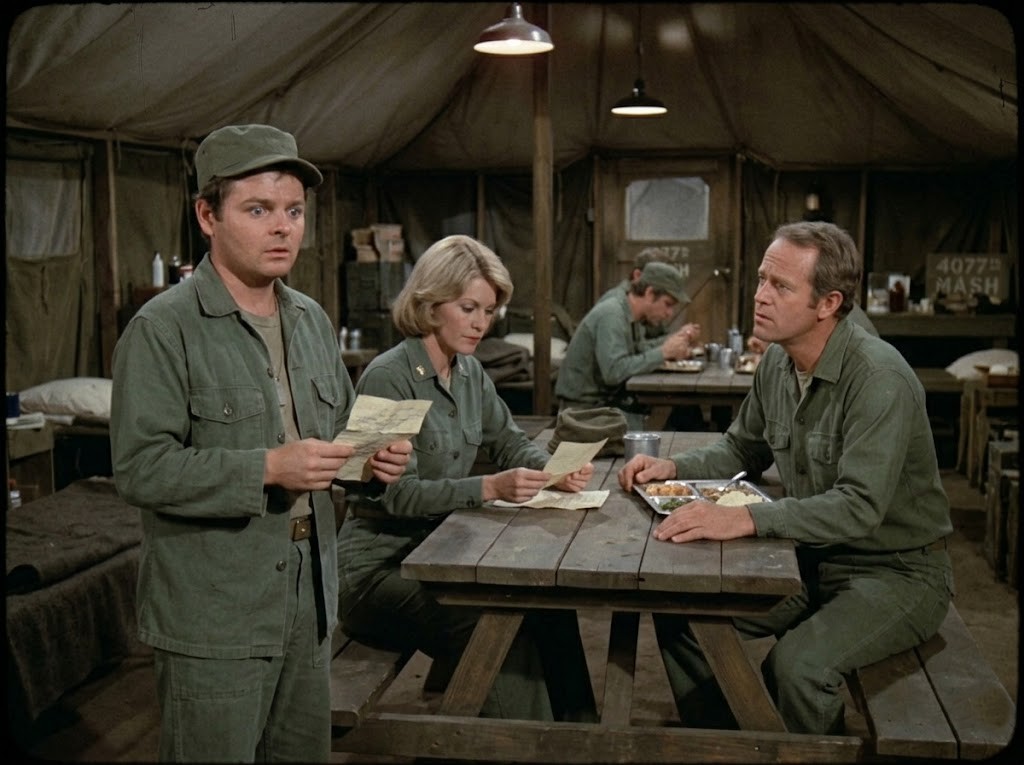
You didn’t need a calendar at the 4077th MASH to know it was Thursday. You just needed to sniff. It was Salisbury steak day—or whatever approximation the Mess Tent had conjured from the powdered-egg supply. A unique, savory, slightly dusty scent.
Inside the tent, the air hung heavy. Not just from the heat (it always felt ten degrees warmer under canvas), but with a weary silence that the hanging lightbulbs couldn’t quite chase away. A 36-hour OR stretch had finally broken, leaving the whole camp exhausted.
At one end of the long wooden picnic table, Captain B.J. Hunnicutt, eyes looking several years older than the rest of his face, stared down at his tray. He poked half-heartedly at something green that was trying very hard not to be broccoli. The thought of home cooked food was stronger than usual.
Beside him sat Major Margaret Houlihan. She hadn’t touched her food. Her posture was erect, professional as always, but her gaze was fixed, distant. She was holding a letter. A simple, folded piece of white paper.
The tension in the tent didn’t come from the OR. It came from that piece of paper. It arrived in the same mail delivery as a bulky cardboard box addressed to Radar, which was currently sitting uncomfortably close to him at the other end of the table.
Margaret slowly unfolded her letter. It wasn’t from a high-ranking officer or her father. It was a letter she’d been dreading from a younger nurse she’d recommended for an award—one who had transferred and since been reassigned back to the States due to “fatigue.”
Her brow furrowed deeper. The usual crisp authority was absent. A single tear poolled, dangerously close to falling.
Opposite them, Corporal Radar O’Reilly, still in his fatigues and the ubiquitous cap, sat perfectly still. He was looking up, his expression a complicated knot of surprise, concern for Margaret, and a deep, unexpected anxiety about the unopened box in front of him.
“Radar,” B.J. finally broke the silence, his voice barely a murmur. “You’re not eating. Is your box… judging you?”
Radar swallowed. He carefully smoothed the edges of his own simple paper note (a handwritten ‘packing slip’ from his mom), but his eyes stayed fixed on the box.
“My mom sent a surprise,” Radar said, his voice unusually small. “I thought maybe it was cookies. I love surprise cookies. But, uh…”
B.J. finally pushed his tray away. He leaned forward, genuine concern surfacing. “What is it, Radar? Bad news?”
“She put a note on the box too,” Radar whispered, his voice trembling slightly. “It says… ‘For when you feel like you can’t do one more hour, but you know you must.’ It’s… it’s a big box, Captain.”
He looked from his letter to B.J., his eyes wide with a strange kind of fear. “What if it’s the kind of item that… that forces you to be stronger than you are? I’m just a farm boy. What if I can’t live up to the box?”
Across the table, Margaret’s controlled breath hitched, and the first tear escaped, tracking down her cheek. The weight of her own letter, of a broken subordinate, was heavy in the silent air. And right then, the unspoken stress of the entire unit seemed centered on the simple wooden table.
B.J. looked between Margaret and the young corporal, the weight of the moment pressing on his own weary shoulders. He knew that look on Margaret’s face—the rare cracks in the armor. And he knew Radar’s earnest fear of disappointing anyone, especially his mom.
He sat for another long moment, listening to the generator hum outside. Then, he put his fork down and sighed.
“You know, Radar,” B.J. said gently, reaching across the table and covering Radar’s clenched hand with his own. “Your mom might be right. But she’s wrong about one thing.”
Radar looked up, confused. “Huh? She’s wrong? About what?”
B.J. tilted his head. “The note says it’s for when you can’t do one more hour. Well, looking at all of us right now… including the good Major over there who’s clearly battling her own ghost…” He gestured with his chin towards Margaret. “I’d say that ‘one more hour’ arrived about four OR stretches ago.”
Margaret blinked, pulled from her thoughts. She dabbed her cheek quickly with the edge of a napkin, looking slightly embarrassed, then straightened. “I’m perfectly fine, Captain.”
“Of course you are, Major. That’s your job,” B.J. said with a soft, tired smile. “Just like it’s Radar’s job to worry. And my job to be grumpy about the food.”
He turned fully to Radar. “The reason your mom is wrong, Radar, is that you don’t use a thing like that only when *you* can’t keep going. You open it when *we* can’t. You open it when the whole damn unit is running on fumes and a memory of chocolate milk.”
Radar stared at B.J. for a long moment, the fear slowly draining from his face, replaced by a quiet realization. He looked at Margaret, whose gaze was now fixed on him, her eyes softer. Then he looked at the box, no longer terrified of its metaphorical weight.
“You mean… it’s a *team* surprise?” Radar whispered.
B.J. grinned, a genuine, tired sparkle returning. “It better be. If it’s just your collection of lucky pebbles, you’re buying the next round at the swamp.”
A small chuckle escaped Radar. He carefully pulled the packing slip away from the top flap. Margaret watched, her own hands now loose in her lap. B.J. pulled his knife. The generator continued its low, steady hum.
Slowly, Radar pried the flaps open.
The whole tent leaned in.
The object inside was wrapped carefully in multiple layers of old brown newspaper. Radar carefully untied the twine. He peeled back the first layer. Then the second.
Finally, he lifted it.
It wasn’t food. It wasn’t ammunition. It wasn’t an instruction manual on courage.
It was a ceramic, hand-painted cow. The coloring was a clumsy, cheerful mixture of black, white, and a little patch of brown where the artist must have run out of paint. Its eyes were slightly misaligned, and it had the most ridiculous, lopsided smile plastered across its face.
Radar held it up, stunned. “It’s… Bessie. Mom said she looked lonely on the shelf, and I might need reminding that the world still makes smiles.”
A moment of absolute silence held the table.
Then, Margaret Houlihan, the strict head nurse of the 4077th, let out a sound that wasn’t a sob or a tear. It was a laugh. A small, surprised, genuine giggle that quickly grew into a tired, wonderful, full belly-laugh.
B.J. joiner her, his grin wide, shaking his head. Radar, holding the cow, blinked rapidly, a huge grin breaking across his own face.
For the next ten minutes, the war, the fatigue, the broken letters, the Salisbury steak—none of it existed. The three of them were connected not by ranking, but by a ceramic cow named Bessie from Dubuque, Iowa, and the unexpected kindness of a mom who knew exactly what they needed.
When they finally calmed down, B.J. wiped his eyes. “Well, that was certainly unexpected. Radar, your mom is a genius.”
Margaret reached out, her hand now resting on the table near B.J.’s, but close enough to the cow. “She knew precisely what this unit needed. A ridiculous reminder of simple decency.” She looked at Radar, her eyes moist but her face bright. “She’s beautiful, Radar. Thank you for sharing her.”
Radar puffed his chest out slightly. “Mom said we have to name her our official morale advisor. The ‘Chief Cow-mander.'”
B.J. raised an eyebrow. “I don’t know if Colonel Potter will approve a civilian appointment, but I suppose we can sneak her past the draft board.”
Radar sat the cow in the middle of the table, making sure her lopsided smile was directed outwards. Then, for the first time that meal, he looked at his tray and picked up his fork.
“You know, Captain,” Radar said, taking a bite of something green. “The powdered broccoli doesn’t taste quite so bad now.”
Margaret finally smiled. B.J. nodded slowly. Outside, the night closed in, but inside the Mess Tent, under the dim bulbs, a little piece of home stood watch. The war was still there, waiting. But in that moment, in the laughter shared over a ceramic cow, they found the quiet tenderness that allowed them all to do one more hour.
Because sometimes, the best medicine didn’t come in a vial; it came from an unopened box.