A Letter Home, Typewritten with Care
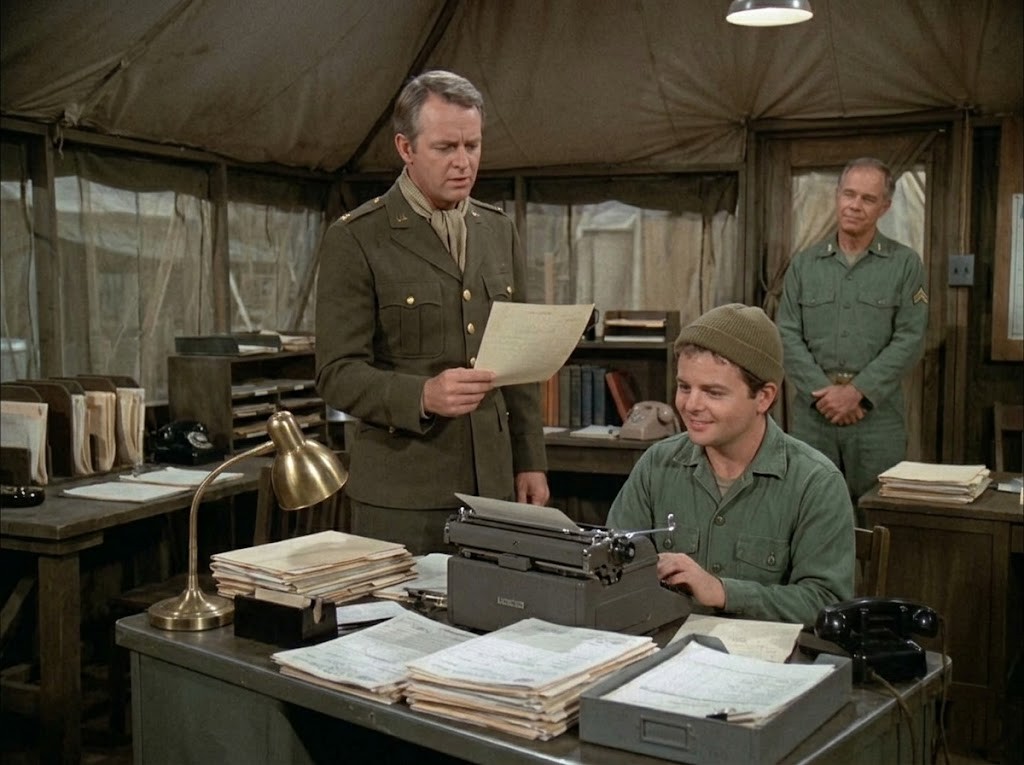
The steady *clack-clack-clack* of Radar O’Reilly’s typewriter was the heartbeat of the 4077th administrative tent. It was a rhythm that was comforting, if a bit monotonous, to Major Charles Emerson Winchester III, who stood looking down at a newly arrived document. Outside, the dust was settling from the afternoon chopper run. Inside, the usual paperwork mountain threatened to overwhelm Radar’s desk. Corporal Walter O’Reilly himself sat centered, focused, and *not* currently looking at the official Army paperwork Winchester held. Instead, he was smiling.
Charles, meticulous in his Class A uniform with the perfectly knotted scarf, held the stiff official memo with some disdain. “Corporal,” he began, his voice maintaining its usual Boston resonance, even amidst the canvas walls, “this dispatch from Seoul regarding the procurement of surplus anesthetic is… well, it’s typed in a font so incredibly minuscule I’m certain the typist used a grain of sand as their template.” He waved the paper. Radar just kept typing, a little grin spreading. “I believe,” Charles continued, slightly louder, “this requires your immediate attention before we entirely lose the ability to see.”
Behind Charles, Sergeant Rizzo, never one to volunteer for extra effort, leaned back. A lazy smirk played on his lips as he watched Radar work. “Ah, Major,” Rizzo drawled, his voice a stark contrast to Winchester’s, “sometimes ya gotta squint at life to see the shiny parts.” Charles gave him a look that could curdle milk. “Sergeant,” he said, “I find life plenty visible from my position. It’s the paperwork that’s elusive.”
Radar finally stopped typing, but the smile remained as he looked up. “I’m sorry, Major Winchester,” he said, his eyes bright behind his glasses. “I’m almost done with this… personal correspondence. For my mom, back in Ottumwa. I was hoping to sneak it in.” Charles frowned. Personal correspondence? On Army time? While Seoul was sending documents that could only be read by mites? “Personal? Corporal, there are requisitions pending! Our entire supply chain hangs by the thread of *correctly sized print*!”
The tent felt different. Usually, Winchester was all sharp corners and biting intellect. But now, seeing Radar so intently focused on a simple letter home, a different energy simmered. Radar’s grin was both simple and profound. B.J. Hunnicutt, having slipped into the tent on a routine errand, leaned against a filing cabinet, his easy presence radiating. “He’s writing to his mom, Charles,” B.J. said quietly. “Not launching a ground offensive.”
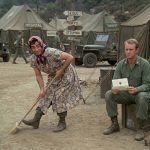
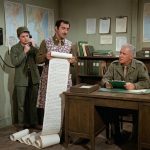
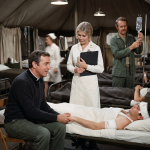
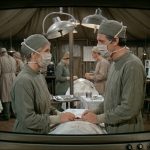
The *clacking* started again, Radar’s fingers dancing across the keys, his face alight with a tenderness Charles had rarely seen. Charles stared. The official memo remained unread. He didn’t want to hear about the letter, really, he just wanted the print to be legible. But he *was* seeing something else. As Radar typed, the image from image_0.png held its breath: the grumpy Major holding the difficult letter, the beaming clerk at the keys, and the laid-back Sergeant watching it all from behind.
Then, Radar hit the carriage return. *Ding!* He sat back, his smile widening even further. “There. Done. It’s not a masterwork, Major. But she’ll understand.” He reached to pull the paper from the machine. Winchester held the unreadable Seoul dispatch tightly, and for the first time, he was less annoyed by the tiny print and more curious about the simple words being typed only feet away. He wanted to look at that *other* piece of paper.
Radar stood up, carefully presenting the finished letter. His proud grin remained, undiminished by Winchester’s earlier bluster. “If you could just… take a glance, Major? It would mean a lot.” Charles bristled, but the request was too sincere to dismiss. The tension in the small room solidified; the *ding* of the carriage return had cleared the air, replacing initial irritation with a new curiosity. “A glance,” Charles grumbled. He reluctantly traded the microscopic Seoul memo for Radar’s single sheet of typed paper.
He looked down, ready to find error. But instead of military jargon, his eyes fell upon words like ‘fresh baked bread,’ ‘the neighbor’s cat,’ and ‘you wouldn’t believe how much milk I drank yesterday.’ It was mundane, predictable, and utterly devoid of the complex world Winchester usually inhabited. Yet, the simple prose struck a quiet chord. Charles cleared his throat. “Well,” he began, trying to summon his usual dismissive tone, “it seems you’ve mastered the art of… domestic simplicity, O’Reilly.” B.J. smiled warmly. Radar waited.
Charles read on. In the final paragraph, Radar had written, *‘Major Winchester is here right now. He’s tough, and sometimes he hollers a bit, but I think he actually cares, deep down, when things go right for us. It feels like home, even without the cow.’* Winchester felt his face flush. He was used to critique and challenge, not quiet, unearned affection from a simple clerk in a wool knit cap. The sarcasm felt clumsy now.
Behind him, Rizzo actually sat up, his lazy smirk softening into surprised respect. B.J. pushed off the filing cabinet and walked over to stand next to Radar, placing a gentle hand on the boy’s shoulder. “Good letter, Radar. Hits all the right notes,” B.J. said, his voice quiet and genuine. Radar’s grin finally began to fade, replaced by a softer expression, his eyes fixed on the Major. He was just a boy, Charles realized. A boy from Iowa, trying to keep a thread to the only world that made sense to him.
Charles looked back at the typed text, then up at Radar. The Major’s face softened, the habitual sternness cracking just enough to reveal the human beneath the rank. “It is… adequate,” Winchester murmured, carefully setting the letter back down on Radar’s desk. “Quite adequate, Corporal. It captures… the essential nature of Ottumwa, I suppose.” It was the closest to praise he could manage. Radar’s face beamed anew, a look of pure relief and happiness. “Thank you, Major Winchester. That means… that means everything.”
He stood straight, now seeing the official memo that Charles had previously discarded. “Right, sir! The Seoul dispatch! Tiny print. I can have it transcribed, no problem.” The professional O’Reilly was back. Winchester reclaimed the unreadable paper. “Indeed. We must maintain proper order.” But the sharpness was gone from his voice. He looked around the cramped, olive-drab tent – the stacked papers, the metal desks, the shared fatigue, and this small, tender moment of connection.
Outside, a jeep honked. Life at the 4077th continued its unpredictable rhythm. Inside, a Major Winchester had momentarily dropped his shield, a Sergeant Rizzo had seen something worth admiring, and a Corporal O’Reilly had bridged the miles with a few typewritten words. Charles turned and left the tent, the official document in his hand, leaving the image from image_0.png etched with a silent understanding: here, surrounded by the absurdity of war, small human truths were often the only ones that remained entirely legible.
Some days, the simple act of typing was the bravest thing anyone could do.