The Unexpected Frequency
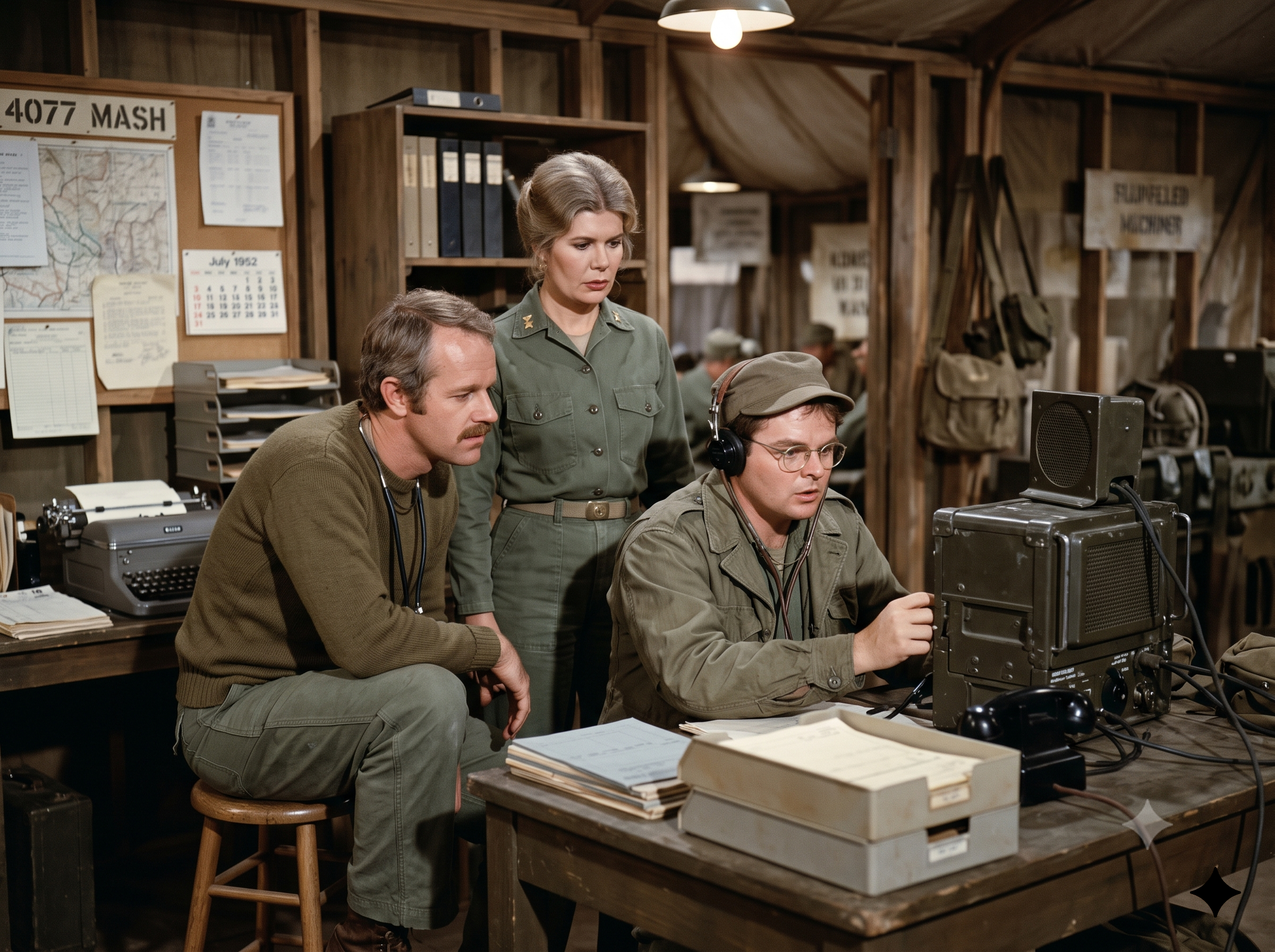
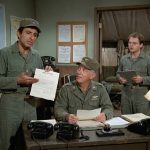
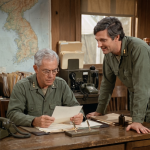
It was the middle of July 1952, and the 4077th Clerk Area was, for once, quieter than the operating room during a blackout. In the cluttered, wood-and-canvas nerve center of the MASH unit, only a single, warm light bulb hanging over the main desk fought back the early morning stillness.
The silence was a rare gift. No shelling. No helicopters. No urgent whistles. But it was the quality of the silence that was unusual.
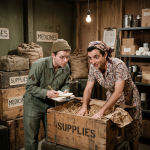
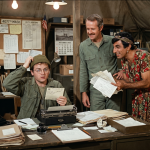
Walter ‘Radar’ O’Reilly, with his soft cap pulled low over his thick lenses and his small frame almost hidden by the bulky green radio set, was locked in a staring contest with the dial. He had been adjusting the frequency for nearly twenty minutes, and not for official business.
Instead of the usual static, there was an empty, humming space, punctuated only by Radar’s intense focus. Every small motion he made to the tuning knob was precise, almost prayerful.
He wasn’t just working; he was waiting. An unexpected, personal message was supposed to come through a private, non-military channel, a fragile connection that only Radar seemed capable of navigating. He hadn’t slept, even after a standard twenty-hour shift, fueled only by grape juice and an unrelenting, earnest hope.
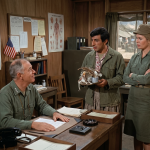
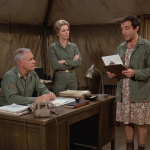
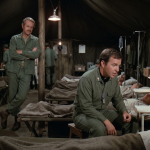
B.J. Hunnicutt, looking comfortable on a simple wooden stool, was seated nearby. He had draped an olive-drab sweater over his fatigues, a stethoscope still hanging around his neck. He leaned an elbow casually on the desk, his warm, concerned eyes fixed on Radar, and by extension, on the radio. He was the silent, steady presence, waiting with his friend, offering his fatigue-worn support through proximity alone.
Behind B.J., standing as rigidly as the tent pole holding up the structure, was Major Margaret Houlihan. She was composed, professional, and controlled in her fatigue uniform, but her eyes betrayed the tough front. They were focused with equal complexity on the radio. Radar’s nervousness was palpable, and it had cracked her usual steely reserve, revealing a quiet, surprising empathy.
They had been like this for half an hour. The Royal typewriter sat cold on the left. The file trays with gray and beige forms were stacked high, mocking the small moment of personal vulnerability unfolding. The calendar confirmed it was still July.
Radar finally muttered something, his voice thick. “It should be here. I checked the frequency band three times. The connection… it has to come.”
“Take it easy, Radar,” B.J. said softly, without moving. “The airwaves don’t run on O’Reilly time.”
“I know, but this isn’t standard transmission! It’s personal.” Radar’s fingers trembled slightly as he nudged the dial again.
Margaret shifted, her weight moving almost invisibly. A faint sigh escaped her lips. “Radar, you have work. This isn’t productive.”
“I’m prioritizing, Major!” he said, not looking up. His voice held a rare, nervous snap.
Then, the humming of the empty channel changed. The static crackled, a sharp, ragged burst. They all froze. Radar’s eyes widened behind his glasses. He held up his left hand for silence, a gesture that even Margaret respected. He adjusted the dial a fraction of a millimeter.
“I think… I think I have it. I think that’s him.“
A low, fragmented voice pulled through the static, distorted and distant. It wasn’t the strong, clear signal of a base command. It was weak. Struggling.
Radar’s face fell from excitement to pure, anxious focus. “I can’t quite make it out… he’s in. He’s trying, Captain. Major. He’s trying.“
He leaned closer to the radio, completely lost in the signal, his small frame quivering as he strained to pull a thread of human connection out of the ether. The silence in the tent returned, heavier now, filled only by the crackle and the faint, garbled hope of a distant voice. They were all waiting with him. And then, the voice got clear enough for one distinct word to cut through the distortion: “O’Reilly…”
Radar’s entire body seemed to unlock. The word—his name, spoken from an ocean away by a voice he hadn’t heard in two years—brought a rush of blood to his face. For a second, he didn’t adjust anything. He just listened to the echo.
Then his fingers flew. He nursed the signal with a delicacy usually reserved for separating arteries. “I’m here! This is Radar… I mean, Walter. I hear you!”
The voice on the other end was fragmented by atmospheric conditions. The distance was immense, but the sentiment was undeniable.
“…Walter… mom… okay. The… the farm… good rain…” The connection wavered, the signal trying to collapse back into static.
Radar strained, tears welling behind his thick lenses. “Ma? Ma’s okay? And the farm? Did the south barn… did you fix it?”
The voice crackled again. “…Fixed. Yes. And the cow… she… she had her calf. Two days ago. A healthy heifer. Ma named her… they named her ‘Radar Jr.’…”
A quiet, choked-off laugh escaped Radar’s throat. It was the best news he’d received in Korea.
B.J. smiled, a genuine, warm expression that crinkled the skin around his eyes and moved his mustache. “A namesake, Walter. That’s big.”
Margaret, standing behind him, felt her throat tighten. Her rigid posture hadn’t changed, but a single tear had escaped and was tracing a silent path down her cheek. She didn’t wipe it away. In this shared moment, watching this nervous boy who ran their entire war receive a fragment of home, she wasn’t Major Houlihan. She was just another weary soul finding comfort in the enduring nature of normal, decent, unimportant things back in ‘the world.‘
Radar was typing furiously on the cold Royal typewriter now, not to log the transmission, but just to have a physical record of the words. His sincere, earnest expression was focused entirely on capturing every syllable of ordinary life. “Ma… tell her I said hello. And… and tell the cow I’m honored.”
The voice on the other end gave one final, slightly clearer signal. “We miss you… son. We all… do. Come home… safe.”
“I will. I will, Ma! Tell them… tell them…” Radar never got to finish. The channel collapsed. The static was gone, replaced by a sudden, total void. The transmission was over.
Radar sat back slowly on his stool, the headphones suddenly feeling very heavy. He looked at the typewriter. His hands were still trembling. For a long, silent minute, nobody spoke. The single light bulb above them cast warm pools of light on the shared space.
It was just another routine day at the 4077th. File trays needed organizing. Forms needed filing. But for a few minutes, in that cluttered office, a simple communication about a healthy cow had provided more strength than any medal or promotion.
“That was… that was good,” Radar said, his voice small, sincere, and entirely peaceful.
B.J. nodded quietly, looking at his friend with deep empathy. “It was the best, Radar.”
Margaret finally moved. She straightened her uniform, composed herself, and wiped the single tear from her cheek. She looked at Radar, her expression controlled, but now mixed with undeniable, quiet tenderness. “Very well, Corporal. The transmission is complete. Log it… and then get back to work. These forms aren’t going to file themselves.”
“Yes, Major!” Radar said, his energy back, standard-issue efficiency masking the deep well of comfort. He put the headphones down and pulled the paper from the typewriter, looking at the misspelled, disjointed words. A new, calm focus had replaced the anxious waiting.
As the sun began to rise outside the tent, casting long, peaceful light across the camp, they all settled back into their roles. But they knew. In that shared human vulnerability, fueled by a weak signal and a personal message, the found-family of the 4077th had just reaffirmed why they all endured this weary life together. They were ready for whatever the new day brought. They could do this. Together.
In the heart of that chaotic camp, we found our family in the shared silence between the static.