THE BOSTON BRAHMIN AND THE MYSTERY MEAT
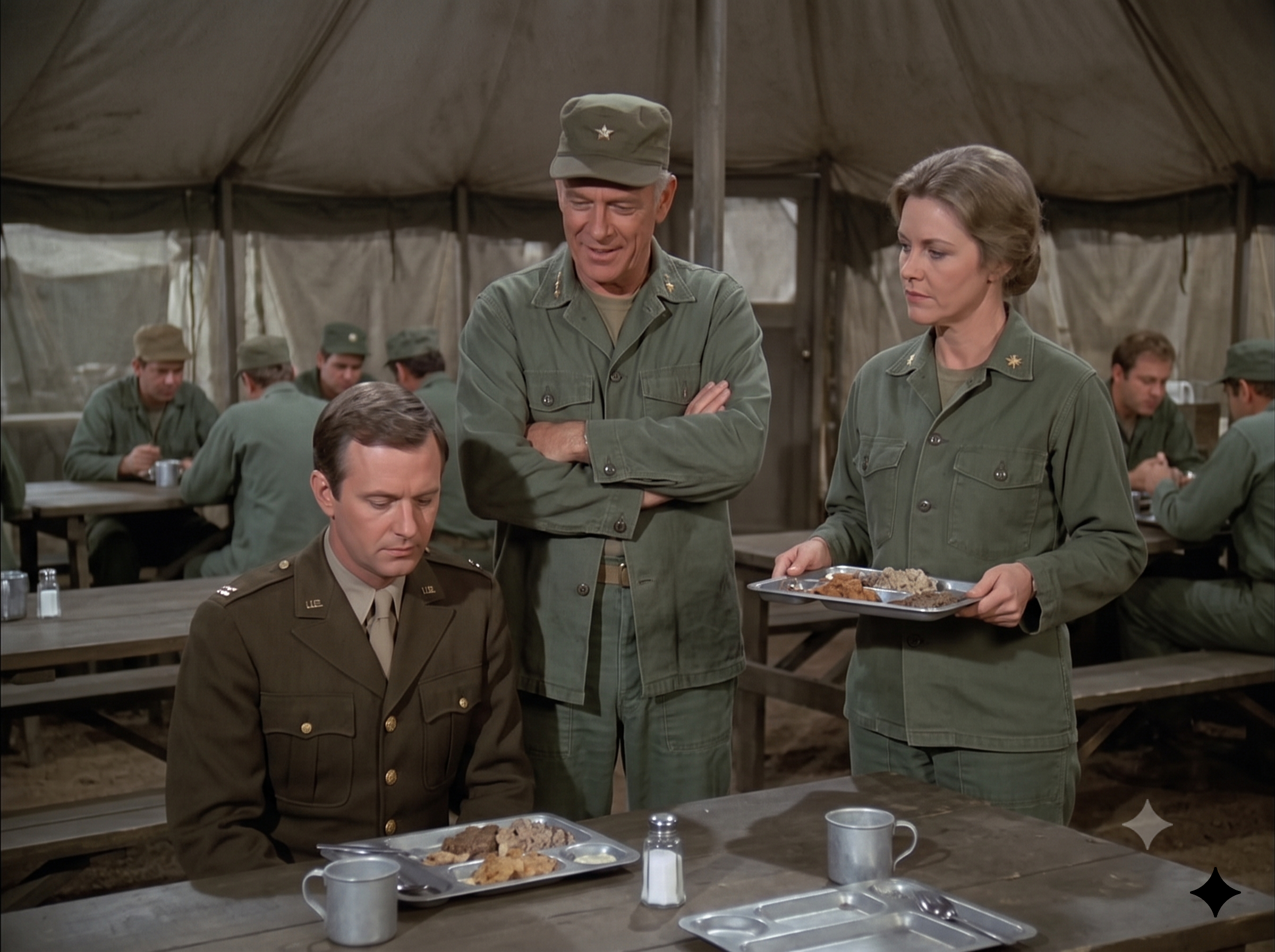
The mess tent of the 4077th Mobile Army Surgical Hospital was rarely a place of culinary delight, but on this particular Tuesday, it felt like an active crime scene.
The air was heavy with the unmistakable aroma of boiled cabbage, wet canvas, and something that Igor enthusiastically insisted was meatloaf. It was the kind of smell that settled into your fatigues and stayed there until the end of the war.
In the center of this culinary purgatory sat Major Charles Emerson Winchester III.
He was a portrait of misplaced dignity. Unlike the rest of the camp, who had long ago surrendered to the comfort of wrinkled green cotton, Charles had chosen to wear his Class A tunic. The dark olive wool was perfectly pressed, the brass buttons gleamed faintly in the soft, dusty light of the tent, and his posture was as rigid as a marble statue in a Boston museum.
He was trying, desperately, to maintain his civilization. But his civilization was currently losing a brutal, one-sided battle against his dinner tray.
Charles stared down at the segmented metal platter. In the largest compartment sat a gray, amorphous lump swimming in a watery brown gravy that defied the basic laws of physics. Next to it was a scoop of something vaguely yellow, and a sad, solitary pile of pale green beans that looked as though they had given up the will to live weeks ago.
He did not move. He did not blink.
His face was a masterpiece of restrained, refined irritation and deeply wounded pride. It was the look of a man who had once dined on Chateaubriand at the Somerset Club, now forced to contemplate whether his dinner had been cooked or simply threatened with hot water.
Behind him, Colonel Sherman T. Potter approached, his arms crossed over his chest.
Potter wore his faded green fatigues with the comfortable authority of a man who had seen it all. He possessed the grounded, fatherly presence of a career cavalry man, and right now, his weathered face was fighting a losing battle against a dryly amused smile.
Beside the Colonel stood Major Margaret Houlihan.
Margaret was perfectly composed, holding her own metal tray with a steady, professional grip. She looked down at Charles with a familiar skepticism. She was a regular Army nurse who knew how to survive on field rations, but even she couldn’t entirely hide the faint grimace at the sight of what the cooks had produced today.
“Something the matter, Winchester?” Colonel Potter asked, his voice a low, gravelly drawl that carried just a hint of paternal teasing. “You look like you just found a bug in your bug juice.”
Charles did not look up. He simply gripped his fork and knife tighter.
His knuckles turned white. His jaw clenched tight. The indignity of the situation was bubbling up inside him, rising from his empty stomach to his aristocratic throat. He took a long, slow breath, closing his eyes as if gathering the strength of every Winchester who had come before him.
The clatter of tin cups and tired voices in the background seemed to fade away.
Charles opened his eyes, staring directly at the gray lump. He raised his fork, his hand trembling slightly—not from fear, but from an overwhelming, articulate rage. The entire tent seemed to hold its breath, waiting for the Boston volcano to finally erupt.
“Colonel,” Charles began, his voice dropping an octave into a dangerously calm, theatrical whisper. “I am a man of science. I am a student of human anatomy, of biology, of the natural world.”
“I’ve read your file, Major,” Potter replied, his amusement deepening into a soft chuckle. “It says you’re a doctor. What’s the diagnosis on the meatloaf?”
“That is precisely the issue,” Charles said, slowly turning his head to look up at the Colonel. The wounded pride in his eyes was almost tragic. “I cannot, in good conscience, classify this as organic matter. It lacks the cellular structure of beef. It lacks the fibrous integrity of pork. I believe, Colonel, that Igor has somehow managed to boil a surplus jeep tire and cover it in mud.”
Margaret shifted her weight, the skepticism on her face softening into a weary, shared understanding.
“Oh, stop whining, Charles,” she said, though her voice lacked its usual sharp edge. It was the tired voice of a woman who had spent twelve hours on her feet in the OR. “It’s protein. You chew it, you swallow it, and you pray it stays down. We have a post-op ward full of boys who need us to keep our strength up.”
Charles looked at Margaret, his eyes flickering down to her tray. She had the exact same gray lump, the exact same watery gravy.
“Margaret, my dear,” Charles sighed, his shoulders dropping a fraction of an inch. “I do not deny the necessity of sustenance. But must it be an insult to the palate? Must it assault the very concept of human dignity?”
Colonel Potter uncrossed his arms and rested a heavy, comforting hand on Charles’s shoulder. The touch was firm, grounding, and unexpectedly gentle.
“Winchester, let me tell you a little secret about Army chow,” Potter said, leaning in slightly. “It ain’t meant to be enjoyed. It’s meant to make you so mad you forget how tired you are. It’s fuel for the fire, son.”
Charles let out a long, slow breath. The theatrical anger drained out of him, leaving behind only the profound, bone-deep fatigue that they all shared. He was exhausted. He missed home. He missed clean linen and the sound of classical music played on a proper phonograph.
But as he looked up at Potter’s warm, weathered face, and saw Margaret standing patiently beside him, enduring the exact same indignity with quiet strength, something inside the aristocratic surgeon softened.
They were not at the Somerset Club. They were in a canvas tent in the middle of a war that made no sense.
And yet, he was not alone.
Colonel Potter reached into the breast pocket of his fatigue shirt. With a slow, deliberate motion, he pulled out a tiny, crinkled paper packet. It was faded and slightly worn at the edges.
“Here,” Potter said quietly, dropping the packet onto Charles’s metal tray, right next to the offending meatloaf.
Charles blinked, adjusting his eyes in the dim light. It was a single packet of real, honest-to-god black pepper. A luxury item in the 4077th.
“Consider it a battlefield promotion for your dinner,” Potter said, his eyes twinkling with quiet affection. “Use it wisely.”
Charles looked at the small packet, then up at the Colonel. For a fleeting second, the mask of the Boston Brahmin slipped completely, revealing the vulnerable, homesick doctor underneath. A profound sense of gratitude washed over him, not just for the pepper, but for the man who had offered it.
“Thank you, Colonel,” Charles said softly, his voice losing all its sarcastic bite. “That is… uncommonly generous of you.”
“Don’t mention it,” Potter said, giving Charles’s shoulder one last, reassuring squeeze before stepping back. “Just eat your jeep tire before it gets cold.”
Margaret offered Charles a small, almost invisible smile. “Bon appétit, Major,” she murmured, before turning and heading toward an empty spot at a nearby table.
Charles was left alone once more. He sat up a little straighter, adjusting the collar of his pristine tunic. He carefully tore open the small paper packet, sprinkling the dark flakes over the gray mass on his tray with the precision of a surgeon performing a delicate operation.
He picked up his knife and fork.
The food was still terrible. The canvas tent was still drafty. The war was still raging miles away. But as Charles took his first bite, surrounded by the dull clatter of tin cups and the murmur of tired, familiar voices, he realized that perhaps he hadn’t entirely lost his civilization after all.
He had simply found a different kind of family to share it with.
Even the bitterest rations go down easier when seasoned with a little grace from a friend.