The Quietest Corner of the War
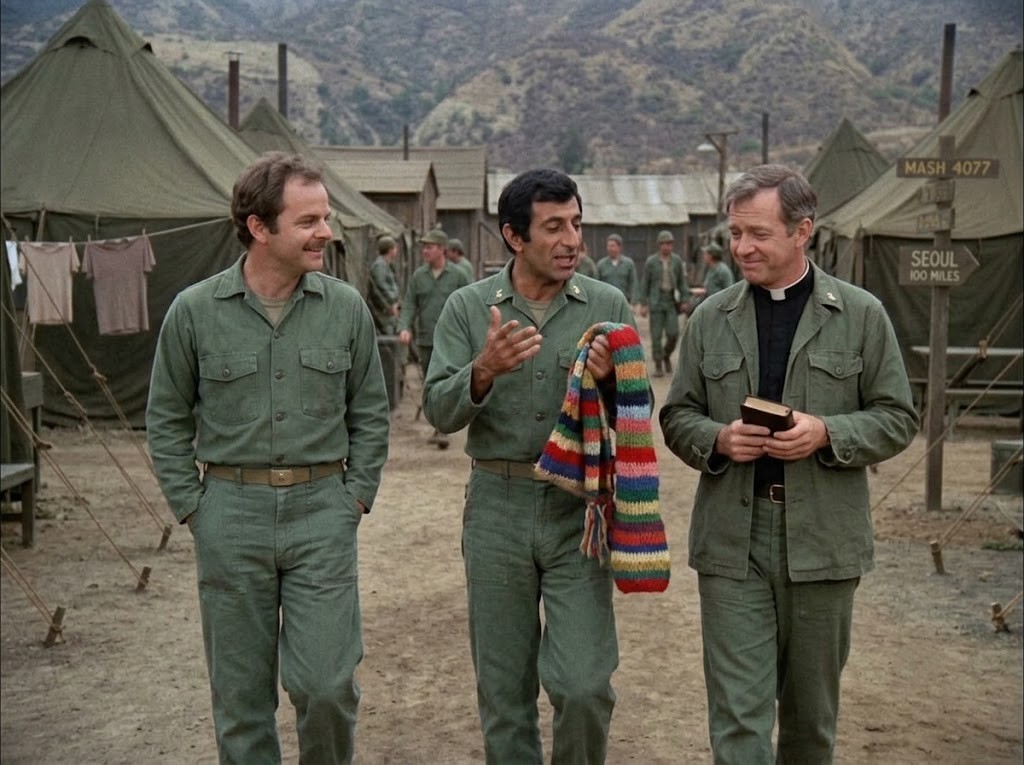
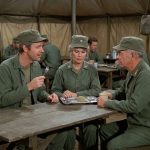
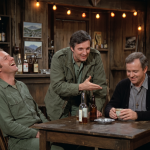
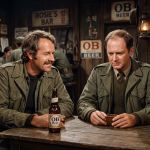
The mud outside the tent was thick enough to swallow a boot, but inside the Mess Tent, the air smelled only of burnt coffee and the faint, lingering hope of a day without incoming. Hawkeye, Father Mulcahy, and B.J. sat hunched over a scarred wooden table, a trio of tired souls carved out of the unrelenting exhaustion of the 4077th.
The lightbulb above them swung almost imperceptibly, casting long, rhythmic shadows that danced across the faces of men who had seen too much before noon. Hawkeye was leaning in, his usual manic energy replaced by a kind of quiet, searching intensity that he rarely allowed anyone to witness. B.J. held his glass of bourbon like a lifeline, his gaze fixed on some point in the distance, his jaw set with the familiar ache of a man missing home.
Father Mulcahy sat between them, his hands wrapped around a simple metal cup, his presence a calm anchor in a sea of turbulence. He wasn’t speaking; he was just listening, his head tilted slightly, catching the unspoken fatigue in the silence between his friends.
“You know,” Hawkeye murmured, his voice cutting through the hum of the distant generator, “there’s a specific kind of quiet that follows a surgical shift. It’s not peace. It’s just… the sound of everything catching its breath before the next scream.”
B.J. sighed, the sound heavy and resonant. “I keep thinking about the sound of my daughter’s laugh, Hawk. And then, for a split second, I can’t hear it over the sound of the scrub sink. It scares me.”
Hawkeye looked at the Padre, then back to B.J., his smirk failing to find its footing. He reached out to nudge B.J.’s arm, but stopped, his fingers hovering just an inch from the rough fabric of the sleeve. The weight of the moment seemed to settle on the table, thickening, turning the simple act of sitting together into a desperate, silent battle against the encroaching darkness of the war.
“I think,” the Padre began, his voice soft but startlingly steady, “that God doesn’t measure us by the silence we keep, but by how we choose to fill it when we’re this tired.”
Hawkeye’s eyes darted up, searching the priest’s face for a punchline, but he found none. Instead, he saw a mirror of his own deep, bone-weary helplessness—and the sudden, jagged realization that if he didn’t find a way to anchor himself right now, he was going to drift away entirely.
Hawkeye pulled his hand back and rested it on the table, his fingers tracing a deep gouge in the wood. “Well, Padre,” he said, his voice straining to regain its usual ironic lilt, “if God is counting, he’s probably tallying up how many cups of this swill we can stomach before we turn into permanent fixtures of this furniture.”
B.J. managed a weak, lopsided grin, the tension in his shoulders dropping just a fraction. He looked at the whiskey in his glass, then pushed it toward the center of the table as if offering a toast to their shared survival. “To the furniture, then. May we be sturdy, unpolished, and eventually sold at a surplus auction.”
Father Mulcahy laughed, a small, genuine sound that seemed to brighten the dim light of the tent. He raised his metal cup, clinking it softly against the glass. “I believe we’ve already been sold, gentlemen. The question is whether we’re worth keeping.”
The humor hung in the air, fragile but functional. It was the currency of their survival—the ability to turn pain into a joke so that it didn’t turn them into ghosts. They didn’t need to discuss the surgeries, or the casualties, or the letters home that they were too tired to write. In that small, dimly lit circle, they were simply three men who had looked into the abyss and were currently taking a coffee break.
Hawkeye watched the Padre, noticing for the first time the way the man’s hands trembled slightly before he set his cup down. He realized then that Mulcahy wasn’t just a shepherd for them; he was walking the same muddy path, his own faith being tested by every life they couldn’t save. The realization tightened Hawkeye’s chest, but it also anchored him. They were all in the same leaky boat, and as long as they were sitting at the same table, they weren’t sinking.
“You know,” Hawkeye said, his voice finally losing its edge, turning honest and low, “I don’t think I’d be able to find my way back to the mess tent, let alone the world, if you two weren’t sitting here waiting for me.”
B.J. nodded slowly, leaning his head on his hand. “We’re the only ones who know the exact shade of grey we’re feeling, Hawk. That has to count for something.”
They sat for a long time, the world outside continuing its chaotic, violent spin, while the three of them remained in their small, amber-lit sanctuary. They didn’t solve the war. They didn’t solve their own grief. But as the generator hummed and the lightbulb continued its slow, hypnotic swing, the heaviness in the room shifted. It was still there, but it was shared now, distributed across three sets of shoulders instead of one.
The war would be waiting for them in the morning. The surgeons would have to stand, scrub in, and pretend that they hadn’t spent the night staring at the edges of their own sanity. But for this moment, in this dusty tent, there was a quiet grace in simply being present, in holding the line together, and in knowing that someone else was watching the shadows with you.
In the heart of the 4077th, the greatest strength was never found in the medicine, but in the simple, quiet act of not letting your friend sit alone.