The Weight of an Unwritten Letter
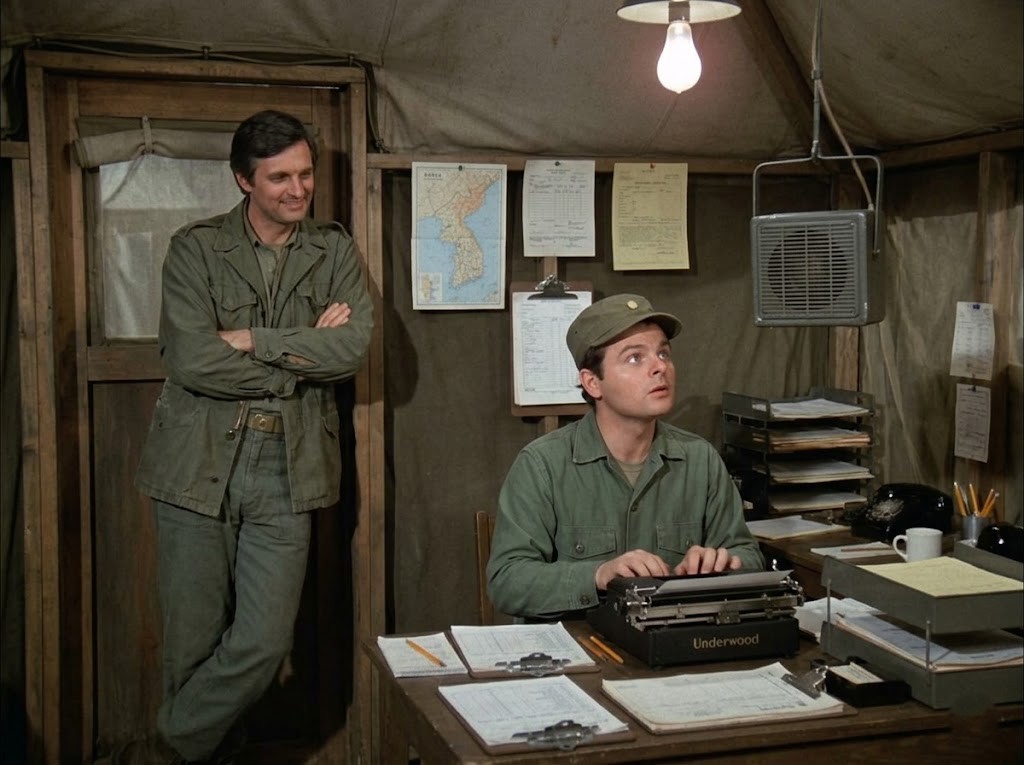
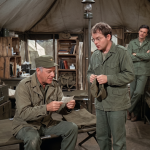
The overhead bulb in the clerk’s office hummed with a low, persistent buzz, casting a harsh yellow glare over the stack of triplicates, the green canvas walls, and the battered Underwood typewriter. Outside, the distant, thudding rhythm of artillery vibrated through the floorboards—a constant reminder of the war that raged just beyond the hills of Uijeongbu. Inside the tent, however, the world had shrunk down to the sharp, metallic snap of typewriter keys and the heavy silence of a long, exhausting week.
Radar O’Reilly sat frozen at his desk, his fingers hovering mid-air over the keys like a pianist who had suddenly forgotten the next note. His eyes were wide, fixed on a spot somewhere near the ceiling, as if the words he desperately needed were written on the canvas seams of the tent. His cap was pushed back slightly on his head, a faint sheen of sweat on his forehead despite the draft slipping under the door.
Leaning against the heavy wooden doorframe behind him was Hawkeye Pierce, his arms crossed tightly over his faded olive-drab jacket. A quiet, knowing smile played on Hawkeye’s lips, but his eyes held that deep, unmistakable exhaustion that only a surgeon in a combat zone could truly understand. He had been watching Radar stare at that blank sheet of paper for the better part of twenty minutes, tracking the kid’s growing anxiety.
“You know, Radar, if you stare at it any harder, you’re going to burn a hole right through the military’s finest cheap stationery,” Hawkeye said softly, his voice cutting through the hum of the lightbulb with its usual dry, comforting wit.
Radar didn’t turn around; his gaze remained locked on the air above the typewriter. “It’s not the stationery, Captain,” he muttered, his voice dropping to a nervous whisper. “It’s the company commander’s monthly report. And… well, it’s something else, too.”
Hawkeye shifted his weight, his smile softening into something more paternal. “The report can wait, kid. Potter’s taking a nap, and the army hasn’t checked these files since 1951 anyway. What’s really jamming the keys?”
Radar swallowed hard, his fingers trembling slightly as they dropped back onto the metal frame of the Underwood. “It’s a letter to a mother, sir. Not mine. Corporal Jenkins’ mother back in Ohio. He… he didn’t make it through the night shift in post-op.”
The easy, sarcastic air left Hawkeye’s shoulders in an instant, replaced by a familiar, heavy ache. He looked down at the clipboards on the desk, filled with casualty lists and supply requisitions, suddenly seeing the true weight of the small room.
“The official telegram went out this morning,” Radar continued, his voice cracking just a bit as he finally looked up, his eyes searching Hawkeye’s face for an answer that didn’t exist. “But Colonel Potter asked me to write a personal note. To tell her he wasn’t alone. But every time I try to type ‘We are sorry to inform you,’ my hands just… they just stop, Captain. How do you tell a mother that her boy is gone in a paragraph or less?”
Hawkeye stepped away from the doorframe and walked slowly into the center of the office, his boots creaking against the rough wood. He didn’t offer a hollow platitude or tell Radar to pull himself together; he knew better than anyone that the only way to survive the 4077th was to acknowledge the cracks in your armor. He placed a steady hand on the corner of the wooden desk, looking down at the blank page inside the machine.
“You don’t use the army’s words, Radar,” Hawkeye said gently, his voice devoid of its usual theater. “The army thinks in numbers, dates, and coordinates. Mothers don’t care about coordinates. They care about whether their son was warm, whether he was scared, and if anybody knew his name.”
Radar looked down at the keys, his lower lip trembling. “He was talking about his dog, Captain. Right before he went under. A golden retriever named Buster. He wanted to know if Buster missed him.”
“Then you write that,” Hawkeye said, sitting down on the edge of the desk, right next to the incoming mail tray. “You tell her that in his final moments, he wasn’t thinking about the mud, or the artillery, or the cold. He was thinking about home. He was thinking about love. And you tell her that a room full of tired doctors and a very brave clerk were holding his hand.”
Radar blinked back tears, looking at Hawkeye with a mixture of awe and relief. “Is that what you do, sir? When you have to write home?”
Hawkeye let out a short, bittersweet laugh, looking toward the open door where the gray Korean sky hung low over the camp. “I write to my dad, Radar. I tell him about the crazy things we do to keep from crying. I tell him about Klinger’s latest outfit, or BJ’s terrible jokes, or how Winchester managed to complain about the quality of the mud. I hide the bad stuff behind the laughs, because if I don’t, the bad stuff wins.”
He leaned closer, tapping the side of the typewriter. “But for Jenkins’ mother, you give her the truth that matters. Not the medical charts. The human truth. You’re the heart of this camp, kid. If anyone knows how to say ‘we cared,’ it’s you.”
Radar took a deep, steadying breath. He adjusted his glasses, straightened his shoulders, and looked at the keys with a new kind of determination. The nervousness was still there, but it was anchored by a profound sense of purpose.
“Thanks, Hawkeye,” Radar whispered.
Hawkeye stood up, giving Radar’s shoulder a firm, affectionate squeeze before turning back toward the door. “Anytime, son. Just make sure you spell Buster’s name right. The army hates typos.”
As Hawkeye walked back out into the compound, his hands buried deep in his pockets, the sharp, rhythmic *clack-clack-clack* of the Underwood began again inside the tent. It was a lonely sound, but it was steady, moving forward one letter at a time through the exhaustion of the 4077th.
In a place where it was so easy to lose your humanity, we always had a clerk who reminded us how to keep it.